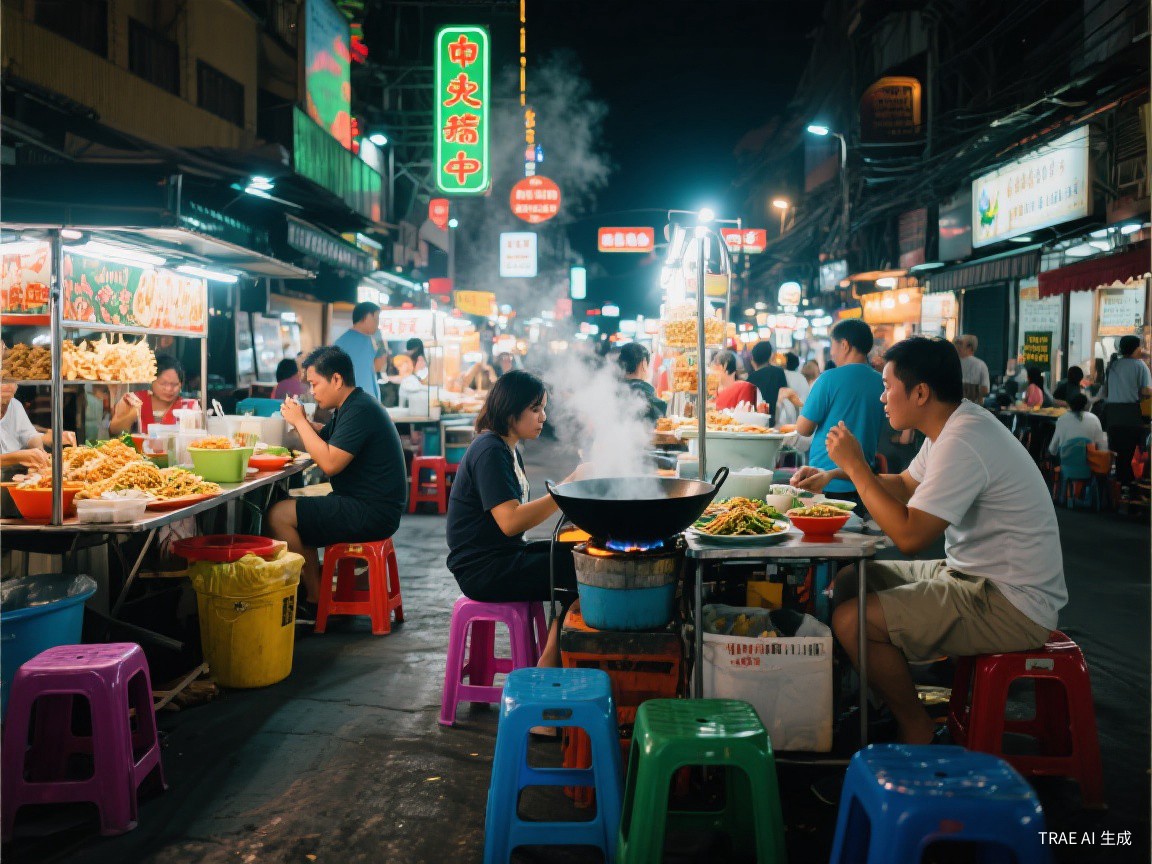
Ten years ago, if you told a serious eater that Bangkok would soon rival Tokyo and Paris as a global fine dining capital, they might have laughed. The city was already legendary for its street food—those intoxicating clouds of wok hei rising from Yaowarat's night markets, the pad thai lady on Sukhumvit Soi 38 who had been perfecting her recipe for three decades. But fine dining? That was Singapore's domain. Today, Bangkok has not merely joined the conversation; it has rewritten the rules entirely.
The Street-Food-to-Fine-Dining Pipeline
What makes Bangkok's fine dining revolution genuinely unique is that it didn't import its identity from elsewhere. Unlike Shanghai or Dubai, which built their gastronomic reputations by importing celebrity chefs and European techniques, Bangkok grew its fine dining scene organically from the ground up—from the streets, markets, and home kitchens that have always defined Thai cuisine.
The pipeline works both ways. Street food vendors have always been the true custodians of Thai flavor, perfecting dishes through relentless repetition and fierce competition. A som tam vendor in Chiang Mai adjusts her lime-to-fish-sauce ratio dozens of times a day, calibrating to each customer's preference. That granular understanding of balance—sweet, sour, salty, spicy, bitter—is precisely what elevates Bangkok's best fine dining restaurants above their international peers.
Consider the trajectory of chef Garima Arora, who earned a Michelin star at her restaurant Gaa by applying progressive techniques to dishes rooted in Indian and Thai traditions. Her journey mirrors Bangkok's own: arriving with external perspective, falling in love with local ingredients, and ultimately creating something that could exist nowhere else on earth.
Traveler's Tip
When dining at Bangkok's top restaurants, request the chef's tasting menu whenever possible. These multi-course experiences tell a story that a la carte ordering simply cannot. Budget roughly 5,000 to 12,000 baht per person for a full tasting menu at the establishments reviewed here.
Gaggan Anand: The Emoji Menu That Changed Everything
Love him or find him exhausting, Gaggan Anand irrevocably altered Bangkok's place on the global dining map. His self-titled restaurant, which held the number one spot on Asia's 50 Best Restaurants list for four consecutive years, proved that a chef could operate at the absolute highest level of creativity while being firmly rooted in a city once dismissed by the fine dining establishment.
Gaggan's famous emoji menu—twenty-five courses represented not by words but by a sequence of symbols—was never merely a gimmick. It was a statement about the universality of flavor and the limitations of language when describing taste. His signature "Lick It Up" course, a single bite served on a stone that you literally lick clean, collapsed the distance between fine dining and primal eating pleasure. His reinterpretation of street food classics—think a deconstructed papaya salad that arrived as a sphere of explosive green flavor—showed that elevation need not mean abandonment.
After a brief closure and relocation, Gaggan's current incarnation continues to push boundaries. The theater is still there, but the food has grown more introspective, more personal. Recent courses have explored his childhood memories of Calcutta alongside his deep love for Bangkok, creating a narrative that is both global and intensely local.
"Bangkok is the only city where you can eat a twenty-course tasting menu at night and wake up the next morning to find the same flavor principles at a fifty-baht noodle stall. That continuity is our superpower."
— Chef Gaggan Anand
Nahm: Resurrecting Royal Thai Cuisine
If Gaggan represents Bangkok's future-facing ambition, then Nahm represents its deep past. Founded by Australian chef David Thompson and now helmed by Pim Techamuanvivit, Nahm has spent nearly two decades excavating the recipes and techniques of Thai royal cuisine—a tradition that stretches back to the courts of Ayutthaya and the early Chakri dynasty.
Royal Thai cuisine, or ahan chao wang, is one of the world's great culinary traditions that remains relatively unknown outside Thailand. Developed for the Siamese court, it demands extraordinary precision: curries pounded by hand in stone mortars, complex spice pastes assembled from dozens of ingredients, and presentations that transform food into visual art. Nahm's kitchen operates with this same discipline, sourcing heritage ingredients that most modern Thai restaurants have abandoned.
The results are revelatory. A bowl of tom yum goong at Nahm tastes like every bowl of tom yum you've ever had, distilled to its Platonic ideal—the lemongrass more fragrant, the galangal more resonant, the heat building in waves rather than arriving all at once. The som tam here uses preserved crab rather than dried shrimp, adding a fermented depth that transforms the dish entirely. These are not modernizations. They are restorations.
The Importance of Heritage Ingredients
One of Nahm's most significant contributions has been its role in preserving ingredients that are disappearing from Thai markets. The restaurant works directly with farmers and foragers to source varieties of holy basil, wild pepper, and heirloom eggplant that have been largely replaced by commercial cultivars. This commitment extends to their rice program, which features multiple varieties of jasmine and glutinous rice, each paired with specific dishes.
- Wild betel leaf (bai chaphlu): Used in miang kham, offering a peppery brightness that cultivated varieties lack
- Smoked snakehead fish: A traditional preservation method that adds extraordinary umami to curries
- Candle nut (look rong): A crucial thickening agent in royal curry pastes, now rarely found in commercial kitchens
- Sugar palm vinegar: A complex, slightly sweet vinegar made from palm sap, essential for certain dipping sauces
Supanniga Eating Room: Where Tradition Meets Warmth
Not every great Bangkok restaurant aspires to reinvent the wheel. Supanniga Eating Room, with locations in Thonglor and on the riverside, has built its reputation on something increasingly rare in the era of molecular gastronomy: genuine hospitality combined with flawlessly executed home-style Thai cooking.
The restaurant's founder, Nusara Tiengkate, drew inspiration from her grandmother's recipes from Trat province, a region bordering Cambodia where the cuisine is notably different from Bangkok's familiar offerings. The flavors here are gentler, more herbaceous, and deeply connected to the rhythms of provincial Thai life. Their signature crab meat yellow curry, served in a young coconut, is a masterclass in restrained richness—coconut milk tempered by the natural sweetness of the crab, with just enough turmeric and chili to keep things interesting.
What sets Supanniga apart is its atmosphere. The dining rooms feel like entering a well-appointed Thai home, with teak furniture, silk cushions, and windows that frame the garden or river. The service is warm without being intrusive, knowledgeable without being pretentious. It is, in many ways, the antithesis of the tasting-menu temple—and all the more refreshing for it.
The Thai Royal Cuisine Tradition
To understand Bangkok's fine dining scene, one must appreciate the tradition of Thai royal cuisine. Unlike European court cooking, which evolved in castles and manor houses, Thai royal cuisine developed within the walls of the Grand Palace, where teams of female cooks prepared elaborate meals for the king and his court.
The tradition demands extraordinary knife skills—ingredients must be cut into uniform, often decorative shapes. Flavor profiles are more nuanced than street food, with less chili heat and greater emphasis on aromatic herbs. Presentation follows strict aesthetic principles, with dishes arranged to reflect natural forms: flowers carved from vegetables, fruit sculpted into ornamental shapes, and curries served in elaborately decorated bowls.
Key Principles of Royal Thai Cooking
- Balance above all: Every dish must harmonize sweet, sour, salty, spicy, and bitter elements
- Pounding, not grinding: Curry pastes are made in stone mortars, which release oils differently than blenders
- Seasonal awareness: Ingredients shift with the monsoon calendar, and menus must reflect what the land provides
- Visual harmony: Color, shape, and arrangement are considered as important as taste
- Communal dining: Even in royal contexts, Thai meals are shared, with dishes served simultaneously rather than in courses
The Future of Bangkok Dining
Bangkok's fine dining scene shows no signs of plateauing. A new generation of Thai chefs, many trained abroad but deeply committed to local ingredients, is opening restaurants that defy easy categorization. The city's dining culture increasingly embraces a hybrid identity—where a chef might serve a course inspired by Isan fermentation techniques alongside a dish incorporating Japanese dashi, all within a dining room that references mid-century Thai architecture.
The Michelin Guide's continued expansion in Bangkok has accelerated this evolution, bringing international attention and investment while also sparking debate about whether Western rating systems can fairly evaluate Thai cuisine. The tension between global recognition and local authenticity is one that Bangkok navigates with characteristic ease—embracing the spotlight while remaining utterly, defiantly itself.
Perhaps that is Bangkok's greatest gift to the global dining landscape: the proof that a city can achieve the highest levels of culinary sophistication without losing its soul. The street vendors still cook at dawn. The night markets still pulse with energy. And the fine dining restaurants, rather than existing in opposition to this vibrant chaos, draw their power from it. In Bangkok, the street and the stars are not enemies. They are partners in an ongoing revolution that shows no sign of ending.
Explore More Asian Dining
From Tokyo's sushi temples to Hanoi's pho stalls, discover our complete collection of Asian restaurant reviews and culinary deep dives.
Browse All Reviews