Every great city has a food that functions as a mirror—reflecting its history, its people, its contradictions, and its soul. Paris has the croissant. New York has the bagel. Tokyo has ramen. And Berlin, a city defined more by division than by culinary tradition, has the Döner Kebab: a towering, juice-dripping, vegetable-stuffed cylinder of spiced meat and bread that is consumed at a rate of roughly four hundred tons per day across the city. It is cheap, it is messy, it is utterly delicious, and it tells the story of modern Berlin more honestly than any museum exhibit ever could.
The Guest Workers Who Brought More Than Labor
The story of the Berlin Döner begins not with food but with politics. In 1961, West Germany signed a labor recruitment agreement with Turkey, bringing hundreds of thousands of Turkish workers to rebuild a country still recovering from the devastation of World War II. These Gastarbeiter, as they were called, were expected to work for a few years and return home. Most did not. Instead, they stayed, built communities, raised families, and—crucially—brought their food with them.
Early Turkish neighborhoods in Berlin, particularly around Kreuzberg and Wedding, were filled with small restaurants and grocery stores catering to the immigrant community. These establishments served traditional Turkish dishes: kebabs cooked over charcoal, lahmacun (thin flatbread with minced meat), and various mezze. But the traditional Turkish kebab was a sit-down affair—skewered meat served on a plate with rice, grilled vegetables, and yogurt. It was delicious, but it was not street food. That transformation would come from one man with a simple but revolutionary idea.
Traveler's Tip
The best Döner shops in Berlin are busiest between 11 PM and 2 AM, when the post-party crowd descends. For shorter queues and the freshest meat, visit during lunch hours. Expect to pay between five and eight euros for a standard Döner.
Kadir Nurman and the 1972 Invention
In 1972, a Turkish immigrant named Kadir Nurman set up a small stand near Zoo Station in West Berlin and began selling something that had never existed before: kebab meat, shaved from a vertical rotating spit, served inside a piece of bread, with fresh salad and sauce. The concept was so simple that it seems inevitable in retrospect, but at the time, it was genuinely revolutionary.
Nurman, who had arrived in Berlin in 1960, recognized that West Berlin's fast-moving, increasingly diverse population needed food that was portable, affordable, and satisfying. The traditional plate-based kebab was too slow, too formal, too expensive for the construction workers, students, and office employees streaming past his stand. By mounting the meat on a vertical spit—borrowing a technique from older Turkish shish kebab traditions—and slicing it directly into bread, he created a meal that could be assembled in under two minutes and eaten while walking.
The genius of Nurman's invention lay in its modularity. The customer could choose their bread, their sauces, their vegetables. The meat, cooked on the outside by the heat of the spit and sliced away to reveal a fresh layer beneath, was perpetually hot and crispy. The salad—shredded lettuce, cabbage, tomatoes, cucumbers, red onion, and fresh herbs—provided crunch and freshness. The sauces—garlic yogurt, herb, and spicy chili—tied everything together. It was, in essence, a complete meal in a handheld format, and Berlin fell in love with it immediately.
"I didn't invent the kebab. I just put it in bread so people could eat it while walking. That was the whole idea. Nothing more, nothing less."
— Kadir Nurman, credited inventor of the Berlin Döner
The Rotating Spit: Engineering Meets Flavor
The vertical spit, or döner as it is known in Turkish (meaning "turning" or "rotating"), is the technological heart of the Berlin Döner. A typical spit holds between forty and one hundred kilograms of seasoned meat—usually a mixture of veal, beef, and lamb, though chicken and vegetarian versions have become increasingly common. The meat is layered onto the spit in thin sheets, pressed together, and cooked by gas or electric heating elements positioned alongside it.
The engineering is elegant. As the spit rotates, the outer layer of meat cooks slowly and evenly, developing a caramelized, slightly charred crust. When a customer orders, the chef (known as a Dönerci) uses a long knife to shave thin slices from the exterior, revealing a fresh layer of raw meat that immediately begins to cook. This means that every serving includes both the crispy, well-done exterior and the tender, juicy interior—a textural contrast that is central to the Döner's appeal.
The Bread: Fladenbrot and Beyond
The bread is as important as the meat, and Berlin's Döner culture has developed distinct preferences. The two main options are Fladenbrot (a flat, round bread similar to pita but thicker and chewier) and the Dönerbox (where the same ingredients are served in a cardboard box, bread on the side). Increasingly, shops offer a "Durum" variant, where the ingredients are wrapped in a large, thin flatbread similar to a lavash or yufka.
- Fladenbrot: The traditional choice—thick, pillowy, and sturdy enough to absorb juices without falling apart
- Durum wrap: A newer innovation using thin flatbread, easier to eat on the move
- Dönerbox: Served open-faced in a box, preferred by those who want less bread and more filling
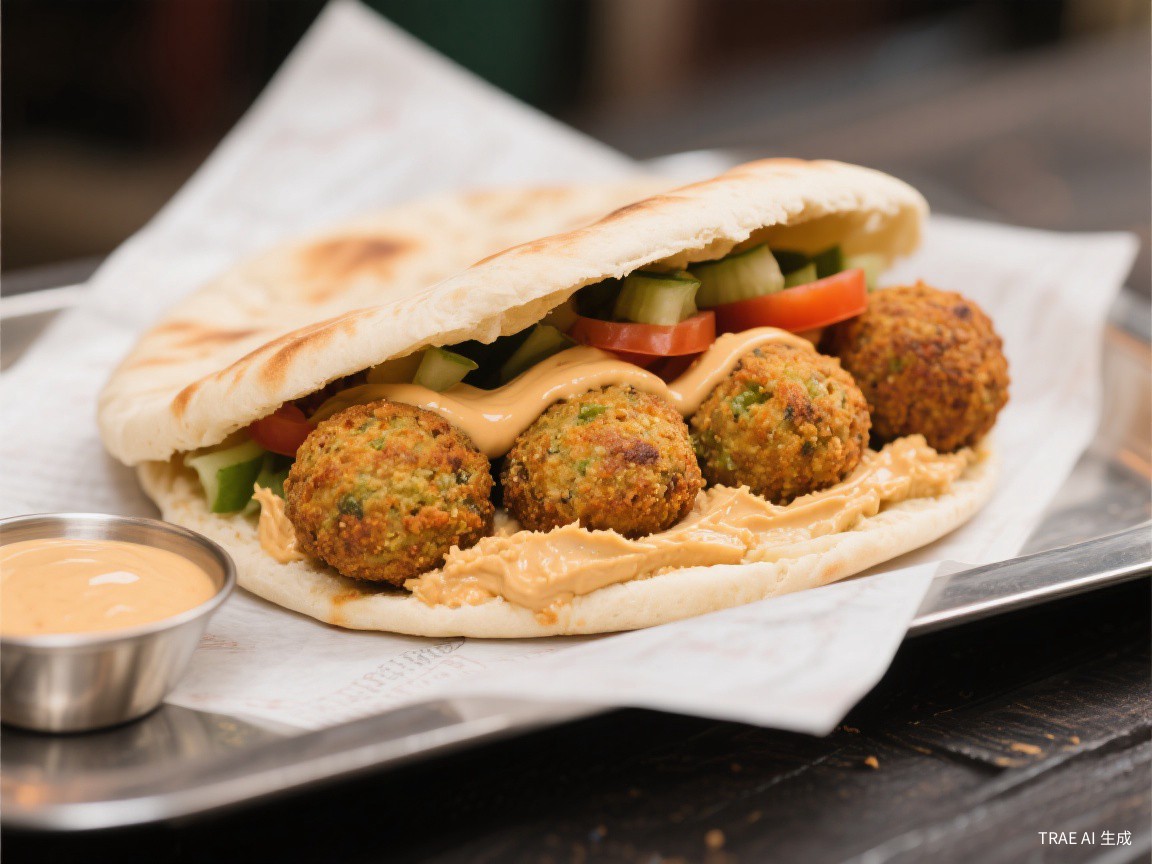
- Vegetarian/Vegan: Many shops now offer falafel, grilled halloumi, or seitan as meat alternatives
Mustafa's Gemüse Kebap: The Pilgrimage Stand
No discussion of Berlin's Döner scene is complete without Mustafa's Gemüse Kebap, the tiny stand on Mehringdamm in Kreuzberg that has become perhaps the most famous street food vendor in Europe. The queue, which can stretch for an hour or more during peak times, is itself a social event—a cross-section of Berlin society united by the promise of an extraordinary sandwich.
Mustafa's distinguishes itself through its vegetable-focused approach. While traditional Döner shops treat the salad as a garnish, Mustafa's treats it as a co-star. The grilled vegetables—eggplant, zucchini, peppers, and cauliflower—are charred over flame before being chopped and mixed with the shaved meat. The result is a Döner that is smoky, sweet, and deeply savory, with the vegetables contributing genuine complexity rather than mere crunch.
The sauce at Mustafa's deserves its own paragraph. It is a house-made combination of yogurt, herbs, and lemon that is simultaneously tangy, creamy, and bright. Combined with a squeeze of fresh lemon and a dusting of sumac, it elevates the entire sandwich into something that transcends its humble origins. At under six euros, it remains one of the great food bargains in all of Europe.
Döner vs. Shawarma vs. Gyro: Untangling the Cousins
The Döner kebab is part of a family of vertical-spit meats that spans the Mediterranean and Middle East, and understanding the differences reveals fascinating culinary history. While all three share the concept of seasoned meat cooked on a rotating vertical spit, they differ in seasoning, accompaniments, and cultural context.
The Turkish Döner, as served in Berlin, typically uses a mixture of veal, beef, and lamb seasoned with cumin, coriander, paprika, and garlic. The Greek gyro uses mostly pork or chicken, seasoned with oregano, thyme, and rosemary, and is traditionally served with tzatziki, tomato, onion, and fries inside a pita. The Middle Eastern shawarma uses lamb, chicken, or beef seasoned with cardamom, turmeric, cinnamon, and allspice, often served with tahini, pickles, and garlic sauce.
Key Differences at a Glance
- Meat: Döner uses veal/beef/lamb; gyro uses pork/chicken; shawarma uses lamb/chicken/beef
- Spicing: Döner favors cumin and paprika; gyro uses oregano; shawarma features cardamom and cinnamon
- Sauce: Döner offers garlic yogurt and herb sauces; gyro uses tzatziki; shawarma features tahini
- Bread: Döner uses Fladenbrot or durum; gyro uses pita; shawarma uses pita or flatbread
- Origin: Döner is Turkish; gyro is Greek; shawarma is Levantine Arab
Currywurst: The Rival That Never Quite Won
No article about Berlin street food would be complete without acknowledging the Currywurst—the other great contender for the title of Berlin's signature dish. Invented in 1949 by Herta Heuwer, who began selling sliced pork sausage doused in a curry-spiced ketchup at a stand in Charlottenburg, the Currywurst is a simpler, more austere pleasure than the Döner.
The rivalry between Döner and Currywurst enthusiasts is mostly playful but reveals something genuine about Berlin's identity. The Currywurst is old Berlin—working-class, no-nonsense, born from postwar scarcity. The Döner is new Berlin—immigrant-born, cosmopolitan, constantly evolving. Both are consumed in vast quantities. Both cost roughly the same. But the Döner has won the demographic war: younger Berliners, and especially the city's large international community, overwhelmingly prefer it.
That said, a proper Currywurst at a dedicated stand—preferably Konnopke's under the Eberswalder Straße U-Bahn station—is a joy in its own right. The sausage, grilled until the skin snaps, sliced into bite-sized pieces, and drenched in that sweet-spicy sauce, hits a satisfaction center that the more complex Döner sometimes misses. It is the difference between a perfectly made hamburger and a elaborate tasting menu: both are valid, but one is more likely to satisfy a specific craving.
A Sandwich That Tells a City's Story
Berlin's Döner kebab is more than a meal. It is a symbol of what happens when cultures collide and create something neither could have produced alone. The vertical spit came from Turkey. The bread draws on Middle Eastern flatbread traditions. The salads reflect German agricultural abundance. The sauces borrow from Mediterranean yogurt cultures. And the entire concept of fast, portable, affordable street food served from a small shop is as Berlin as the Fernsehturm.
In a city that spent decades divided by a wall, the Döner has become a powerful symbol of unity—not through any deliberate political statement, but simply by being delicious enough to transcend every boundary of class, ethnicity, and nationality. When a Turkish-German teenager, a Japanese exchange student, and a retired East German schoolteacher are all waiting in the same line at midnight for the same sandwich, something important is happening. The Döner doesn't just feed Berlin. It holds it together.
Explore More European Street Food
From Lisbon's pastelarias to the night markets of Bangkok, discover our complete collection of street food reviews and culinary deep dives.
Browse All Reviews