Of all the dishes that emerge from the Levantine kitchen, few are as misunderstood as baba ganoush. Often confused with hummus, frequently made without the smoke that defines it, and too often reduced to a bland, beige puree on a supermarket shelf, the real baba ganoush is something altogether more extraordinary—a silky, smoky, deeply savory dip that captures the very essence of fire-kissed eggplant and the bright, nutty complexity of tahini.
The Open Flame Charring Technique
The soul of authentic baba ganoush is smoke. Not the subtle, incidental smokiness that comes from roasting eggplant in an oven, but the deep, primal, almost intoxicating smoke that can only be achieved by placing the whole eggplant directly over an open flame. This is the technique that separates baba ganoush from every other eggplant dip in the world, and it is the step that most home cooks skip—to their detriment.
The process begins with selecting the right eggplant. Large, globe-shaped eggplants with glossy, unblemished skin are ideal. The eggplant is pierced several times with a fork or knife to prevent it from exploding as the internal moisture turns to steam, and then it is placed directly on the grate of a gas burner, a charcoal grill, or even a bed of hot embers. The flame should be medium-high, and the eggplant is turned every few minutes with tongs.
Over the course of twenty to thirty minutes, the eggplant undergoes a dramatic transformation. The skin blackens and blisters, sometimes catching fire briefly before being extinguished with a quick turn. Beneath that charred, ruined-looking exterior, the flesh is being gently steamed and permeated with smoke. When the eggplant collapses entirely, sagging like a deflated balloon, it is done. The skin peels away easily, revealing flesh that is golden, silky, and fragrant with the unmistakable aroma of wood smoke.
Chef's Tip
If you do not have a gas stove or an outdoor grill, you can achieve a reasonable approximation by broiling the eggplant on the highest setting, turning it every five minutes until the skin is thoroughly blackened. It will not be as smoky as flame-charred eggplant, but it will be far superior to baking. For an extra boost of smoke, add a pinch of smoked paprika or a drop of liquid smoke to the finished dip.
Why Smoke Matters
The smoke is not merely a flavor garnish—it is the defining characteristic of baba ganoush. The phenolic compounds created during the charring process penetrate the flesh and interact with the eggplant's natural sugars, creating a complex flavor profile that is simultaneously sweet, bitter, earthy, and aromatic. This smokiness is what gives baba ganoush its distinctive personality and what separates it from its close cousin, mutabbal, which is made with roasted but not necessarily charred eggplant.
The Tahini-Lemon-Garlic Base
Once the eggplant is charred and peeled, it is combined with a trio of ingredients that form the flavor backbone of baba ganoush: tahini, lemon juice, and garlic. The proportions of these three elements determine the character of the finished dip, and every family across the Levant has its own preferred ratio.
Tahini—ground sesame seed paste—is the structural foundation. It provides richness, body, and a nutty, slightly bitter depth that anchors the smoky eggplant. The quality of tahini matters enormously. Look for brands made from 100% hulled sesame seeds, with a smooth, pourable consistency and a clean, roasted flavor. Avoid tahini that has separated into a hard layer and a pool of oil, as this indicates age and poor quality.
Fresh lemon juice provides the acidity that brightens the entire dip and prevents the tahini from tasting heavy or muddy. The juice should be squeezed from fresh lemons—bottled lemon juice lacks the complexity and brightness needed. Garlic, used sparingly, adds a sharp, aromatic bite that cuts through the richness of the tahini and the smokiness of the eggplant. A single clove, minced to a fine paste, is usually sufficient for a batch made with two large eggplants.
"Baba ganoush teaches you that the most memorable flavors come not from adding more ingredients, but from treating a few ingredients with absolute respect. Char the eggplant over fire, use good tahini, squeeze the lemon yourself, and you will understand why this dish has endured for centuries."
— Chef Yotam Ottolenghi
Baba Ganoush vs. Mutabbal: Knowing the Difference
The confusion between baba ganoush and mutabbal is one of the most common misunderstandings in Middle Eastern cuisine, and it persists even in restaurants that should know better. While both dishes are eggplant-based dips, they are fundamentally different in composition and character.
Baba ganoush is, at its core, an eggplant dish. The charred, smoked eggplant is the dominant ingredient, with tahini, lemon, and garlic playing supporting roles. The texture is loose and rustic, often left slightly chunky rather than pureed to complete smoothness. The flavor is smoky first, nutty second, with the eggplant's natural sweetness shining through.
Mutabbal, by contrast, is essentially a tahini dish that happens to contain eggplant. The proportions are reversed: tahini dominates, and the eggplant provides body and a subtle smoky undertone. Mutabbal is typically smoother, creamier, and more uniform in texture than baba ganoush. It is also often enriched with a drizzle of olive oil and a sprinkle of pomegranate seeds or chopped parsley for visual appeal.
- Baba ganoush: Eggplant-forward, smoky, rustic, less tahini
- Mutabbal: Tahini-forward, creamy, smooth, more tahini, often with yogurt
- Both: Use charred eggplant, lemon juice, and garlic as foundational ingredients
The Levantine Mezze Tradition
Baba ganoush does not exist in isolation. It is part of the mezze tradition—a style of dining that is central to the culinary cultures of Lebanon, Syria, Jordan, Palestine, and Israel. A mezze spread is not a formal, sequential meal but a generous, convivial array of small dishes served all at once, designed for sharing, grazing, and conversation.
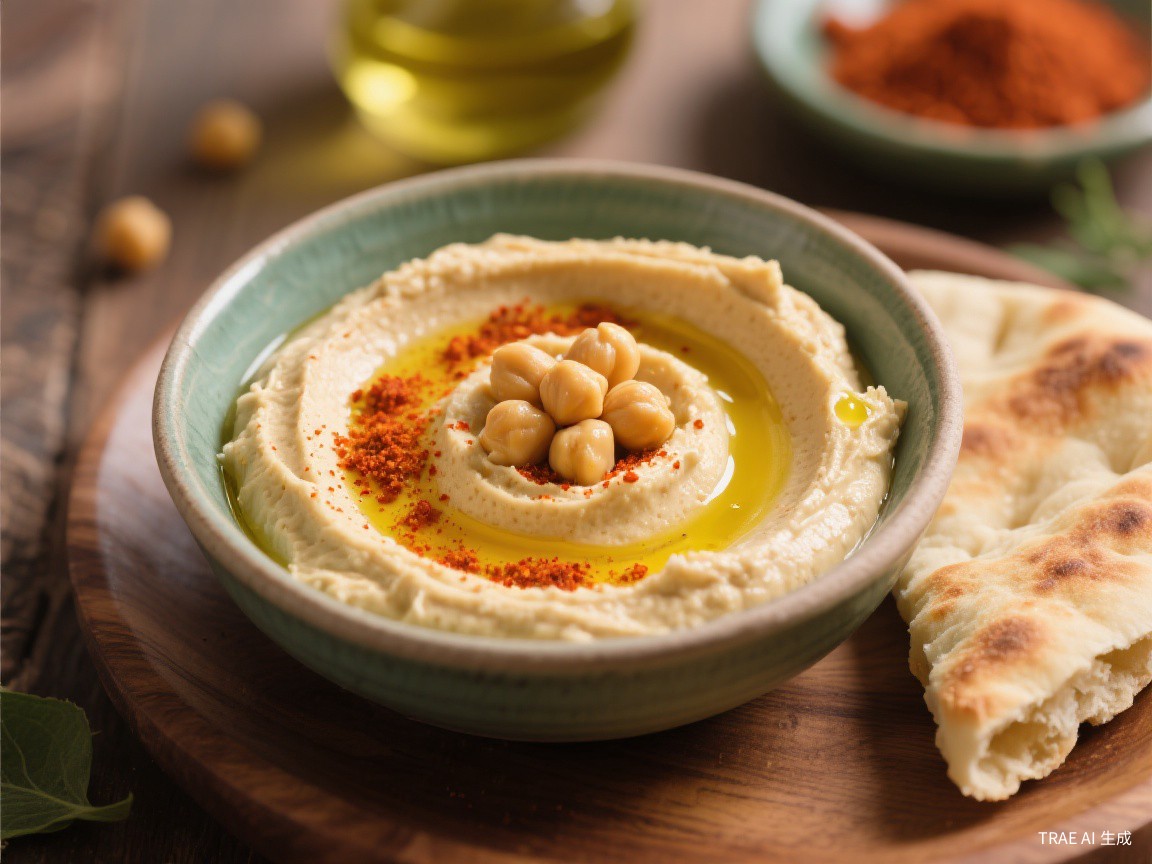
A typical mezze table might include hummus, baba ganoush, mutabbal, tabbouleh, fattoush, muhammara, falafel, stuffed grape leaves, olives, pickled turnips, labneh, and fresh bread—all presented simultaneously on a table surrounded by family and friends. The dishes are meant to be eaten in any order, in any combination, with torn pieces of warm pita as the universal utensil.
Within this context, baba ganoush plays a specific role. It is the smoky, earthy counterpoint to the bright, lemony freshness of tabbouleh and the creamy mildness of hummus. Its presence on the mezze table adds textural and flavor variety that elevates the entire spread. A mezze without baba ganoush is like an orchestra without the cello—technically complete, but missing a voice that adds depth and resonance.
Pita Bread: The Perfect Vessel
The relationship between baba ganoush and pita bread is sacred. Warm, freshly baked pita—with its soft interior and slightly charred exterior—is the ideal vehicle for scooping up the silky dip. The bread should be torn into generous pieces, not cut with a knife, and each piece should be used to gather a substantial portion of the dip before being brought to the mouth.
In the Levant, pita is not merely a delivery system for dips. It is an integral part of the meal, providing the starch and mild sweetness that balance the bold flavors of the mezze. The best pita for baba ganoush is thin, with a pocket that can be opened and filled, and it should be served warm—either freshly baked or briefly reheated in a dry skillet or over a flame. Cold pita, with its stiff, unyielding texture, is a disservice to the dip it carries.
Variations Across the Middle East
Like all great dishes with deep roots, baba ganoush varies significantly from region to region and kitchen to kitchen. In Lebanon, it is often made with the addition of pomegranate molasses, which lends a dark, fruity sweetness that complements the smokiness. In Syria, some cooks add a spoonful of yogurt for extra creaminess. In Turkey, a similar dish called patlican salatasi uses roasted eggplant but incorporates diced tomatoes, onions, and olive oil in a chunkier preparation.
In Egypt, baba ganoush takes a different form entirely. The eggplant is roasted and mashed with tahini, garlic, lemon juice, and cumin, then garnished with a drizzle of olive oil and a dusting of ground cumin. The Egyptian version tends to be more heavily spiced than its Levantine counterpart, reflecting the broader flavor profile of Egyptian cuisine.
- Lebanese style: Extra smoky, with pomegranate molasses and chopped parsley
- Syrian style: Creamier, with the addition of yogurt and sometimes walnuts
- Egyptian style: Spiced with cumin, garnished generously with olive oil
- Turkish patlican salatasi: Chunkier, with tomatoes and onion, less tahini
- Israeli style: Often includes a touch of mayonnaise for extra richness
Mastering the Dip
Baba ganoush rewards patience and attention to detail at every stage. The charring must be thorough but not careless. The peeling must be complete—any blackened skin left behind will add bitterness. The tahini must be whisked until smooth and creamy before it meets the eggplant. The lemon juice must be added gradually, tasting as you go, until the balance of smoke, nuttiness, and brightness reaches its peak.
Like all the great dishes of the Middle East, baba ganoush is a study in the power of simplicity. It contains no exotic spices, no expensive ingredients, no techniques that require years of training. It requires only an eggplant, a flame, tahini, lemon, garlic, and the willingness to treat each of these humble ingredients with the care they deserve. Master it, and you will have a dish that brings people together around a table—a dish that is, in the truest sense, worth mastering.
Ready to Master Baba Ganoush?
Download our complete guide with charring techniques, tahini selection tips, and regional variation recipes.
Get the Free Guide