There is a moment in every focaccia baker's life when they first pull a golden, olive-oil-glistening slab from the oven and press their fingers into that impossibly soft, airy crumb. It's a moment of pure revelation—the realization that flour, water, salt, yeast, and generous amounts of good olive oil can combine to create something so profoundly satisfying that it hardly seems possible from such humble ingredients.
The Genoa Origin Story
Focaccia belongs to Genoa, the capital of the Liguria region in northwestern Italy, with the same certainty that croissants belong to France and tortillas belong to Mexico. The name itself derives from the Latin word "focus," meaning hearth or fireplace, a testament to the bread's ancient origins as a flatbread baked directly on the hot stones of the family hearth. The Roman soldiers baked a similar flatbread called "panis focacius" on the underside of their shields over open fires, making focaccia one of the oldest bread traditions in Western cuisine.
In Genoa, focaccia is not merely bread—it's a way of life. It's eaten for breakfast, torn into pieces and dipped in morning cappuccino. It's sold at every bakery and corner shop, where it's purchased by the slice and wrapped in paper. It accompanies every meal, from the simplest lunch of prosciutto and cheese to the most elaborate holiday dinner. The most iconic Genoese version is focaccia col formaggio, a stuffed variation from the town of Recco that features an incredibly thin layer of creamy crescenza cheese sandwiched between two sheets of paper-thin dough.
The Ligurian climate plays a crucial role in focaccia's character. The region's mild, Mediterranean-influenced weather produces exceptional olive oil—fruity, peppery, and intensely aromatic—which is not merely an ingredient in focaccia but its defining element. A Ligurian baker would tell you that focaccia is less a bread and more a vehicle for olive oil, and they wouldn't be entirely wrong.
"In Liguria, we don't say we eat bread with olive oil. We say we eat olive oil with bread. The distinction is everything. Focaccia is the purest expression of this philosophy—a bread that exists to celebrate the olive."
— Chef Marco
High-Hydration Dough: The Science of Softness
The defining characteristic of great focaccia is its extraordinarily soft, open crumb—the network of irregular air pockets that gives the bread its cloud-like texture. Achieving this structure requires a high-hydration dough, meaning a dough with a high ratio of water to flour, typically between 70 and 85 percent hydration by weight.
Working with high-hydration dough is notoriously challenging for beginners. The dough is sticky, slack, and resistant to shaping. It clings to your hands, your work surface, and everything else it touches. This is not a flaw—it's exactly what you want. The high water content creates steam during baking, which inflates the air pockets in the dough and produces the characteristic open crumb. The stickiness is the price you pay for that ethereal texture.
The technique for handling wet dough is counterintuitive: instead of fighting it with excessive flour, you embrace it. Use wet hands, a dough scraper, and a technique called the "stretch and fold" to develop gluten without adding more flour. Every thirty minutes during the initial rise, reach under the dough, pull it upward until it stretches but doesn't tear, and fold it over itself. Rotate the bowl and repeat four times. This gentle manipulation strengthens the gluten network while preserving the dough's high water content.
Chef's Tip
If you're new to high-hydration dough, start with 70 percent hydration and work your way up as you gain confidence. Even a 70 percent hydration focaccia will be softer and more open-crumbed than most breads you've made. Use a kitchen scale for accuracy—measuring by volume is unreliable with wet doughs.
The Role of Salt
Salt in focaccia serves a dual purpose that goes beyond seasoning. In addition to enhancing flavor, salt strengthens the gluten network, allowing the dough to hold its shape and trap the carbon dioxide produced by the yeast. Most focaccia recipes use a slightly higher percentage of salt than standard bread dough—around 2.5 to 3 percent of the flour weight—which produces a more pronounced savory flavor that stands up to the generous olive oil. The coarse sea salt sprinkled on top before baking is not just garnish; it provides bursts of salty crunch that contrast with the soft, oily crumb.
The Dimple Method: Dita in Focaccia
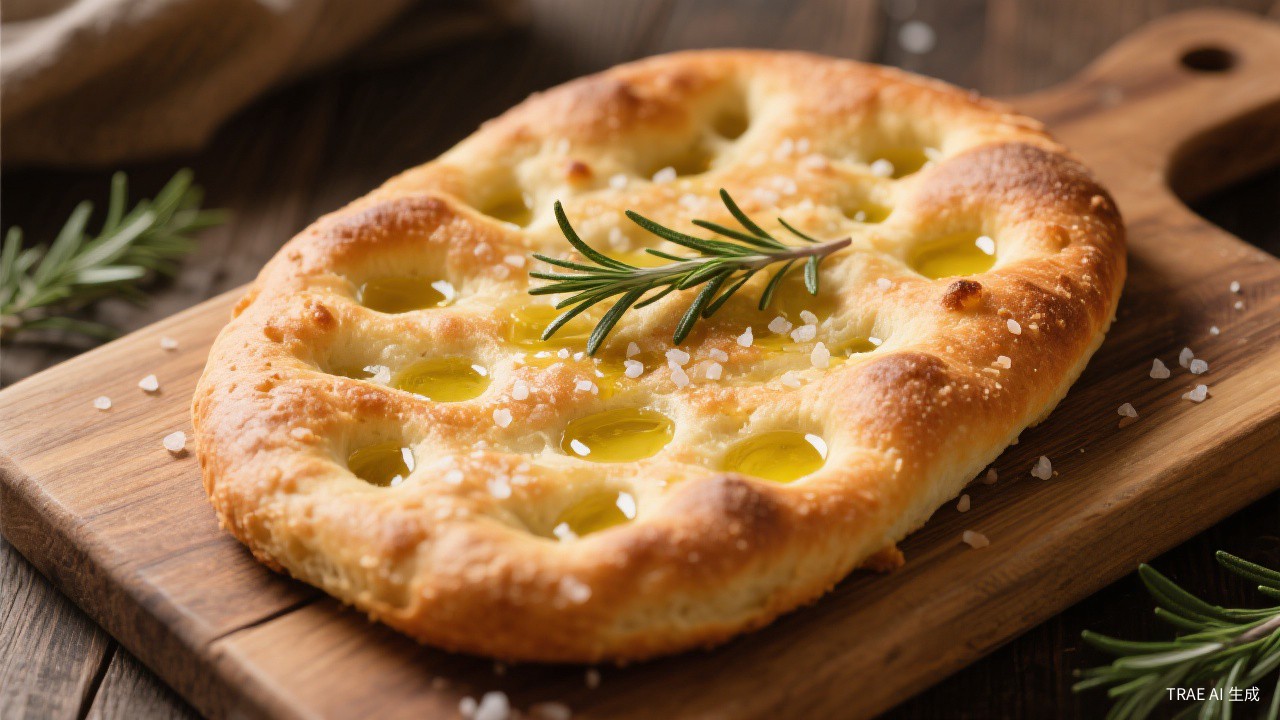
The most recognizable feature of focaccia is its dimpled surface—those distinctive indentations that pockmark the top of every loaf like a landscape of tiny craters. In Italian, these dimples are called "dita" (fingers), because they're made by literally pressing your fingers into the dough. But the dimple method is not merely decorative; it serves several important functional purposes.
First, dimpling releases large air bubbles that have accumulated during the final rise, creating a more even crumb structure. Without dimpling, those bubbles would expand unpredictably during baking, producing an uneven, tunnel-like interior. Second, the dimples create reservoirs for olive oil, which pools in the indentations and soaks into the dough during baking, creating those irresistibly soft, oily pockets that are the hallmark of great focaccia.
The technique requires a confident touch. After transferring the dough to your oiled baking sheet, press your fingers firmly into the surface all the way to the bottom of the pan, spacing the dimples about an inch apart. Don't be gentle—the dough should deflate noticeably. If your fingers leave shallow impressions that spring back, you're not pressing hard enough. After dimpling, drizzle generous amounts of olive oil over the surface, letting it pool in the wells. This is not the time for restraint.
Olive Oil Pooling: The Ligurian Secret
The amount of olive oil used in authentic focaccia would shock many home bakers accustomed to more restrained recipes. In Genoa, olive oil is added to the dough, poured over the dough before baking, and drizzled over the finished bread. The baking pan itself is coated with a thick layer of oil, essentially shallow-frying the bottom of the focaccia as it bakes. This produces the characteristic crisp bottom crust that contrasts with the soft, oily interior.
The type of olive oil matters enormously. Use a good extra virgin olive oil with a fruity, slightly peppery flavor—ideally from Liguria if you can find it, though any high-quality Italian or Spanish oil will produce excellent results. Avoid "light" or "pure" olive oil, which lacks the flavor and aroma that make focaccia special. The oil should taste good enough to drink on its own, because in focaccia, its flavor is front and center.
Topping Traditions
While the simplest focaccia—just dough, oil, and salt—is arguably the purest expression of the form, a wide variety of toppings have become traditional across Italy and beyond.
Classic Rosemary and Sea Salt
The most iconic focaccia topping is fresh rosemary and flaky sea salt, scattered over the dimpled surface before baking. The rosemary should be fresh, not dried, and the sprigs should be laid flat on the dough so they char slightly in the oven. Maldon sea salt or another large-flake variety provides the best texture, creating crunchy crystals that dissolve slowly on the tongue. This combination is so beloved that in many parts of the world, "focaccia" and "rosemary bread" are virtually synonymous.
Cherry Tomatoes and Garlic
In Puglia, in southern Italy, focaccia is often topped with halved cherry tomatoes and whole garlic cloves, pressed gently into the dimpled dough. The tomatoes roast and burst during baking, releasing their juices into the olive oil wells and creating pockets of sweet, tangy intensity. The garlic softens into a spreadable, mellow paste. This version, sometimes called focaccia barese, is heartier and more meal-like than its Genoese cousin.
Other Popular Toppings
- Olives: Black or green, pitted and pressed into the dough for briny pops of flavor
- Caramelized onions: Sweet and deeply savory, especially when paired with rosemary
- Thinly sliced potatoes: A traditional Ligurian variation that adds substance and a delicate sweetness
- Cheese: Stracchino or crescenza for focaccia col formaggio, or Parmigiano-Reggiano for a sharper bite
- Grapes or figs: For a sweet focaccia, served as dessert or an unusual breakfast treat
Cold Fermentation: Patience Rewarded
The most significant technique improvement most home bakers can make to their focaccia is embracing cold fermentation—letting the dough rise slowly in the refrigerator for 12 to 24 hours before baking. This extended, cool fermentation develops flavors that simply cannot be achieved with a quick room-temperature rise.
During cold fermentation, the yeast and naturally occurring bacteria in the dough produce organic acids and esters that create complex, nuanced flavors with notes of nuts, butter, and subtle fermentation. The dough also develops better structure, becoming easier to handle and producing a more open, irregular crumb. Many professional bakers consider cold fermentation non-negotiable, and once you've tasted the difference, you'll understand why.
The practical benefit is flexibility. You can mix the dough in the evening, let it rise at room temperature for an hour, then transfer it to the refrigerator overnight. The next morning or afternoon, bring it to room temperature, shape it, dimple it, and bake. The long, slow rise fits naturally into a home cook's schedule and produces dramatically better results than a rushed two-hour version.
Focaccia Col Formaggio: The Recco Masterpiece
No discussion of focaccia would be complete without mentioning focaccia col formaggio di Recco, a stuffed variation from the coastal town of Recco that is one of the most extraordinary breads in all of Italy. Unlike standard focaccia, which is thick and airy, the Recco version consists of two tissue-thin sheets of dough enclosing a layer of stracchino or crescenza cheese—a soft, creamy, tangy cow's milk cheese that melts into a molten pool during baking.
The dough for focaccia col formaggio contains no yeast, relying instead on olive oil and hot water to create a pliable, stretchy dough that can be rolled paper-thin. The technique requires practice and confidence, as the dough tears easily and must be stretched until it's nearly translucent. When done correctly, the result is a crisp, blistered exterior giving way to a stratum of oozing, bubbling cheese—a dish that is somehow both rustic and refined, simple and spectacular.
The Focaccia You'll Make Again and Again
Focaccia rewards patience, practice, and a generous hand with olive oil. It's a bread that teaches you to trust the process—to believe that a sticky, unmanageable mass of wet dough will transform in the oven into something golden, fragrant, and impossibly tender. It's a bread that connects you to centuries of Italian baking tradition, to the hearths of ancient Rome and the bakeries of Genoa, to the fundamental human act of transforming flour and water into nourishment.
Start with the classic rosemary and sea salt version. Master the high-hydration dough, perfect your dimpling technique, and learn to recognize when your focaccia is properly proofed and ready for the oven. Once you've nailed the basics, the variations are endless—every topping, every olive oil, every flour will produce a slightly different result, and exploring those differences is part of the joy. Focaccia is not just a recipe. It's a craft, a tradition, and an invitation to slow down and enjoy the deeply satisfying act of making something wonderful with your own hands.
Ready to Bake Perfect Focaccia?
Download our complete focaccia guide with hydration ratios, cold fermentation schedules, and topping inspiration.
Get the Free Guide