My grandfather used to say that a man's character could be judged by his jambalaya. Not by how fancy the ingredients were, but by whether he had the patience to let the rice do its work. In south Louisiana, where I was raised, jambalaya is more than a dish—it is a communal ritual, a test of skill, and a point of fierce regional pride. Every family claims the best recipe, every church has a designated jambalaya cook, and every parish holds at least one annual jambalaya festival where the air hangs thick with the perfume of smoked sausage, caramelized onions, and long-grain rice steaming in its own fragrant broth.
Creole vs. Cajun: Two Dishes, One Name
The first thing any visitor to Louisiana learns about jambalaya is that there are two distinct versions, and conflating them is a quick way to start an argument at a dinner table. Creole jambalaya (also called "red jambalaya") originates from New Orleans and the surrounding parishes, where French, Spanish, and African culinary influences converged. It includes tomatoes, which give the dish its characteristic reddish hue and a tangy sweetness that balances the richness of the meats. Creole jambalaya is the more cosmopolitan version, reflecting the urban, multicultural character of New Orleans itself.
Cajun jambalaya (or "brown jambalaya") comes from the rural Acadiana region of southwest Louisiana, where the French-Canadian exile community settled after being expelled from Nova Scotia in the eighteenth century. The Cajun version contains no tomatoes whatsoever. Instead, its color and depth come from the browning of meat and the careful caramelization of the Holy Trinity vegetables. The result is a darker, earthier, more intensely savory dish that speaks to the resourcefulness of a people who learned to coax extraordinary flavor from modest ingredients in a landscape that offered little in the way of luxury.
"Jambalaya is a conversation between the pot and the cook. You cannot rush it, you cannot force it, and you cannot look away from it. It demands your full attention, and it rewards you accordingly."
— Chef Paul Prudhomme
The Holy Trinity: Louisiana's Flavor Foundation
Every discussion of Louisiana cooking eventually arrives at the Holy Trinity: diced onion, celery, and bell pepper in roughly equal proportions. This aromatic base is to Cajun and Creole cuisine what mirepoix (onion, carrot, and celery) is to French cooking—with one critical difference. Where mirepoix leans on carrots for sweetness, the Holy Trinity substitutes bell pepper, which contributes a grassy, slightly bitter complexity that pairs naturally with the spices and smoked meats of Louisiana cooking.
The ratio matters. I use one part onion, one part celery, and one-half part green bell pepper. Some cooks prefer equal parts of all three, but I find that too much bell pepper can overwhelm the dish with its vegetal sharpness. The onion should be diced small—about a quarter inch—so it melts into the dish during cooking, providing sweetness and body without identifiable chunks. The celery should be sliced slightly finer, as its stringy texture can be unpleasant in larger pieces. The bell pepper, diced to match the onion, retains enough structure to provide textural contrast in the finished dish.
Chef's Tip
The Holy Trinity must be cooked slowly in rendered fat before anything else enters the pot. In Creole jambalaya, this means sauteing the Trinity in the fat left behind after browning your meats. In Cajun jambalaya, the Trinity is often cooked alongside the browning meat, absorbing the fond (the browned bits stuck to the pot) that contains the deepest flavors. Either way, cook the vegetables until the onions are translucent and the edges of the bell pepper begin to caramelize—about eight to ten minutes. This is not a step to rush.
Building Layers of Meat
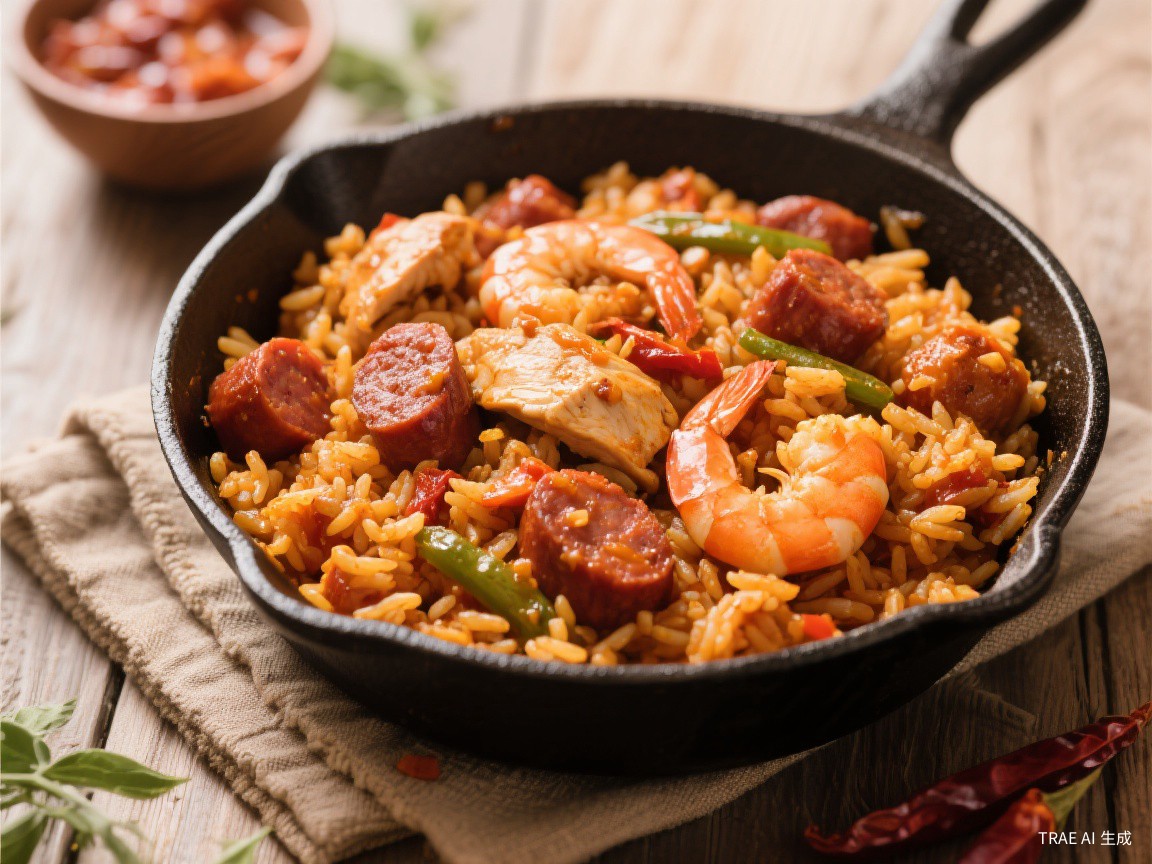
Traditional jambalaya contains at least two, often three types of meat, each contributing a different quality to the final dish. Andouille sausage is non-negotiable. This coarse-ground, smoked pork sausage, heavily seasoned with garlic, thyme, and cayenne, provides the smoky backbone that defines jambalaya's character. Look for genuine Louisiana andouille if possible—it has a firmer texture and more complex smoke profile than the mass-produced supermarket versions. If you cannot source it, a high-quality kielbasa or smoked Spanish chorizo can substitute, though the flavor will shift noticeably.
Chicken, typically bone-in thighs, is the second meat in most recipes. The bone-in cut adds gelatin to the cooking liquid, which gives the rice a richer, more velvety mouthfeel. Some cooks use chicken breast for convenience, but I consider this a compromise—the thigh's higher fat content and deeper flavor are essential to the dish's overall richness. The chicken is browned first, then removed, then returned later, ensuring it stays tender without overcooking.
The third meat, when included, is either shrimp (added in the final five minutes so they do not turn rubbery) or, in more traditional preparations, smoked tasso ham or pickled pork. Tasso, a highly seasoned smoked pork shoulder, is a uniquely Louisiana ingredient that adds an almost indecent amount of flavor. If you can find it, use it.
The Rice Absorption Method
Here is where jambalaya either succeeds or fails, and it all comes down to the rice. Jambalaya uses the absorption method, where rice cooks in a measured amount of liquid until every drop is absorbed. Unlike risotto, which requires constant stirring, jambalaya rice should be stirred minimally—just enough to distribute the ingredients evenly, then left alone to cook undisturbed. Excessive stirring releases starches and turns the rice gummy, which is the most common flaw in poorly made jambalaya.
The rice itself matters enormously. Long-grain white rice is the only appropriate choice—specifically, a variety that holds its shape during cooking without becoming sticky. Jasmine rice works well, as does traditional American long-grain. Avoid medium-grain, short-grain, Arborio, or any rice labeled "sticky." The ideal jambalaya rice should be fluffy, with each grain separate and distinct, coated in the flavorful cooking liquid but never clumping together.
The Liquid Ratio
The standard ratio for jambalaya is one cup of rice to two cups of liquid, but this is an approximation that requires adjustment based on your specific ingredients. If you are using Creole jambalaya with tomatoes, the tomatoes contribute additional moisture, so reduce your added liquid by roughly a quarter cup per can of diced tomatoes. If your meats are particularly fatty, they will render more oil during cooking, which can affect how the rice absorbs liquid. The safest approach is to use slightly less liquid than you think you need—you can always add more, but you cannot remove it once the rice has absorbed it.
- Brown the meats: Sear andouille, chicken, and any other meats in batches until deeply caramelized. Remove and set aside.
- Cook the Holy Trinity: In the rendered fat, saute onion, celery, and bell pepper until softened and beginning to brown.
- Add aromatics and liquid: Garlic, bay leaves, thyme, cayenne, and your liquid (stock, water, or tomato-based broth for Creole).
- Bring to a boil, then add rice: Stir once to distribute, then reduce heat to low.
- Cover and cook undisturbed: Twenty to twenty-five minutes. Do not lift the lid.
- Rest before serving: Remove from heat, let stand covered for ten minutes, then fold in the reserved meats and any shrimp.
Seasoning: The Cajun Trinity of Spice
Beyond the vegetable Holy Trinity, Louisiana cooking relies on a spice trinity of cayenne pepper, black pepper, and white pepper. Cayenne provides the heat, black pepper contributes earthy warmth, and white pepper—often overlooked in other cuisines—adds a sharp, fermented pungency that is distinctly Cajun. Together, they create a layered heat that builds gradually rather than hitting you all at once.
File powder (ground sassafras leaves) is another signature seasoning, though its use in jambalaya is debated. Some cooks stir it in at the end as a thickener and flavoring, while others argue it belongs only in gumbo. I add a small amount—about a teaspoon per large pot—just before serving, which contributes a subtle, almost minty-earthy note that rounds out the dish without dominating.
The Social Pot: Jambalaya as Community
In Louisiana, jambalaya is rarely made for one. It is a dish of abundance, designed to feed a crowd, and its preparation is inherently social. Church fundraisers, family reunions, Mardi Gras celebrations, and Friday night football tailgates all revolve around a massive cast-iron pot of jambalaya. The cook—almost always a man in traditional Louisiana culture, a rare gender dynamic in the culinary world—tends the pot for hours while friends and family gather around, tasting, advising, and arguing about whether this batch is better than the last.
This communal aspect is not incidental to the dish's identity. Jambalaya was born from economic necessity—a way to stretch limited meat and rice to feed large families—and it retains that generous, open-door spirit. A proper pot of jambalaya is always large enough for unexpected guests, and in Louisiana, turning someone away from your jambalaya pot is a social offense of the highest order.
Ready to Cook a Pot of Jambalaya?
Download our complete Creole and Cajun jambalaya recipes with ingredient lists, timing guides, and regional variation tips.
Get the Free Guide