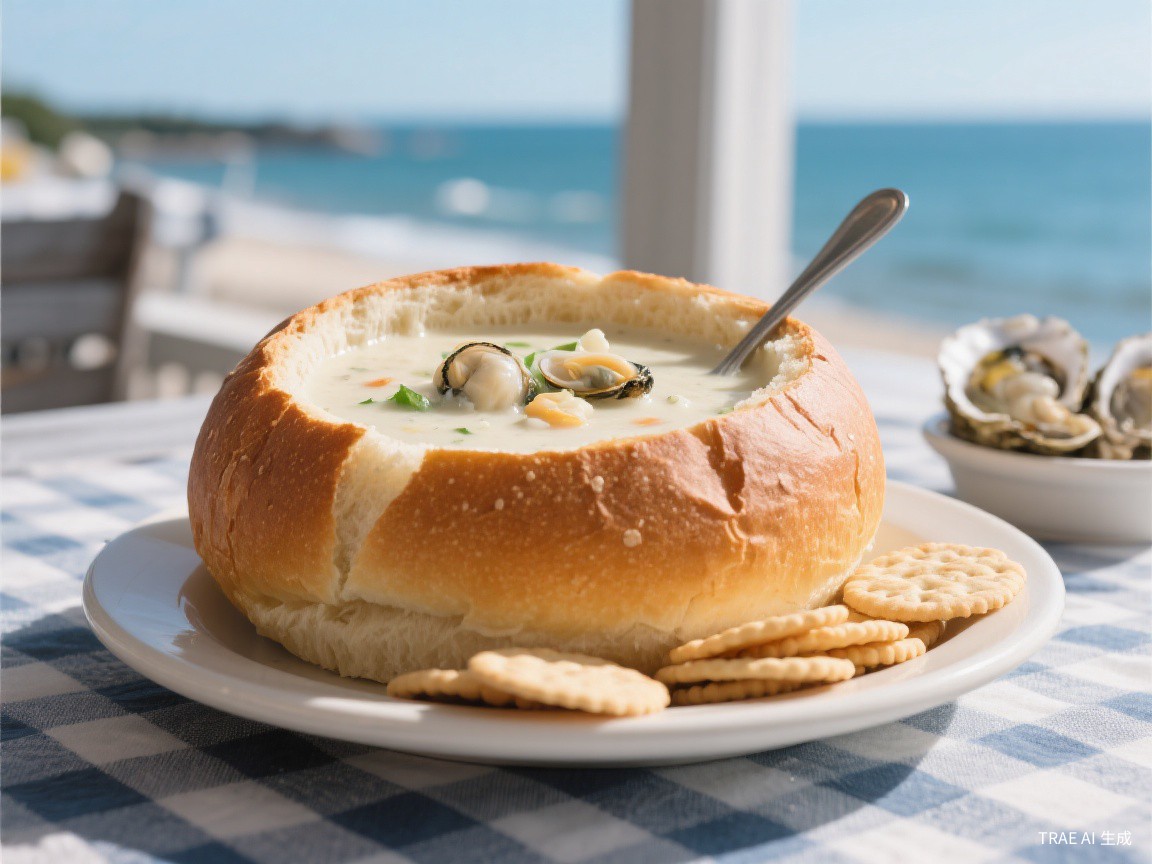
On a gray November afternoon in coastal Massachusetts, there are few things more restorative than a steaming bowl of New England clam chowder. Thick, creamy, studded with tender potatoes and briny chunks of clam, it is the kind of dish that seems to warm you from the inside out—part meal, part memory, part argument waiting to happen. For in New England, clam chowder is not just food. It is identity, heritage, and a surprisingly passionate subject of debate.
The Great Chowder War
To understand New England clam chowder, you must first understand what it is not. It is not Manhattan clam chowder—that tomato-based upstart that New Englanders regard with a mixture of pity and mild outrage. The rivalry between the two styles is one of the oldest and most good-natured food feuds in American cuisine, and it runs surprisingly deep.
New England clam chowder, sometimes called Boston clam chowder, is a cream-based soup thickened with potatoes and rendered salt pork, with fresh clams as its soul. Manhattan clam chowder, by contrast, uses a tomato broth base and has no cream. The divide is largely geographic—New England to the north, Manhattan to the south—but it also reflects fundamentally different philosophies about what clam chowder should be. New Englanders believe it should be rich, milky, and comforting. New Yorkers believe it should be bright, acidic, and lighter.
The feud became so heated that, in 1939, a bill was introduced in the Maine legislature that would have made it illegal to add tomatoes to clam chowder. The bill did not pass, but the sentiment was clear: in Maine, and throughout New England, the cream-based version is not merely preferred—it is considered the only legitimate article. I grew up in a household where mentioning tomato-based chowder at the dinner table was met with the same reaction as suggesting we serve Thanksgiving dinner on paper plates.
"A man who puts tomatoes in clam chowder is a man who has lost his way in this world. I pity him, but I will not eat his chowder."
— Old New England proverb, author unknown
The Clam: King Quahog
The heart of any respectable New England clam chowder is the quahog—a large, hard-shell clam native to the Atlantic coast from Canada to Florida. Quahogs (pronounced KO-hog, or sometimes KWA-hog, depending on how far north you are) come in several sizes, and each has its place in the chowder hierarchy.
The largest quahogs, known as chowder clams, are the traditional choice for chowder. They are tough when raw but become tender and flavorful when simmered slowly in the broth. Their meat has a deep, briny character that permeates the entire soup. Littleneck clams, smaller and more tender, are often served on the half shell but can be steamed open and added to chowder for a more delicate texture. Some cooks use a combination—chopped chowder clams for the body of the soup and whole littlenecks added at the end for visual appeal and bursts of concentrated flavor.
Fresh vs. Canned: A Practical Guide
Purists insist on fresh clams, and there is no denying that starting with live quahogs produces a superior chowder. Steaming the clams in a small amount of water or wine creates a concentrated clam liquor that becomes the foundation of the broth—a liquid so flavorful that discarding it borders on criminal. However, high-quality canned clams, particularly those labeled "chopped clams with clam juice," can produce a remarkably good chowder when fresh clams are unavailable or impractical. The key is never discarding the liquid from the can—it is liquid gold.
Chef's Tip
When using fresh clams, scrub them thoroughly under cold running water to remove sand and grit. Discard any clams that are open and do not close when tapped, or whose shells are cracked. After steaming, strain the cooking liquid through a fine-mesh sieve lined with cheesecloth to catch any remaining sand. This single step is the difference between a gritty chowder and a silky one.
The Salt Pork Foundation
Before a single potato is peeled or a drop of cream is poured, the chowder begins with salt pork. Diced small and rendered slowly in the bottom of a heavy pot, salt pork provides the foundational fat and a subtle smokiness that defines the soup's character. Bacon is a common substitute, and a perfectly acceptable one, but traditional salt pork has a cleaner, less aggressively smoky profile that allows the clams to remain the star.
The rendering process is meditative. Over medium-low heat, the cubes of salt pork gradually release their fat, shrinking and crisping. Once they have given up most of their fat and turned golden, they are typically removed and set aside, to be added back later as a garnish. The rendered fat becomes the medium in which the onions are sautéed, infusing them with a savory depth that butter alone cannot achieve.
Some recipes call for a combination of salt pork fat and butter—the pork fat for flavor, the butter for richness and to help the flour roux develop. This dual-fat approach is the method I was taught, and it produces a chowder with remarkable depth. The roux itself should be cooked just long enough to lose its raw flour taste—about two minutes—but not so long that it darkens significantly. You want a pale roux that thickens without coloring the soup.
The Potato Question
Potatoes in clam chowder serve a dual purpose: they are a key ingredient and a natural thickener. As they cook, they release starch into the broth, contributing to the chowder's characteristic body. The best potato for chowder is a matter of some debate, but the consensus among New England cooks leans toward waxy varieties such as Yukon Gold or Red Bliss. These hold their shape during cooking, providing distinct cubes of potato in the finished soup rather than disintegrating into mush.
Russet potatoes, while excellent for baking and mashing, are too starchy and prone to breaking down in a simmered soup. They will thicken the chowder, yes, but at the cost of turning it cloudy and grainy. Yukon Gold, with its buttery flavor and firm texture, is the potato I reach for every time. Cut them into half-inch cubes—large enough to maintain their integrity, small enough to cook through in a reasonable time.
Cream vs. Milk: The Dairy Dilemma
Traditional New England clam chowder uses milk rather than heavy cream, and there is a meaningful difference. Milk produces a lighter, more delicate chowder that allows the clam flavor to shine. Heavy cream, while undeniably luxurious, can overwhelm the subtle brininess of the clams and turn the soup into something closer to a bisque. Many cooks, myself included, split the difference: a combination of whole milk and a modest amount of heavy cream provides richness without heaviness.
The most critical rule regarding dairy in clam chowder is temperature. Cold milk or cream added to a hot soup will curdle, producing an unappetizing texture. Always warm your dairy before adding it, and do so gently—stir it in off the heat or over the lowest possible flame. Some traditional recipes call for pouring the hot chowder over crackers or bread in the serving bowl, letting the starch absorb some of the liquid and naturally thicken the soup at the table.
- Never boil after adding dairy: Simmering is fine; boiling will cause curdling and separation
- Warm the dairy first: Take the chill off milk or cream before adding it to the pot
- Add dairy off the heat: Remove the pot from the flame, stir in the dairy, then return to low heat
- Make it a day ahead: Like most soups, clam chowder tastes better the next day as flavors meld
Oyster Crackers: The Essential Companion
No bowl of New England clam chowder is complete without a small mound of oyster crackers perched on top or floating on the surface. These tiny, hexagonal crackers are so named because they were originally served alongside oyster stews in the nineteenth century, but they found their true calling atop clam chowder. Their mild saltiness and slight crunch provide a textural contrast to the creamy soup, and they absorb just enough liquid to soften without dissolving entirely.
Some New Englanders crush a handful of oyster crackers into the soup before eating, thickening it further and creating a porridge-like consistency that is oddly satisfying. Others prefer to eat them one at a time, alternating spoonfuls of chowder with individual crackers. There is no wrong approach, though the crushing method tends to provoke strong opinions on both sides.
The Cape Cod Connection
Cape Cod and the islands of Martha's Vineyard and Nantucket are the spiritual heartland of New England clam chowder. The region's cold, clean Atlantic waters produce some of the finest quahogs in the world, and the chowder houses that dot the coastline—from the Wursthaus in Cambridge to the Black Dog Tavern on Martha's Vineyard—have elevated the dish to an art form. Summer tourists and year-round residents alike line up at weathered shacks and white-tablecloth restaurants, all seeking the same thing: a bowl of chowder that tastes like the sea.
What makes Cape Cod chowder distinctive is often a matter of subtle differences—the particular blend of cream and milk, the ratio of clams to potatoes, the addition of a bay leaf or a sprig of fresh thyme, the decision to include a splash of dry sherry at the end. These variations are fiercely guarded by their practitioners, each cook convinced that their version is the one true chowder. It is a rivalry conducted with love, and it ensures that no two bowls are ever quite the same.
Common Mistakes to Avoid
- Overcooking the clams: Add them toward the end and simmer gently. Tough, rubbery clams are the cardinal sin of chowder.
- Skimping on the salt pork: Its rendered fat is the flavor foundation. Do not substitute entirely with butter.
- Boiling after adding dairy: Gentle heat is essential once the milk or cream goes in.
- Using the wrong potato: Waxy varieties hold their shape; starchy varieties turn the soup to paste.
- Serving immediately: Chowder benefits enormously from resting. Make it a day ahead if possible.
A Bowl That Holds a Place
New England clam chowder is more than a recipe. It is a connection to a place, a season, and a way of life shaped by tides and weather and the stubborn belief that simple ingredients, treated with care, can produce something extraordinary. Whether you make it with fresh quahogs dug from the sand at low tide or with a can of chopped clams from the pantry, the result is a bowl of comfort that has sustained New Englanders for generations—and that will, with any luck, sustain them for generations to come.
Ready to Make Authentic Clam Chowder?
Download our complete recipe with step-by-step instructions, from selecting clams to achieving the perfect creamy consistency.
Get the Free Recipe