Ask any Thai person what they crave after a long day, and the answer is almost always the same: pad see ew. This humble stir-fry of wide rice noodles, dark soy sauce, egg, and Chinese broccoli is the undisputed king of Thai comfort food—a dish so deeply embedded in the national consciousness that it transcends class, region, and occasion. It is the meal a street vendor makes for a taxi driver at midnight, the dish a mother prepares for a child returning home from school, and the plate that appears at every neighborhood food stall from Chiang Mai to Hat Yai. Pad see ew is not fancy. It does not aspire to elegance. It aspires only to satisfy, and in that aspiration, it achieves a kind of perfection.
Understanding Sen Yai: The Wide Rice Noodle
The foundation of pad see ew is sen yai, which translates literally to "big thread"—wide, flat rice noodles that are approximately one inch across and have a soft, slightly chewy texture. These noodles are made from a batter of rice flour and water, steamed into thin sheets, then cut into ribbons. Fresh sen yai are available at Thai and Southeast Asian markets, and using them makes an enormous difference in the final dish. They are softer, more pliable, and more absorbent than dried versions, soaking up the soy sauce and developing a beautiful, glossy sheen during stir-frying.
If you cannot find fresh sen yai, dried wide rice noodles are an acceptable substitute, but they require careful preparation. Soak them in room-temperature water for at least thirty minutes—do not boil them, as they will become mushy and break apart during stir-frying. The goal is to rehydrate them until they are pliable but still firm, with a slight resistance when you bend them. They will finish cooking in the wok, absorbing the sauce and softening to the perfect chewy texture.
One of the most common mistakes home cooks make with sen yai is not separating the noodles before cooking. Fresh noodles, in particular, arrive stacked and stuck together. If you try to stir-fry them without first gently pulling them apart, you will end up with clumps of uncooked noodle surrounded by overcooked, broken pieces. Take the time to separate each ribbon individually before you begin cooking. It is tedious but essential.
Chef's Tip
If your fresh sen yai are more than a day or two old, they may have dried out and become stiff. Lightly mist them with water and cover with a damp towel for fifteen minutes before using. This restores enough moisture to make them pliable without making them soggy.
The Sauce: Sweet Soy and Its Secrets
The sauce that gives pad see ew its characteristic color and flavor is built primarily on two soy sauces: light soy sauce for saltiness and dark sweet soy sauce (si-io dam in Thai) for color, sweetness, and body. Dark sweet soy sauce is a thick, viscous, molasses-like condiment that is fundamentally different from the dark soy sauce used in Chinese cooking. It is sweeter, less salty, and has a caramel richness that coats the noodles and gives the dish its distinctive deep brown color.
The brand of sweet soy sauce matters. In Thailand, the two most respected brands are Healthy Boy and Dragonfly, both of which produce a sweet soy sauce with the right balance of sweetness, saltiness, and umami. If you are shopping at a Thai market, look for a bottle labeled "see ew wan" or "sweet soy sauce." Chinese kecap manis is a reasonable substitute in a pinch, as it has a similar consistency and sweetness, but it lacks the specific fermented depth of Thai sweet soy.
Beyond the two soy sauces, the sauce for pad see ew typically includes a splash of oyster sauce for additional umami depth, a pinch of white pepper for subtle heat, and sometimes a touch of fish sauce for complexity. The proportions are roughly equal parts light soy and sweet soy, with a smaller amount of oyster sauce. The exact ratios depend on personal preference and the saltiness of your specific soy sauce brands.
"The best pad see ew I ever ate was at a roadside stall in Bangkok's Chinatown, cooked by a woman who had been making it for forty years. She used the same wok, the same brand of soy sauce, and the same supplier for her noodles every single day. Consistency is not the enemy of creativity—it is its foundation."
— Chef Niran, Thai Cuisine Specialist
The Role of Sugar
Some recipes call for additional sugar beyond what the sweet soy sauce provides. I generally find this unnecessary if you are using a quality Thai sweet soy, which already contains significant sugar. However, a tiny pinch of granulated sugar—less than a quarter teaspoon—added to the wok at the moment of stir-frying can help caramelize the sauce and create those dark, slightly charred edges on the noodles that are the hallmark of great pad see ew. This is a technique borrowed from wok cooking across Asia: a small amount of sugar accelerates the Maillard reaction and deepens the color of the finished dish.
The Wok: Temperature Is Everything
Pad see ew is a stir-fry, and like all stir-fries, it demands high heat and fast execution. The wok must be smoking hot before any ingredients go in. This intense heat serves multiple purposes: it sears the protein, caramelizes the sauce, and creates the slight smokiness—wok hei—that elevates the dish from ordinary to extraordinary.
The cooking sequence for pad see ew follows a specific order, and timing is critical. First, the wok is heated until smoking. A generous amount of oil is added—more than you might think necessary, because the wide rice noodles absorb oil rapidly and will stick to the wok if the surface is not well-lubricated. Garlic is added first, fried until fragrant but not browned. Then the protein—typically sliced pork, chicken, or tofu—goes in and is seared quickly. The Chinese broccoli stems are added next, as they take slightly longer to cook than the leaves. Then comes the noodles, followed by the sauce, which is poured over the noodles and tossed to coat evenly. Finally, the egg is cracked directly into the wok and scrambled into the noodles, and the Chinese broccoli leaves are added in the last few seconds of cooking.
The Egg: Incorporation Technique
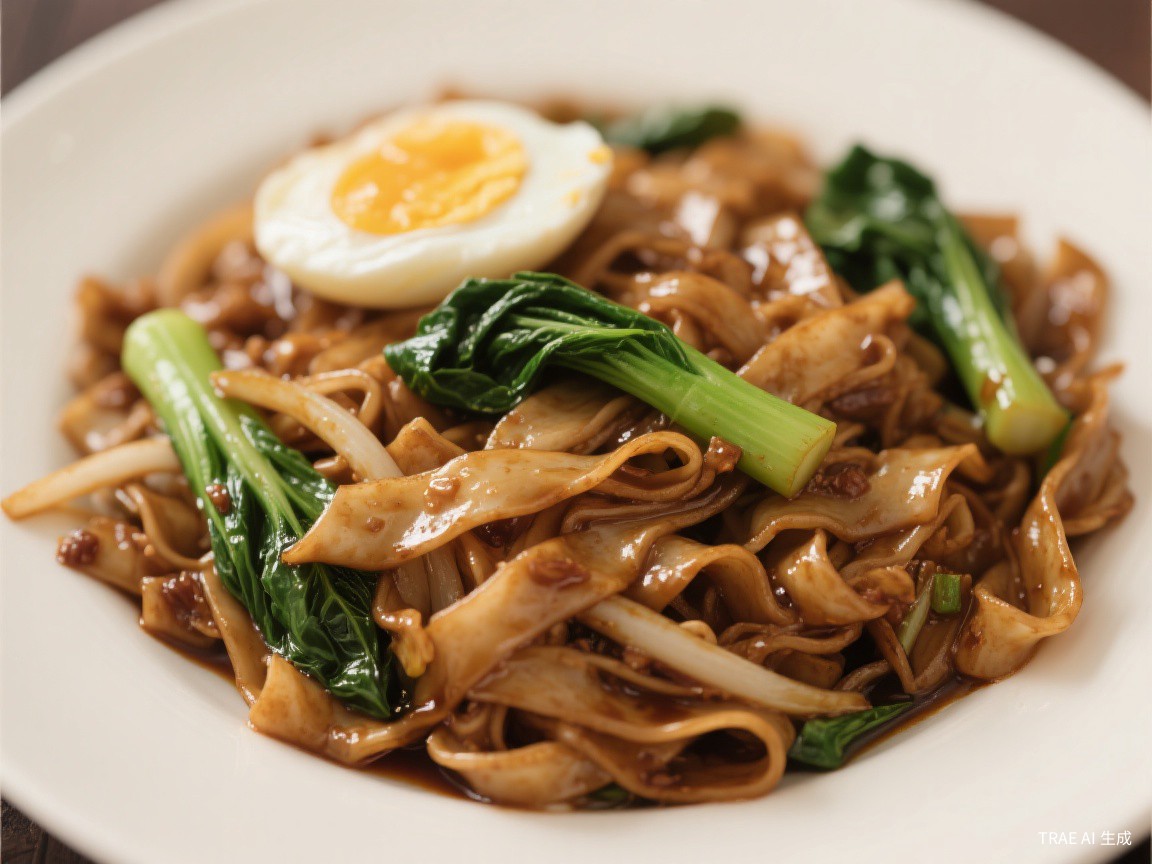
The way the egg is incorporated into pad see ew is one of the dish's most distinctive features. Unlike many stir-fried noodle dishes where the egg is scrambled separately and then added, in pad see ew the egg is cracked directly into the wok over the noodles and sauce. As it begins to set, the cook uses a spatula or wok ladle to break it into large, irregular pieces, simultaneously folding the noodles over and around the egg. The result is not uniform scrambled egg but rather streaks and ribbons of egg that cling to the noodles, creating pockets of richness throughout the dish.
The egg also serves a practical function: its proteins help bind the sauce to the noodles, creating a cohesive coating rather than a puddle of sauce at the bottom of the plate. For this reason, do not use the egg too early or too late. Too early, and it will overcook and become rubbery. Too late, and it will not integrate properly with the noodles. The sweet spot is about thirty seconds before the dish is finished—when the noodles are fully coated with sauce and the broccoli is just wilted.
- Use room-temperature eggs: Cold eggs lower the wok temperature and disrupt the cooking rhythm
- Crack into a clear space: Push the noodles to one side, crack the egg into the exposed wok surface, let it set briefly, then fold
- Don't over-scramble: Large, rustic pieces of egg are preferable to fine curds
- One egg per serving: This ratio provides richness without overwhelming the noodles
Chinese Broccoli: The Essential Green
Chinese broccoli, known as gai lan in Cantonese or kana in Thai, is the traditional vegetable in pad see ew, and substituting it changes the character of the dish significantly. Unlike regular broccoli, Chinese broccoli has thick, flat leaves, crisp stems, and small flower buds that are slightly bitter. This bitterness is essential—it cuts through the richness of the sauce and egg, providing the balance that prevents the dish from becoming cloying.
Preparation is straightforward but important. Separate the leaves from the stems, and cut the stems into bite-sized pieces on a diagonal angle. The stems go into the wok before the noodles, as they need more time to cook. The leaves are added at the very end, with just enough residual heat to wilt them slightly while preserving their bright green color and fresh flavor. Overcooked Chinese broccoli becomes mushy and loses its appealing bitterness, so err on the side of undercooking.
Street Food Origins and Modern Evolution
Pad see ew originated in the street food culture of central Thailand, where it has been a staple for well over a century. The dish reflects the Chinese influence that permeates Thai cuisine—wide rice noodles, soy sauce, and the stir-frying technique are all Chinese in origin—but the specific combination of ingredients and the balance of flavors are uniquely Thai. The dish is particularly associated with the Teochew Chinese community, whose cooking traditions have shaped much of Bangkok's street food landscape.
In recent years, pad see ew has gained international recognition, appearing on menus from New York to Melbourne. This globalization has brought both welcome attention and unfortunate modifications. Some Western versions add ingredients that have no place in the traditional dish—bell peppers, carrots, or excessive amounts of chili. Others replace the sweet soy sauce with regular soy sauce and sugar, producing a dish that is pale, salty, and one-dimensional. Authentic pad see ew is dark, slightly sweet, deeply savory, and subtly smoky. It should taste like it was cooked over fire by someone who has made it ten thousand times.
Common Mistakes to Avoid
- Using low heat: Pad see ew requires maximum heat. If your stove cannot produce a vigorous flame, cook in smaller batches.
- Substituting regular soy for sweet soy: The color and sweetness of sweet soy are irreplaceable.
- Overcooking the noodles: They should be chewy, not soft. If they break apart easily, they are overcooked.
- Crowding the wok: Too many noodles at once will steam instead of sear. Cook in batches if needed.
- Skipping the Chinese broccoli: Regular broccoli is not an adequate substitute. Its texture and bitterness are wrong for this dish.
Ready to Master Pad See Ew?
Download our Thai street food guide with sourcing tips for authentic ingredients and wok setup instructions.
Get the Free Guide