The first time I tasted tom kha gai, I was seven years old, sitting on a wooden stool in my grandmother's kitchen in Chiang Mai. The monsoon rains hammered the tin roof overhead, and the air was thick with humidity and the fragrance of simmering coconut milk. My grandmother placed a steaming bowl in front of me—creamy white, studded with slices of chicken, mushrooms, and floating aromatics I could not yet name. One spoonful, and I understood something that would take me decades to articulate: that Thai cooking is not about complexity of ingredients but about the precision of balance.
What Makes Tom Kha Gai Different from Tom Yum
Travelers to Thailand often confuse tom kha gai with its more famous cousin, tom yum goong. Both are soups. Both feature the holy trinity of Thai aromatics—lemongrass, galangal, and kaffir lime leaves. But the similarity ends there. Tom yum is a clear, brothy soup defined by its sharp, sour heat, a direct punch of lime juice and chili that awakens the palate like a splash of cold water. Tom kha gai, by contrast, is a coconut milk soup—rich, creamy, and layered, where the heat and sourness are woven into a silky texture rather than standing in stark relief against clear broth.
The word "tom" means boiled, and "kha" refers to galangal, the aromatic rhizome that gives the soup its distinctive character. "Gai" simply means chicken. So the name itself tells you everything: boiled soup with galangal and chicken. Yet within that simple description lies an extraordinary range of flavor that has made this dish one of Thailand's most beloved culinary exports.
Galangal: The Soul of the Soup
If there is one ingredient you cannot substitute in tom kha gai, it is galangal. This knobby, pale rhizome looks superficially like ginger, and they are indeed botanical cousins, but their flavors are worlds apart. Ginger is sharp, peppery, and slightly sweet—a versatile workhorse used across Asian cuisines. Galangal is something else entirely: piney, citrusy, with an almost medicinal coolness that is difficult to describe but unmistakable once you have tasted it.
There are two main varieties of galangal used in Thai cooking. Greater galangal, the one called for in tom kha gai, is lighter in color with a smoother skin and a flavor that leans toward pine and citrus. Lesser galangal, darker and more pungent, is used primarily in curry pastes and is rarely called for in soups. If you attempt to substitute ginger for galangal, the soup will still be edible—it will simply not be tom kha gai. The flavor profile will shift from ethereal and complex to merely pleasant.
Chef's Tip
When preparing galangal for tom kha gai, do not peel it. Slice it into thin rounds—about one-eighth inch thick—and bruise each slice lightly with the flat side of your knife. The aromatics are concentrated just beneath the skin, and peeling removes a significant portion of the essential oils that flavor the soup. Never mince or grate galangal for this dish; the slices are meant to infuse the broth and be left in the bowl as a fragrant garnish, not eaten.
Finding and Storing Galangal
Fresh galangal can be found at most Asian markets and increasingly at well-stocked grocery stores. Look for firm roots with smooth, unblemished skin and a faintly floral aroma. Avoid pieces that are shriveled, moldy, or soft to the touch. At home, wrap galangal loosely in a paper towel and store it in the refrigerator, where it will keep for two to three weeks. For longer storage, galangal freezes remarkably well—slice it before freezing, and you can drop frozen slices directly into simmering broth without thawing.
The Coconut Milk Question: Fresh, Canned, or Carton
Coconut milk is the second pillar of tom kha gai, and the quality you choose will profoundly affect the finished soup. In Thailand, where coconuts are plentiful, many cooks still make their own coconut milk by grating fresh coconut meat and pressing it with warm water. The first pressing yields "coconut cream"—a thick, rich liquid that rises to the top—and subsequent pressings yield progressively thinner milk. This distinction between cream and milk is central to the traditional technique.
For home cooks outside the tropics, canned coconut milk is the practical choice, but not all cans are created equal. Look for brands that list only coconut extract and water as ingredients—no emulsifiers, stabilizers, or thickeners. The fat content should be at least seventeen percent. Shake the can before opening; you should hear the liquid sloshing, which indicates the cream has not separated into a solid block. Brands from Thailand, the Philippines, and Sri Lanka tend to produce more authentic results than Western brands formulated for smoothies or curries.
The Layering Technique
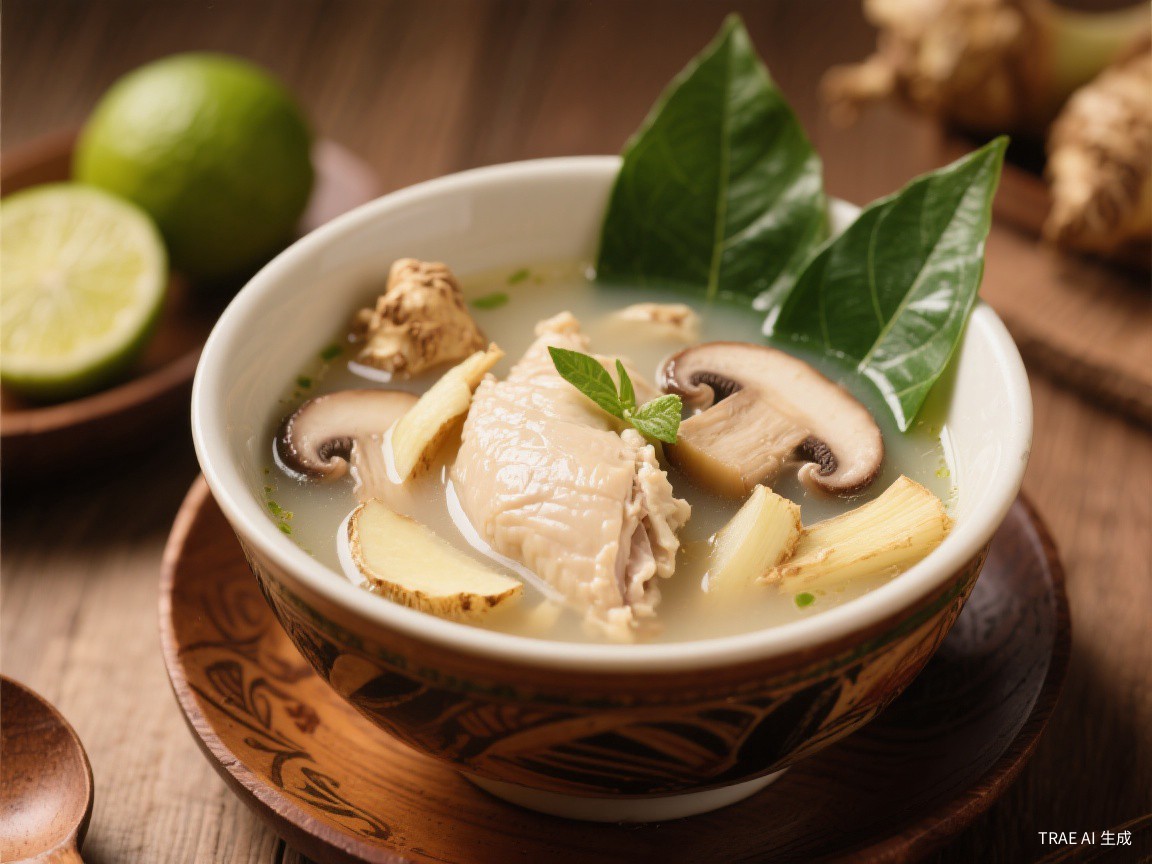
Traditional tom kha gai preparation uses both coconut cream and thinner coconut milk in distinct stages. The cream goes into the pot first, heated until it begins to separate and release its oils—a process called "breaking" the cream. This is when the aromatics go in: bruised lemongrass stalks, galangal slices, and torn kaffir lime leaves. Sautéing these aromatics briefly in the hot coconut cream releases their essential oils in a way that simply simmering them in liquid cannot achieve.
Only after the aromatics have bloomed does the thinner coconut milk and chicken stock get added, followed by the chicken and mushrooms. This layered approach creates a depth of flavor that is the hallmark of properly made tom kha gai. The soup is never boiled vigorously after the coconut milk is added—gentle simmering preserves the coconut's delicate texture and prevents the milk from separating or becoming grainy.
"A bowl of tom kha gai should make you close your eyes. If you can taste each element—the galangal, the lemongrass, the coconut, the lime, the chili—then the cook has done their job. If they blur together into a single muddy flavor, something has gone wrong."
— Chef David Thompson, Nahm Bangkok
Balancing the Four Tastes
Thai cuisine is built on the principle of balancing four fundamental tastes: sweet, sour, salty, and spicy. Tom kha gai is perhaps the purest expression of this philosophy in soup form. The coconut milk provides sweetness and richness. Lime juice adds sourness. Fish sauce contributes saltiness and umami. And bird's eye chilies bring the heat. Getting these four elements into harmony is the art of the dish.
The critical insight is that these tastes should not be equal. In a well-made tom kha gai, the coconut's sweetness and richness form the dominant base, with sourness and heat playing supporting roles that prevent the soup from becoming cloying. The fish sauce should be present but invisible—a quiet foundation of salt and umami that you notice only in its absence. The lime juice should brighten without overwhelming, and the chili should warm gradually, building on the palate with each spoonful rather than hitting you all at once.
Seasoning in Stages
- Start with the broth base: Coconut milk and chicken stock provide the canvas
- Add fish sauce first: Begin with about two tablespoons, adjusting later for salt
- Introduce palm sugar: A small amount—one to two teaspoons—rounds out the coconut's natural sweetness
- Add lime juice off the heat: Squeeze fresh lime into the finished soup just before serving; heat destroys its brightness
- Taste and adjust: The soup should taste slightly sweet at first, then reveal layers of sour, salty, and spicy as you continue eating
The Supporting Cast: Chicken, Mushrooms, and Chilies
Chicken in tom kha gai should be thigh meat, preferably bone-in for maximum flavor. Breast meat becomes dry and stringy in the gentle simmering process, while thigh meat stays juicy and tender. Cut the chicken into bite-sized pieces on the bone—the bones contribute gelatin and depth to the broth as they cook. In Thailand, you will often find the chicken still on the bone, and diners simply eat around it, which is part of the soup's rustic charm.
Mushrooms are the other essential component. Straw mushrooms are traditional and have a firm, slightly crunchy texture that holds up well in the creamy broth. If straw mushrooms are unavailable, oyster mushrooms or shiitake caps make excellent substitutes. Button mushrooms work in a pinch but lack the earthy complexity that makes the best versions sing. Add the mushrooms after the chicken has begun to cook but before the final seasoning, giving them about five minutes to soften and release their flavors into the broth.
Bird's eye chilies, known in Thailand as prik kee noo, provide the heat. These small, potent chilies pack far more punch than their size suggests. For a moderate level of heat, add two to three whole chilies, lightly crushed. For those who prefer it mild, slice the chilies lengthwise and remove the seeds—the heat resides primarily in the white pith and seeds. Always add chilies early in the cooking process so their heat infuses the broth gradually rather than arriving as a sharp, unpleasant surprise at the end.
Chef's Tip
For an authentic finishing touch, stir a handful of torn cilantro leaves and a few slices of raw bird's eye chili into each bowl just before serving. The fresh cilantro adds a bright, herbaceous note that lifts the entire soup, while the raw chili slices provide visual contrast and an extra kick of heat for those who seek it.
Common Mistakes and How to Avoid Them
- Boiling the coconut milk: High heat causes coconut milk to separate and become oily. Simmer gently throughout.
- Using ginger instead of galangal: The flavors are fundamentally different. Find galangal—it is worth the effort.
- Adding lime juice too early: Heat neutralizes lime's brightness. Add it at the very end, off the heat.
- Overcooking the chicken: Chicken thighs need only eight to ten minutes in the simmering broth. Overcooking makes them tough.
- Skipping the kaffir lime leaves: These are not optional. Their distinctive citrus-floral aroma is irreplaceable.
Ready to Master Thai Soups?
Download our guide to essential Thai aromatics with sourcing tips, storage methods, and substitution charts.
Get the Free Guide