I still remember the first time my grandmother placed a plate of freshly made baklava before me. The golden, glistening layers caught the afternoon light streaming through her kitchen window, and the aroma of toasted nuts, warm butter, and honey filled the room like a benediction. One bite—crisp, syrupy, impossibly rich—and I understood why this pastry has survived for centuries, crossing borders and empires without ever losing its power to astonish.
An Imperial Dessert: Ottoman Origins
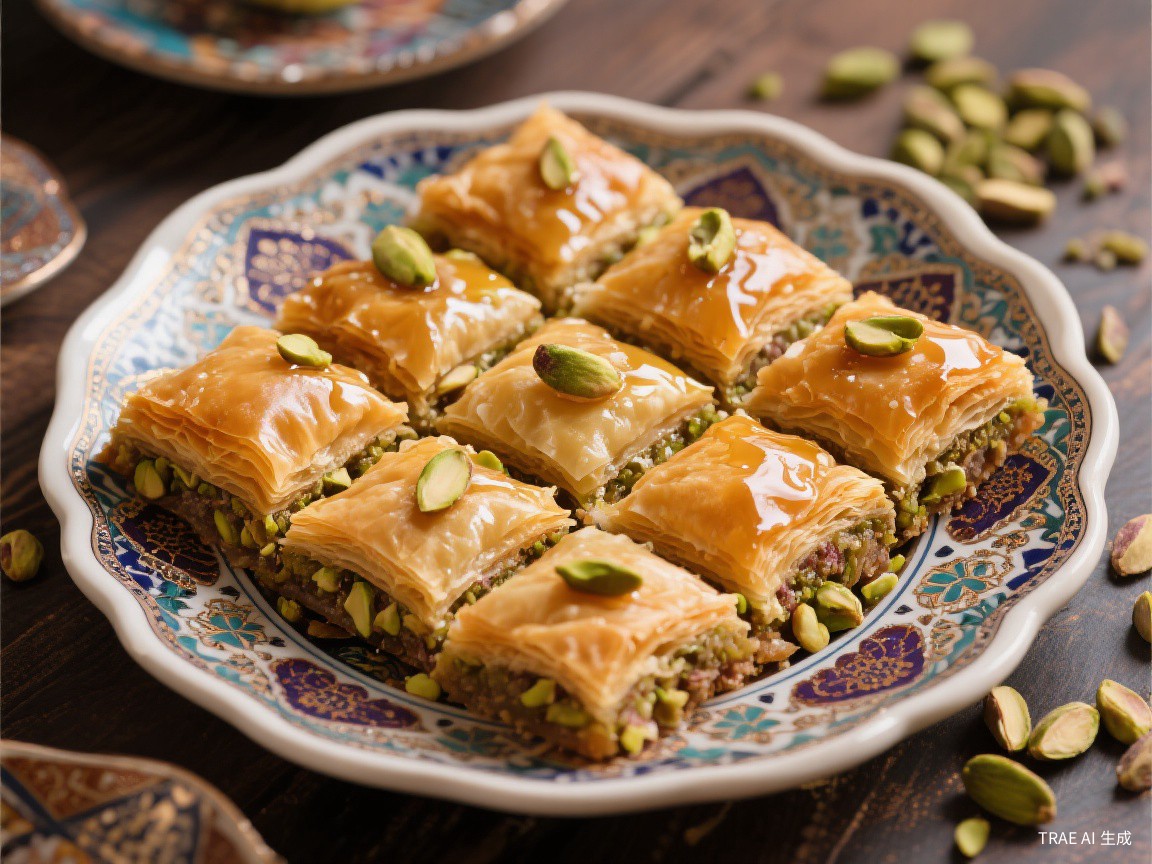
Baklava's history is as layered as the pastry itself. While the exact origins are fiercely contested among Greeks, Turks, and various Middle Eastern cultures, the most widely accepted narrative traces the modern version to the imperial kitchens of the Ottoman Empire in Istanbul, around the fifteenth century. The Topkapi Palace kitchens employed hundreds of cooks whose sole purpose was to perfect dishes for the sultan's table, and baklava was among their most celebrated creations.
The technique of stretching dough impossibly thin, however, predates the Ottomans considerably. The ancient Assyrians are believed to have created early versions of layered bread with nuts, and the Greeks developed a primitive phyllo-like dough as early as the second century BCE. But it was the Ottomans who refined the process into the precise, architectural pastry we recognize today—thin as paper, buttered with meticulous care, layered with ground nuts, and drenched in fragrant syrup.
So central was baklava to Ottoman culture that the sultan traditionally presented trays of it to the Janissaries every fifteenth of Ramadan in a ceremony known as the Baklava Alayi. The soldiers would receive the trays in order of rank, and the size of each portion reflected the recipient's position in the military hierarchy. It was dessert as diplomacy, sweetness as power.
"Baklava is not merely a dessert. It is a document of empire, a record of trade routes written in butter and honey, a testament to the ingenuity of cooks who turned flour, nuts, and syrup into something that approaches the divine."
— Chef Hassan
Phyllo Dough: The Foundation of Everything
Everything in baklava depends on the phyllo—the thin, translucent sheets of dough that create its signature flaky texture. Making phyllo from scratch is an art form that requires years of practice: the dough is stretched over a large table, worked by hand until it is thin enough to read a newspaper through. For home bakers, commercially made phyllo is not only acceptable but often preferable, as factory-produced sheets achieve a uniformity that is extraordinarily difficult to replicate by hand.
The critical challenge with phyllo is moisture management. Phyllo dries out within minutes when exposed to air, becoming brittle and impossible to work with. The moment you open the package, you must cover the unused sheets with a damp (not wet) kitchen towel. Work quickly but calmly—rushing leads to tearing, and tears lead to frustration, and frustration leads to the kind of kitchen meltdown that no amount of honey can fix.
Chef's Tip
Clarified butter, or ghee, is the secret to the crispiest baklava. Regular butter contains water and milk solids that can make phyllo soggy and cause uneven browning. Clarified butter is pure fat, which means it coats each sheet evenly and produces a uniformly golden, shatteringly crisp result. Melt it gently and keep it warm—cold butter seizes when it hits cool phyllo, creating patches of unmelted fat that ruin the texture.
Brushing Technique: Less Is More, But Not Too Less
The buttering of each phyllo sheet is where patience becomes non-negotiable. Use a wide, soft-bristled pastry brush and apply the butter in long, even strokes from edge to edge. Every millimeter of the sheet must be coated—if you miss a spot, that section will remain dry and papery instead of becoming crisp and golden. However, avoid pooling butter, which creates greasy patches and prevents the layers from separating properly during baking.
A common beginner's mistake is using too much butter per sheet, which results in a heavy, oily baklava rather than a light, flaky one. A thin, even film is all you need. Think of it as painting, not flooding. The butter's job is to separate the layers and help them crisp, not to saturate them.
The Nut Question: Pistachio, Walnut, or Both?
The choice of nuts defines the character of your baklava, and this is where regional traditions diverge dramatically. Turkish baklava overwhelmingly favors pistachios—specifically the Antep pistachio from the Gaziantep region, which is smaller, more intensely flavored, and greener than the pistachios commonly found in Western supermarkets. A well-made Turkish baklava is almost emerald green at its center, the pistachios ground to a coarse texture that retains some crunch.
Greek baklava, by contrast, traditionally uses walnuts, often combined with almonds. The nuts are typically chopped more finely than in Turkish versions and are frequently mixed with cinnamon, which adds a warm, aromatic spice note that Turkish bakers generally avoid. Some Greek recipes also include a splash of brandy or rose water in the nut mixture, contributing additional layers of fragrance.
Preparing the Nut Filling
- Pulse, don't pulverize: The nuts should be coarsely ground, not reduced to flour. You want distinct pieces that provide texture and crunch, not a smooth paste
- Mix nuts just before assembling: Ground nuts release their oils quickly, which can make the filling greasy if prepared too far in advance
- Add a pinch of salt: Even in a sweet dessert, salt amplifies the nut flavors and balances the syrup's sweetness
- Consider cardamom: A small amount of ground cardamom—no more than a quarter teaspoon per cup of nuts—adds a floral complexity that pairs beautifully with both pistachios and walnuts
The Syrup: Timing Is Everything
If there is a single step that makes or breaks baklava, it is the application of the syrup. The syrup must be poured over the hot baklava the moment it comes out of the oven. This is not negotiable. The contrast between the hot pastry and the cool syrup is what creates baklava's characteristic texture—the syrup is absorbed into the layers, softening them slightly while the exterior remains crisp. If you pour cold syrup over cooled pastry, it will sit on the surface, creating a soggy, unappetizing mess.
The syrup itself is a simple mixture of sugar, water, honey, and lemon juice, simmered for about fifteen minutes until slightly thickened. The lemon juice is critical—it prevents the sugar from crystallizing and adds a subtle brightness that cuts through the sweetness. Some recipes include a cinnamon stick, a few cloves, or a strip of orange peel during simmering, which infuses the syrup with gentle spice notes.
Honey vs. Sugar Syrup
Traditional Turkish baklava uses a sugar syrup with a small amount of honey, while Greek versions often lean more heavily on honey for a more pronounced floral sweetness. Raw, unfiltered honey delivers the most complex flavor, but it can be overpowering if used exclusively. A blend of two-thirds sugar syrup to one-third honey strikes a balance that allows the nut flavors to come through while still providing the characteristic floral sweetness that makes baklava irresistible.
Regional Variations Worth Exploring
While the classic rectangular or diamond-cut baklava is the most widely known, the pastry world offers extraordinary regional variations. In Lebanon, a rolled version called baklava asabi features phyllo rolled around a pistachio filling, cut into finger-length pieces, and baked standing upright. The result is a baklava with more defined layers and a higher ratio of crisp exterior to soft interior.
In Armenia, paklava is made with a thicker dough, sometimes including a semolina-based layer, and the nut filling typically features walnuts flavored with cinnamon and cloves. The Syrian city of Aleppo is famous for its baklava stuffed with cream (ashta) alongside the traditional nut versions, creating a dessert that is simultaneously crisp and creamy.
- Turkish Güllü Baklava: Shaped into small rolls resembling roses, filled with pistachios, and served with clotted cream
- Greek Saragli: Rolled phyllo logs sliced into rounds, typically made with walnuts and cinnamon
- Lebanese Boukaj: Triangular phyllo parcels filled with pistachios and drizzled with attar syrup
- Iranian Baghlava: Made with a cardamom-scented almond and pistachio filling, often cut into small diamond shapes and decorated with crushed saffron
The Waiting Game
Perhaps the hardest part of making baklava is the waiting. Once the syrup has been poured over the hot pastry, the baklava must sit at room temperature for at least six to eight hours—ideally overnight—so the syrup can be fully absorbed and the flavors can meld. Cutting into it too early is a common mistake that results in a soggy, improperly set dessert.
This waiting period is not passive time. Something extraordinary happens during those hours: the butter solidifies between the layers, locking in crispness, while the syrup penetrates gradually, creating that miraculous contrast between the shatteringly crisp exterior and the tender, syrup-soaked interior. It is a transformation that cannot be rushed, and it is the reason that baklava made a day ahead always tastes better than baklava eaten the same day.
Ready to Master Baklava?
Download our complete guide with step-by-step phyllo handling photos, regional variation recipes, and syrup timing charts.
Get the Free Guide