In the rolling hills of Piedmont, where truffles hide beneath oak trees and Barolo ages in cool cellars, a dessert of extraordinary simplicity was born. Panna cotta—literally "cooked cream"—is Italy's quiet masterpiece, a dish that proves beyond doubt that the most luxurious textures require the fewest ingredients and the most precise technique.
Roots in the Piedmont Countryside
The story of panna cotta begins not in a grand kitchen, but in the dairy farms scattered across the Langhe region of Piedmont, in northwestern Italy. Local farmers, surrounded by an abundance of fresh cream and milk, needed ways to preserve and enjoy their surplus. The earliest versions were thickened by boiling cream with fish bones—a technique borrowed from the ancient Romans, who used isinglass (a form of gelatin derived from fish bladders) to set their custards.
The modern panna cotta we know today emerged in the early twentieth century, when gelatin sheets became commercially available and replaced the more laborious fish-bone method. The first written recipe appeared in the 1960s, credited to a Turin chef named Ettore Daniele, though the dish had been served in homes and trattorias across Piedmont for decades before that. What made it revolutionary was its sheer simplicity: no eggs, no stovetop custard anxiety, no risk of curdling. Just cream, sugar, and gelatin, united in a wobble that would make the world swoon.
"Panna cotta is the most honest dessert in the Italian repertoire. It doesn't pretend to be anything other than what it is—pure, sweet cream, set to a trembling perfection that asks nothing of you but a spoon."
— Chef Marco
The Gelatin Question: Sheets vs. Powder
If there is a single debate that divides panna cotta enthusiasts, it is the question of gelatin form. Powdered gelatin is widely available, easy to measure, and familiar to most home bakers. Gelatin sheets—also called gelatine leaves—are the choice of professional pastry chefs, and for good reason.
Gelatin sheets produce a cleaner, more delicate set with a smoother mouthfeel. Because they are pre-measured in uniform sheets (typically 2 grams each), they offer more consistent results. They also bloom more evenly, absorbing cold water without clumping, which eliminates the gritty texture that powdered gelatin can sometimes produce if not dissolved properly. The most commonly used grade is platinum, which has the highest bloom strength, meaning you need fewer sheets to achieve the same set.
Chef's Tip
Always bloom gelatin in cold water—never warm. Submerge the sheets in a bowl of ice-cold water for five to seven minutes until they become soft and pliable, like damp silk. Squeeze out excess water gently before adding to warm cream. If the cream is too hot when you add the gelatin, it can weaken the setting power. Aim for a cream temperature of around 60°C (140°F)—warm enough to dissolve the gelatin, cool enough to preserve its strength.
Converting Between Forms
If you only have powdered gelatin on hand, don't worry. The conversion is straightforward: one standard gelatin sheet (2 grams) equals roughly half a teaspoon of powdered gelatin. However, powdered gelatin needs to be bloomed in a small amount of cold water for about five minutes before being gently heated until dissolved. Never boil it, as high heat degrades the protein chains that create the gel structure.
The Cream-to-Milk Ratio: Finding Your Texture
The ratio of cream to milk is where panna cotta becomes deeply personal. A classic Piedmontese panna cotta uses heavy cream exclusively—no milk at all—which produces an extraordinarily rich, velvety texture that coats the palate like liquid satin. This is the version I grew up eating at my nonna's table, served in shallow ceramic bowls with nothing more than a drizzle of wildflower honey.
However, many contemporary recipes split the dairy, using roughly two parts heavy cream to one part whole milk. This lighter version still delivers a luxurious mouthfeel but is less cloying, allowing the vanilla or other flavorings to shine through more clearly. For a dairy-free alternative, full-fat coconut cream can substitute for heavy cream, though the flavor profile shifts dramatically toward the tropical.
- Classic Piedmontese: 100% heavy cream — richest, most indulgent texture
- Modern balanced: 2 parts cream to 1 part whole milk — lighter but still luxurious
- Light contemporary: 1 part cream to 1 part milk — delicate and refreshing
- Dairy-free: Full-fat coconut cream — tropical twist with natural sweetness
The Art of the Set: Not Too Firm, Not Too Loose
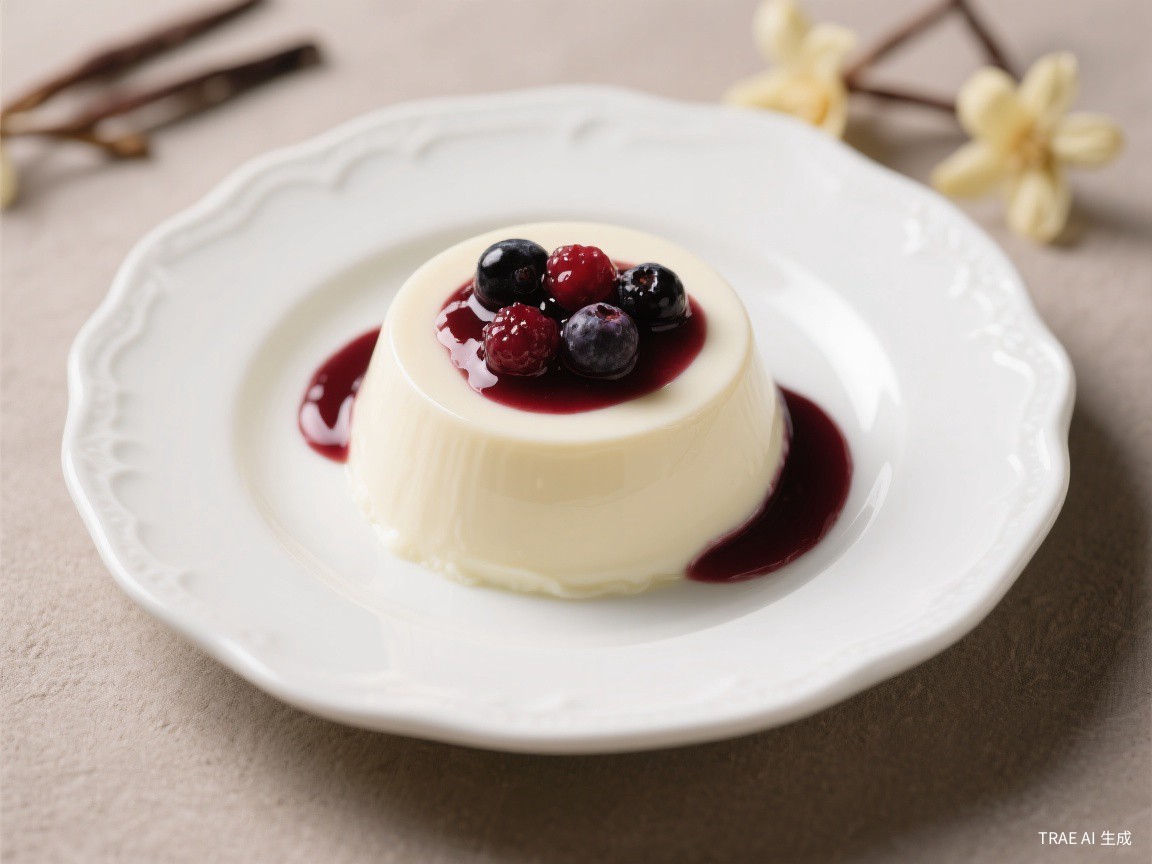
The most common mistake in panna cotta is using too much gelatin. A properly made panna cotta should barely hold its shape—it should tremble when the plate is nudged, and collapse into a silky puddle the moment your spoon touches it. If your panna cotta stands rigid and bounces like rubber, you've used too much gelatin. If it pours like liquid when unmolded, you haven't used enough.
The golden rule is approximately 2 to 2.5 grams of gelatin per 100 milliliters of liquid for a soft, spoonable set. For a panna cotta that you plan to unmold onto a plate, use the higher end of that range—around 2.5 grams per 100 milliliters. If you're serving it directly in a glass or ramekin, you can use slightly less, since structural integrity matters less when the dessert isn't being inverted.
Temperature and Timing
Panna cotta needs a minimum of four hours in the refrigerator to set properly, though overnight is ideal. The gelatin network forms gradually as the cream cools, and rushing this process by placing it in the freezer will result in an uneven, grainy texture. Patience is not just a virtue here—it is a structural requirement.
Before serving, let the panna cotta sit at room temperature for about ten minutes. Cold mutes flavor, and a slightly tempered panna cotta will reveal nuances in the vanilla and cream that are completely lost when served ice-cold straight from the refrigerator.
Berry Compote: The Classic Pairing
A great panna cotta deserves a great companion, and the most beloved pairing is a simple berry compote. The tartness of berries cuts through the richness of the cream, creating a balance that elevates both components. In Piedmont, wild strawberries and raspberries are the traditional choices, but any combination of seasonal berries works beautifully.
The compote itself should be straightforward: fresh or frozen berries, a modest amount of sugar, a squeeze of lemon juice, and perhaps a sprig of fresh thyme or a strip of lemon zest for aromatic complexity. Cook the berries just until they release their juices and the sugar dissolves—no more than five to seven minutes. Overcooking destroys the fresh berry character and turns the compote into jam, which is too heavy and sweet for panna cotta's delicate texture.
Beyond Berries: Alternative Pairings
- Espresso caramel: A thin layer of bitter-sweet caramel infused with espresso, spooned over the top, creates a sophisticated affogato-inspired dessert
- Mango and passion fruit: Tropical fruits bring acidity and brightness that contrast beautifully with the cream
- Balsamic vinegar and strawberries: A drizzle of aged balsamic over fresh strawberries is a Piedmont tradition that sounds unusual but tastes extraordinary
- Pistachio and rose: Ground pistachios and a few drops of rose water give the panna cotta a distinctly Middle Eastern elegance
Flavoring the Cream
Vanilla is the default flavoring for panna cotta, and it deserves to be treated with respect. A real vanilla bean, split and scraped, infuses the cream with hundreds of aromatic compounds that pure vanilla extract simply cannot replicate. Drop the pod into the cream as it heats, and leave it there during steeping. The seeds will speckle the finished panna cotta with those beautiful black flecks that signal quality.
If you want to venture beyond vanilla, the possibilities are endless. A strip of orange or lemon zest adds brightness without overwhelming. A cinnamon stick or a cardamom pod introduces warm spice notes. Infusing the cream with fresh mint leaves creates a refreshing summer dessert. Even a tablespoon of instant espresso dissolved in the warm cream produces a mocha panna cotta that coffee lovers find irresistible.
Ready to Master Panna Cotta?
Download our complete guide with step-by-step photos, gelatin conversion charts, and seasonal compote recipes.
Get the Free Guide