On my first visit to Bangkok's Or Tor Kor market as a young culinary student, I watched a street vendor ladle a creamy, pale-golden soup into a battered aluminum bowl. The steam carried an aroma I couldn't decode—coconut, certainly, but beneath it lay something sharp, piney, and deeply floral that I had never encountered in any Western kitchen. That something was galangal, and that soup was tom kha, a dish that would forever change the way I understood what soup could be.
Understanding Tom Kha: More Than Just Coconut Soup
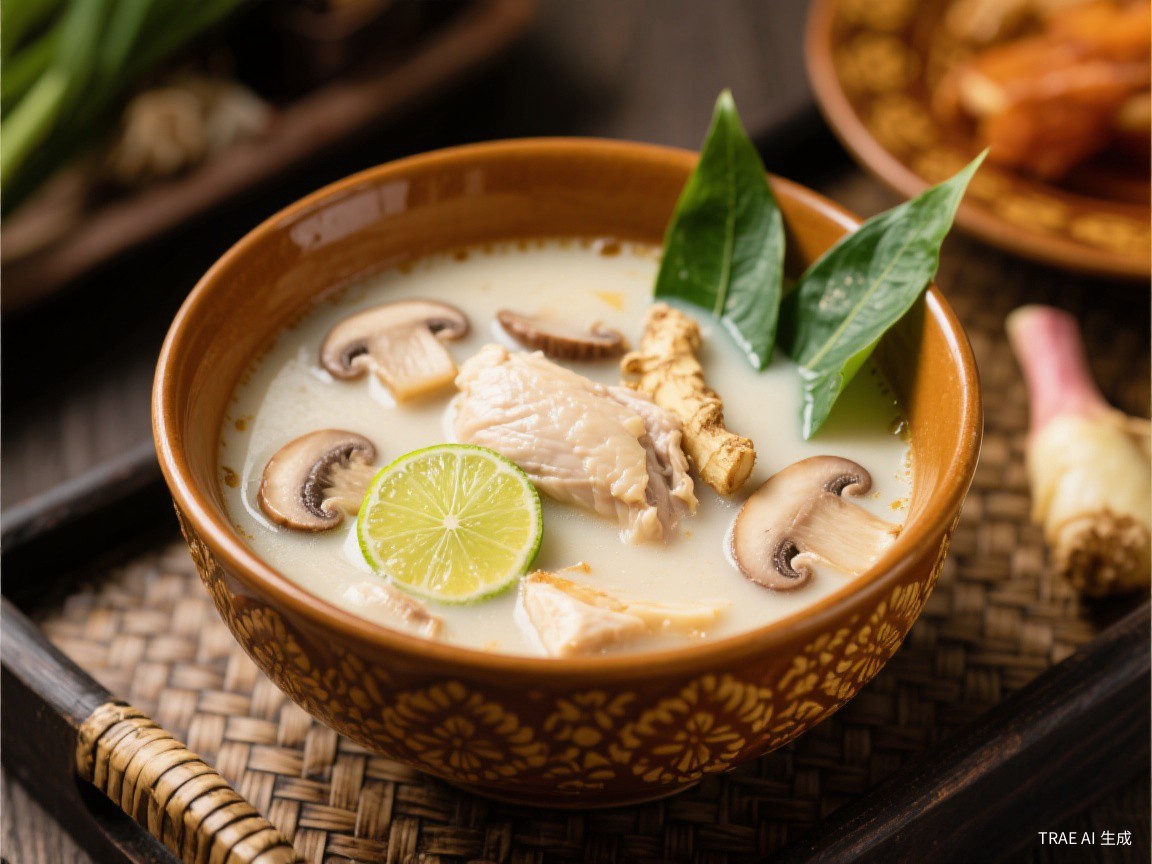
Tom kha is often described simply as "Thai coconut soup," but this reductive label fails to capture its complexity. The name itself reveals its essence: "tom" means boiled, and "kha" refers to galangal, the aromatic rhizome that gives the soup its distinctive character. Unlike its fiery cousin tom yum, which is built on a clear, chili-spiked broth, tom kha derives its body and richness from coconut milk, creating a soup that is simultaneously warming and cooling, rich and bright.
What distinguishes tom kha from virtually every other soup in the global culinary repertoire is its refusal to choose between comfort and complexity. It is creamy without being heavy, aromatic without being perfumed, spicy without being punishing. It achieves this through a philosophy of flavor that is central to Thai cooking: the delicate balance of four fundamental tastes—hot, sour, salty, and sweet—each present in careful measure, none dominating the others.
"A bowl of tom kha is a conversation between opposites. The coconut soothes while the chili ignites. The lime sharpens while the palm sugar softens. Galangal anchors everything with an earthiness that is neither ginger nor pepper but something entirely its own."
— Chef Niran
Galangal: The Soul of the Soup
Galangal is the ingredient that separates tom kha from every other coconut soup in the world, and understanding it is essential to making the dish authentically. Often confused with ginger—its botanical cousin—galangal has a distinctly different flavor profile. Where ginger is sharp, peppery, and slightly sweet, galangal is piney, citrusy, and almost medicinal, with an aromatic intensity that persists even through long cooking. It is the backbone of the soup's fragrance, and no substitution will truly replicate it.
There are two main varieties: greater galangal (Alpinia galanga), which is the one used in tom kha, and lesser galangal (Alpinia officinarum), which is smaller, darker, and more pungent. Greater galangal has a smooth, pale skin with pinkish nodules and a firm, almost woody interior. When sliced, it releases a camphor-like aroma that immediately signals authenticity.
Chef's Tip
Never mince or grate galangal for tom kha. The traditional technique is to slice it into thin, coin-shaped rounds and bruise them lightly with the flat side of a knife. This releases the aromatic oils while keeping the pieces large enough to be easily removed before serving—galangal is woody and unpleasant to bite into. Think of it as a flavoring agent, like a bay leaf, not an ingredient to be eaten. If you cannot find fresh galangal, frozen slices are a reasonable alternative, though the flavor will be somewhat diminished. Dried galangal should be considered a last resort.
Sourcing Galangal Outside Thailand
Finding fresh galangal can be challenging depending on where you live. In cities with large Southeast Asian communities, it is typically available at Thai, Vietnamese, or Chinese grocery stores, often sold alongside lemongrass and kaffir lime leaves. If your local Asian market doesn't carry it, check online specialty produce suppliers—many ship fresh galangal overnight. When selecting fresh galangal, look for firm, heavy roots with smooth skin and no soft spots or mold. It keeps well in the refrigerator for two to three weeks when wrapped loosely in a paper towel and placed in a plastic bag.
The Aromatics: Lemongrass, Kaffir Lime, and Chili
Galangal does not work alone. It is part of a triumvirate of aromatics that form the soup's aromatic foundation, each contributing a distinct layer of fragrance. Lemongrass provides a bright, lemony top note that lifts the richness of the coconut. Kaffir lime leaves add an incomparable citrus perfume that is more complex than standard lime—earthy, floral, and slightly astringent. Bird's eye chilies (prik kee noo) deliver heat that blooms at the back of the palate rather than scorching the tongue.
The preparation of these aromatics matters enormously. Lemongrass should be trimmed of its dry outer layers, cut into two-inch segments, and bruised with a pestle or the back of a knife to release its essential oils. Kaffir lime leaves should be torn—never cut with a knife, which crushes the cells unevenly and releases bitter compounds. Tear the central vein out and discard it, then tear the leaf into halves. These aromatics are also not meant to be eaten; they infuse the broth and should be fished out before serving, or at least pushed to the side of the bowl.
Coconut Cream vs. Coconut Milk: Knowing the Difference
One of the most important distinctions in Thai cooking—and one that is frequently misunderstood outside of Thailand—is the difference between coconut cream (hua kathi) and coconut milk (kathi). Coconut cream is the thick, rich layer that rises to the top of a can of full-fat coconut milk when it has not been shaken. It contains a higher proportion of coconut oil and solids, making it ideal for frying aromatics and creating the luxurious mouthfeel that defines tom kha.
The traditional technique is to open a can of full-fat coconut milk without shaking it, carefully scoop off the thick cream from the top, and use it to bloom the aromatics over medium heat. As the cream heats, it separates slightly, and the aromatics sizzle gently in the coconut oil that renders out. Only after the aromatics have released their fragrance do you add the thinner coconut milk to create the soup's body. This two-stage process produces a depth of flavor that simply dumping the entire can into the pot cannot achieve.
- Coconut cream (first press): Thick, rich, high in fat — used for frying aromatics and building the soup's base
- Coconut milk (second press): Thinner, more liquid — added after aromatics to create the soup's volume
- Full-fat is non-negotiable: Light or reduced-fat coconut milk produces a watery, insipid soup that lacks the velvety texture tom kha demands
- Brands matter: Look for coconut milk with only two ingredients—coconut extract and water. Avoid brands with emulsifiers, thickeners, or preservatives
The Balancing Act: Hot, Sour, Salty, Sweet
Thai cuisine's defining principle is the balance of four tastes, and tom kha is perhaps the purest expression of this philosophy in soup form. The heat comes from the bird's eye chilies. The sourness from lime juice and, in some versions, a splash of tamarind paste. The saltiness from fish sauce (nam pla), which also contributes umami depth. The sweetness from palm sugar, which rounds out the sharp edges and harmonizes the other flavors.
The critical rule is this: add the sour and sweet elements only at the very end, after the soup has finished cooking. Lime juice loses its brightness if simmered, turning flat and bitter. Palm sugar needs only seconds to dissolve in the hot broth. Taste the soup after each addition, adjusting incrementally. The goal is a broth where no single flavor dominates—where you can identify each element, but none shouts over the others. My mother taught me to taste tom kha seven times before serving, adjusting after each taste, until the broth achieves what she called "the smile"—that moment when all four flavors lock into place and the soup seems to glow from within.
Fish Sauce: The Umami Foundation
Fish sauce is as essential to tom kha as salt is to French cooking. It provides not just saltiness but a deep, fermented umami that gives the soup its savory backbone. The best fish sauces are made from just two ingredients—anchovies and sea salt—fermented for months in wooden barrels. Look for a clear, amber-colored liquid with a clean, pungent aroma. Avoid fish sauces that are dark brown or syrupy, as these may contain added sugar or caramel coloring.
Protein: Shrimp, Chicken, or Tofu
The most traditional version of tom kha is tom kha gai, made with chicken. Bone-in chicken pieces—typically thigh and drumstick—are preferred because the bones contribute body and richness to the broth. The chicken is simmered gently in the coconut broth until just cooked through, then removed, shredded, and returned to the pot. This prevents overcooking and ensures tender, juicy meat.
Tom kha goong, made with shrimp, is equally beloved. The shrimp should be added in the last two to three minutes of cooking—any longer, and they turn rubbery. Large shrimp in the shell are traditional, as the shells contribute additional flavor to the broth. For a vegetarian version, firm tofu and mushrooms create a deeply satisfying soup, with the mushrooms providing much of the umami that the fish sauce would normally supply.
- Tom kha gai (chicken): The most common version; use bone-in thigh pieces for maximum flavor
- Tom kha goong (shrimp): Add shrimp in the final minutes; leave shells on for richer broth
- Tom kha het (mushroom): A vegetarian option using straw mushrooms, oyster mushrooms, or a combination
- Tom kha tofu: Firm tofu paired with mixed mushrooms and soy sauce in place of fish sauce
Mushrooms: The Unsung Heroes
Mushrooms appear in virtually every version of tom kha, and they play a more important role than most Western cooks realize. In Thailand, straw mushrooms (het fang) are the default choice—their small, firm caps have a delicate, slightly sweet flavor that absorbs the coconut broth beautifully. Oyster mushrooms (het nang fa) are also popular, their velvety texture complementing the soup's creaminess. Shiitake mushrooms can be used but should be added sparingly, as their strong flavor can overwhelm the more delicate aromatics.
The mushrooms should be added early in the cooking process, giving them time to release their juices into the broth. This mushroom essence adds another layer of umami that rounds out the soup and makes it feel more substantial than its simple ingredient list suggests.
Ready to Master Tom Kha?
Download our complete guide with ingredient sourcing tips, flavor balance charts, and step-by-step photos for authentic tom kha at home.
Get the Free Guide