The first time I tasted curry laksa, I was seven years old, sitting on a plastic stool at a hawker stall in Penang. The stall was nothing more than a cart with a gas burner and a massive wok, tended by a woman my grandmother called Mak Cik Kiah. She ladled a thick, orange-red broth over a tangle of noodles and pushed the bowl toward me without ceremony. I remember the steam hitting my face, the overwhelming aroma of coconut and chili and something else—something fermented and funky and completely unfamiliar. I took a sip, and the world rearranged itself. That single bowl contained more flavors than I had experienced in my entire young life, and I have been chasing it ever since.
The Peranakan Story: Where Laksa Was Born
To understand curry laksa, you must first understand the Peranakan people—also known as the Baba-Nyonya—a community of Chinese immigrants who settled in the Malay Peninsula and Indonesian archipelago beginning in the fifteenth century. These early settlers married local Malay women, and from this union of cultures emerged a unique culinary tradition that is neither wholly Chinese nor wholly Malay but something entirely its own. Peranakan cooking is one of the world's great fusion cuisines, and laksa is its most famous creation.
The word "laksa" itself is debated among food historians. Some trace it to the Sanskrit word "laksha," meaning "many" or "a hundred thousand," referring to the countless ingredients and complex layering of flavors. Others connect it to the Persian word "lakhsha," meaning "slippery," describing the noodles. Whatever its etymological roots, laksa has evolved into a dish with dozens of regional variations across Malaysia, Singapore, Indonesia, and southern Thailand—each one a reflection of local ingredients, trade routes, and cultural history.
"Laksa is not a recipe. It is a conversation between cultures—Chinese soy, Malay coconut, Indian spices—carried on for five hundred years across the Straits of Malacca. Every bowl is a history lesson."
— Chef Ahmad
Asam Laksa vs. Curry Laksa: Two Brothers, Different Paths
Before diving into the curry laksa recipe, it is important to distinguish it from its better-known sibling, asam laksa. While both fall under the laksa umbrella, they are fundamentally different dishes with different flavor profiles, different ingredients, and different cultural associations.
Asam laksa, the pride of Penang, is a tangy, sour, fish-based soup. Its broth is built on mackerel (ikan kembung) that is boiled, flaked, and returned to the pot with a paste of shallots, galangal, lemongrass, turmeric, and the defining ingredient: asam gelugur, a sour fruit that gives the soup its distinctive tartness. The broth is thin and intense, almost like a Thai tom yum, and it is served with thick rice noodles, shredded fish, pineapple, cucumber, onion, mint, and a thick dollop of fermented shrimp paste (hae ko) on the side.
Curry laksa, also known as laksa lemak, is its richer, creamier counterpart. Where asam laksa is sharp and acidic, curry laksa is warm and enveloping. The broth is built on coconut milk and a spice paste called rempah, creating a sauce that is thick, fragrant, and deeply satisfying. Curry laksa is the version most commonly found in Kuala Lumpur, Singapore, and the southern Malaysian states, and it is the version we will explore here.
Rempah: The Soul of the Soup
In Malay and Indonesian cooking, rempah is the term for a freshly ground spice paste, and it is the foundation upon which virtually every dish is built. For curry laksa, the rempah is a complex, aromatic paste that combines ingredients from multiple culinary traditions: dried chilies from the Malay pantry, galangal and lemongrass from Southeast Asian forests, coriander and cumin seeds from Indian trade routes, and shrimp paste (belacan) from the coastal fishing communities.
Making rempah from scratch is non-negotiable if you want authentic curry laksa. Store-bought curry pastes, while convenient, cannot replicate the freshness and complexity of a paste made minutes before cooking. The ingredients should be ground to a smooth paste using a traditional stone mortar and pestle (batu lesung), though a food processor is an acceptable modern substitute. The key is grinding each ingredient thoroughly before adding the next, building layers of flavor within the paste itself.
Chef's Tip
Toasting whole spices before grinding them is the single most impactful step in rempah preparation. Dry-toast coriander seeds, cumin seeds, and fennel seeds in a hot skillet for sixty to ninety seconds, shaking constantly, until fragrant and slightly darkened. This simple act awakens volatile oils and deepens their flavor exponentially. Never skip it.
The Rempah Ingredient List
- Dried red chilies (15-20): Soaked in hot water for twenty minutes until softened. Use a mix of mild and hot varieties to control heat level
- Shallots (6-8): Peeled and roughly chopped. Shallots provide sweetness and body that regular onions cannot match
- Galangal (2-inch piece): Not interchangeable with ginger. Galangal has a piney, camphor-like flavor that is essential to the laksa profile
- Lemongrass (3 stalks): Use only the tender white and light green parts. Slice thinly to ensure smooth grinding
- Turmeric (1-inch piece, fresh): Gives the broth its characteristic golden-orange color and an earthy, warm flavor
- Garlic (6 cloves): Provides a pungent backbone that mellows during cooking
- Shrimp paste (belacan, 1 tablespoon): The controversial ingredient. Toast it in a dry pan or wrap it in foil and grill it before adding to the paste—raw belacan is overpoweringly pungent
- Coriander seeds, cumin seeds, fennel seeds: Toasted and ground, these provide warmth and depth
Building the Broth
Once your rempah is prepared, building the broth is a process of layering flavors in a specific sequence. First, heat a generous amount of oil in a large pot or wok over medium heat. Fry the rempah paste for eight to ten minutes, stirring constantly, until the paste darkens slightly and the oil begins to separate from the solids—a crucial visual cue that the paste is properly cooked and its flavors have fully developed. This step, called "splitting the paste" (pecah minyak), is the most important moment in the entire recipe.
Next, add chicken stock or water and bring to a simmer. Then pour in the coconut milk—use thick, full-fat coconut milk (santan pekat), never the lite variety. The coconut milk transforms the spiced broth into a rich, creamy sauce that coats the noodles and carries the aromatics to your palate. Simmer gently for fifteen to twenty minutes, skimming any impurities that rise to the surface. Season with fish sauce, sugar, and a pinch of salt. The broth should be spicy, slightly sweet, deeply savory, and fragrant enough to fill the entire kitchen.
Noodles, Toppings, and the Art of Assembly
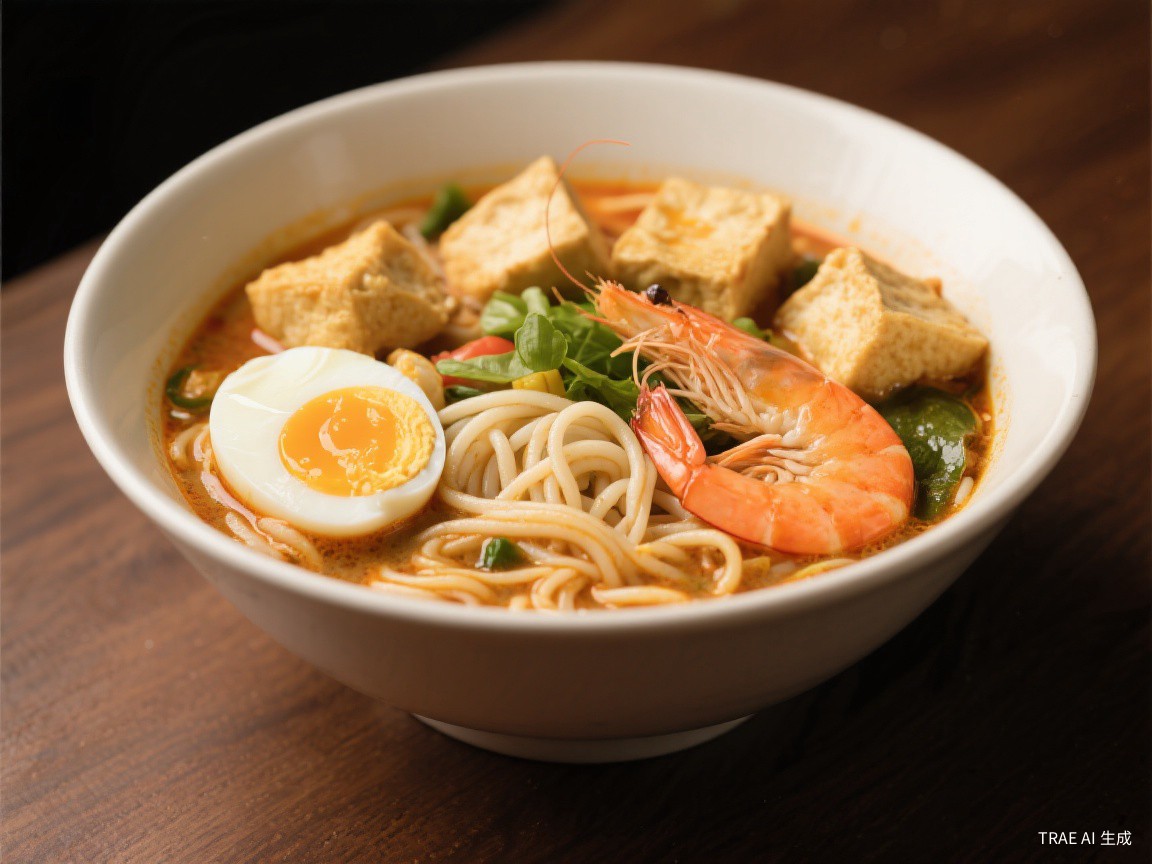
Curry laksa is defined by its abundance of toppings, and assembling a proper bowl is an exercise in generosity. The noodles come first: thick, round rice noodles called laksa noodles or mee, though yellow wheat noodles (mee kuning) or thin rice vermicelli (bee hoon) are also common. Many hawker stalls offer a choice, and some diners request a mix of both—a combination called "mee siam" in some regions.
The toppings are where curry laksa becomes a meal rather than just a soup. A proper bowl includes:
- Shrimp (udang): Large, shell-on prawns that are poached in the simmering broth just until pink and curled
- Fish cake (keropok lekor or fish balls): Sliced fish cake adds a bouncy, chewy texture that contrasts with the soft noodles
- Tofu puffs (tauhu goreng): Deep-fried tofu cubes that act like sponges, soaking up the coconut broth and bursting with flavor when bitten
- Chicken (ayam): Shredded poached chicken thigh, optional but traditional in many regions
- Bean sprouts (taugeh): Raw, for crunch, added at the last moment so they retain their snap
- Hard-boiled egg: Halved, placed prominently on top
- Chili sambal: A spoonful of fresh sambal oelek on the side for those who want additional heat
- Lime: A squeeze of lime juice brightens the entire bowl and cuts through the coconut richness
The Tofu Puff Secret
Tofu puffs are arguably the most underrated component of curry laksa. These golden cubes of deep-fried tofu have an incredibly porous, spongy interior that absorbs the coconut broth like a sponge. When you bite into a tofu puff that has been sitting in hot laksa broth, it releases a burst of spiced coconut liquid that is arguably the most satisfying single bite in the entire bowl. Buy the freshest tofu puffs you can find—they should be light, airy, and golden, without any dark or greasy spots. If they seem dense or flat, they are stale and will not absorb the broth properly.
Laksa at Home: Practical Advice
While the list of ingredients may seem daunting, curry laksa is actually a very forgiving dish once you understand its structure. The rempah can be made ahead—up to three days in the refrigerator or three months in the freezer—so you can break the work into manageable sessions. The broth improves with time, so making it a day ahead actually produces better results. And many of the toppings (shrimp, tofu puffs, hard-boiled eggs) can be prepared in advance.
The one element that must be fresh is the garnish. A handful of Vietnamese mint (daun kesum), a sprig of cilantro, and a squeeze of lime added just before serving elevate the entire bowl from good to extraordinary. These fresh elements provide the brightness and herbaceous lift that prevent the rich coconut broth from becoming cloying. Without them, the soup is heavy and one-dimensional. With them, it is alive.
Chef's Tip
When reheating leftover laksa broth, never let it reach a full boil—gentle simmering preserves the coconut milk's texture and prevents it from separating or becoming oily. If the broth has thickened in the refrigerator, add a splash of chicken stock or water to restore its original consistency.
A Bowl That Tells a Story
Every bowl of curry laksa carries within it the history of the Malay Peninsula: Chinese merchants who sailed south with their woks and their noodles, Malay villagers who cultivated coconut palms and chilies, Indian traders who brought coriander and cumin across the Bay of Bengal. It is a dish born of migration, adaptation, and the beautiful human impulse to combine the familiar with the foreign and create something neither could have produced alone.
When I make curry laksa in my restaurant kitchen in Kuala Lumpur, I think of Mak Cik Kiah and her battered cart in Penang. I think of my grandmother, who could identify every ingredient in a bowl of laksa by smell alone. And I think of that seven-year-old boy on a plastic stool, tasting the world for the first time in a single, extraordinary spoonful. That is the power of curry laksa—it is not just a soup. It is a story, a history, and a home, all served in one bowl.
Ready to Master Curry Laksa?
Download our complete rempah guide with spice sourcing tips and regional variation recipes.
Get the Free Guide