Every Sunday evening in my mother's kitchen in Osaka, the dining table would transform into a small production line. My older sister would roll the filling into balls. My mother would place each ball on a wrapper with surgical precision. And I, the youngest, would attempt to fold them—my clumsy pleats a source of gentle laughter and patient instruction. We would make two hundred gyoza in a single session, freezing most of them for the week ahead. Those Sunday evenings taught me more about Japanese cooking than any culinary school ever could: that repetition builds intuition, that hands remember what the mind forgets, and that food made together tastes better than food made alone.
From Jiaozi to Gyoza: A Culinary Journey
Gyoza did not originate in Japan. The story begins in China, where dumplings known as jiaozi have been eaten for over eighteen hundred years. According to legend, a physician named Zhang Zhongjing created the first jiaozi during the Han Dynasty, filling dough wrappers with lamb, pepper, and herbs to treat frostbitten ears. Whether or not this origin story is historically accurate, jiaozi became a cornerstone of Chinese cuisine, evolving into countless regional varieties across the vast country.
Gyoza arrived in Japan after World War II, brought home by Japanese soldiers who had been stationed in Manchuria and had developed a taste for the local dumplings. The adaptation was swift and significant. Japanese cooks made the wrappers thinner and more delicate, reduced the amount of garlic and ginger compared to Chinese jiaozi, and developed the signature cooking method that creates gyoza's defining characteristic: a lacy, crispy bottom crust that contrasts beautifully with the tender, steamed upper half.
"Gyoza is the perfect example of how Japan takes a foreign idea and refines it into something distinctly and undeniably Japanese. It is not better than jiaozi—it is simply its own thing, shaped by Japanese sensibilities about texture, restraint, and balance."
— Chef Kenji
The Filling: Moisture Is the Enemy
The classic gyoza filling is a mixture of ground pork, cabbage, garlic chives (nira), scallions, ginger, garlic, soy sauce, sesame oil, and a touch of salt and pepper. The proportions matter, but the technique matters more. The single biggest challenge in gyoza-making is controlling moisture in the filling, and it is the primary reason homemade gyoza often turn out soggy or burst during cooking.
Cabbage is the main culprit. Fresh cabbage is roughly eighty percent water, and if you simply chop it and mix it into the pork, your filling will be a wet, soupy mess that leaks through the wrappers and makes the gyoza impossible to seal properly. The solution is to salt the shredded cabbage, let it sit for ten minutes, then squeeze it firmly in a clean kitchen towel or cheesecloth until no more liquid can be extracted. This simple step removes excess water while preserving the cabbage's crunch and sweetness.
Chef's Tip
Do not skip the aromatics, but do not overdo them either. The garlic and ginger should be grated to a fine paste, not minced. Grating releases more volatile oils and distributes the flavor more evenly throughout the filling. Use a microplane or the fine side of a box grater, and press the pulp through to extract the juice while leaving the fibrous bits behind.
Building the Filling Layer by Layer
- Season the pork first: In a bowl, combine ground pork with soy sauce, sesame oil, a pinch of sugar, salt, and white pepper. Mix vigorously in one direction until the meat becomes sticky and cohesive—this develops the myosin proteins and gives the filling a bouncy, cohesive texture
- Add the aromatics: Fold in the grated ginger, garlic, and finely chopped scallions and garlic chives
- Incorporate the cabbage last: Gently fold in the squeezed cabbage just before you are ready to wrap. Do not overmix at this stage, or you will bruise the cabbage and release the very moisture you worked so hard to remove
- Chill the filling: Thirty minutes in the refrigerator firms up the fat and makes the filling easier to portion and wrap
Wrapping: The Art of the Pleat
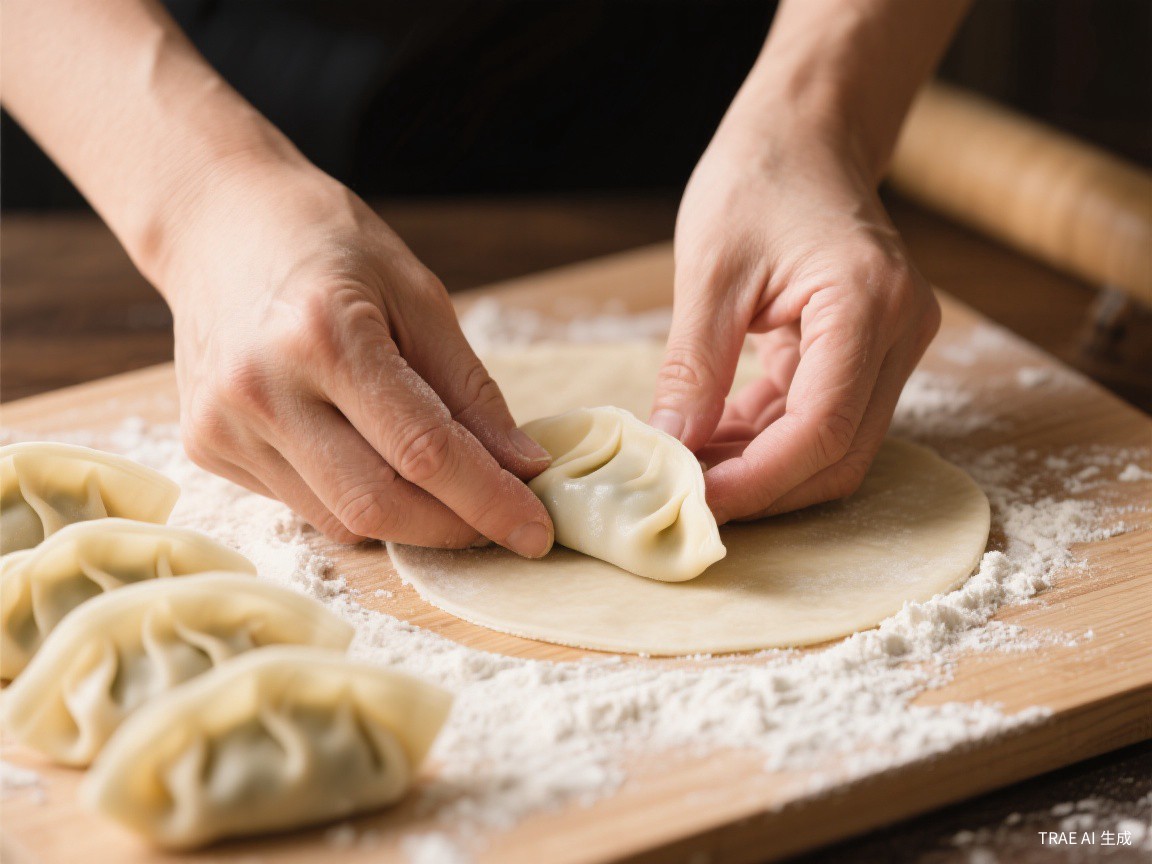
Wrapping gyoza is the step that intimidates most home cooks, and it is the step where practice truly makes perfect. A well-wrapped gyoza should have a flat bottom for even browning, a sealed edge that will not leak during cooking, and a series of small pleats along one side that create a beautiful crescent shape. The pleats are not merely decorative—they create a thicker wall of dough on one side that helps the gyoza stand upright in the pan and provides a textural contrast between the thin, smooth side and the pleated side.
Here is the method my mother taught me, refined over thirty years of Sunday gyoza sessions. Hold a wrapper in your non-dominant hand. Place a heaping teaspoon of filling in the center—about a walnut-sized amount. Dip your finger in water and moisten the outer half of the wrapper's edge. Fold the wrapper in half to create a half-moon shape, pressing the moistened edge to the dry edge to seal the center point. Then, working from one end to the other, create small pleats along the top edge by pinching and folding the dough at regular intervals, pressing each pleat firmly against the flat bottom edge. A typical gyoza has five to seven pleats.
Common Wrapping Mistakes
- Too much filling: Overstuffed gyoza burst during cooking and are impossible to seal. Start with less than you think you need
- Not sealing properly: Press the edges firmly and ensure there are no air pockets trapped inside, which will expand during steaming and rupture the wrapper
- Wet wrappers: Keep unused wrappers covered with a damp towel to prevent drying, but do not let them become soggy
- Inconsistent pleats: Even spacing creates a uniform shape that cooks evenly. Take your time—speed comes with practice
The Three-Stage Cooking Method
This is where gyoza transcends ordinary dumplings. The Japanese cooking method for gyoza employs three distinct stages—pan-fry, steam, and fry again—each contributing a different texture to the finished dumpling. It is a technique that requires attention and timing, but once mastered, it produces results that rival any gyoza shop in Tokyo.
Stage One: Pan-Fry. Heat a tablespoon of neutral oil (vegetable or canola) in a non-stick skillet over medium-high heat until shimmering. Arrange the gyoza flat-side down in a snug, circular pattern—they can touch each other, which actually helps them stand upright. Cook without moving for two to three minutes, until the bottoms are golden brown and crisp. This initial fry creates the foundation crust.
Stage Two: Steam. Pour about a quarter cup of water into the pan—enough to reach about a third of the way up the gyoza—and immediately cover with a tight-fitting lid. The water will hiss and sputter violently; this is normal. Steam the gyoza for three to four minutes, until the wrappers are translucent and the filling is cooked through. The steam cooks the upper half of the dumpling, making it tender and juicy, while the bottom remains crisp from the initial fry.
Stage Three: Fry Again. Remove the lid and let any remaining water evaporate. If the gyoza are stuck together, gently separate them with a spatula. Add a small drizzle of sesame oil to the pan and let it cook for another thirty seconds to a minute. This final fry re-crisps the bottom crust, which may have softened slightly during steaming, and adds a nutty sesame aroma that is quintessentially Japanese.
Chef's Tip
The hardest part of the three-stage method is the flip. To serve gyoza presentation-side up with the crispy bottom facing the diner, slide a large plate over the pan, invert the pan and plate together as a unit, then lift the pan away. The gyoza will land perfectly arranged on the plate, golden bottoms gleaming. Practice this move with an empty pan before attempting it with hot gyoza.
The Dipping Sauce: Simplicity Perfected
A great gyoza deserves a great dipping sauce, and the Japanese approach is characteristically restrained. The classic gyoza dipping sauce contains just three ingredients: soy sauce, rice vinegar, and ra-yu (Japanese chili oil). The standard ratio is two parts soy sauce to one part rice vinegar, with ra-yu added to taste. Some cooks add a drop of sesame oil for richness, and a scattering of thinly sliced scallions for freshness.
The sauce should be mixed fresh for each serving. Rice vinegar loses its brightness when left standing, and the chili oil's heat dissipates over time. In our household, each person mixed their own sauce in a small dish, adjusting the ratios to their preference. My sister liked hers heavy on the vinegar. My father added extra ra-yu until the sauce was a deep, threatening red. My mother kept hers simple—mostly soy, a splash of vinegar, nothing more. There is no wrong answer, only personal taste.
Gyoza Culture in Japan
Gyoza occupies a unique place in Japanese food culture. Unlike sushi or ramen, which carry an air of formality and tradition, gyoza is unabashedly casual. It is street food, bar food, and home cooking. It is the dish you order alongside a cold draft beer at an izakaya after work. It is the midnight snack you make from frozen gyoza bought at the supermarket. It is the dish that Japanese people consistently rank as their favorite comfort food in national surveys, year after year.
The city of Utsunomiya, located about sixty miles north of Tokyo, has declared itself the gyoza capital of Japan. The city consumes more gyoza per capita than anywhere else in the country, and its streets are lined with hundreds of gyoza shops, each with its own signature style. Some specialize in grilled gyoza, others in boiled or deep-fried. The annual Utsunomiya Gyoza Festival draws hundreds of thousands of visitors who sample creative variations ranging from curry gyoza to cheese-filled gyoza to gyoza-flavored ice cream (which, I must confess, is an acquired taste).
But for all the regional variations and modern twists, the best gyoza I have ever eaten remains the ones my mother made on those Sunday evenings in Osaka. They were not the most beautiful—my sister's pleats were always neater than mine. They were not the most innovative—always pork and cabbage, never anything else. But they were made with care, shared with family, and eaten while still too hot, burning the roof of my mouth in the best possible way. That, more than any technique or ingredient, is what makes gyoza special.
Ready to Make Perfect Gyoza?
Download our step-by-step folding guide with photo illustrations for every pleat.
Get the Free Guide