I was twelve years old the first time my abuela let me pipe churros dough into a vat of bubbling oil. The kitchen smelled of toasted flour and warm fat, and the sound—the sizzle, the crackle, the hiss—was like music. When I pulled that first golden loop from the oil and rolled it in sugar, I bit into something that was simultaneously crisp and tender, with a hollow, steamy center that seemed impossible for such a simple tube of dough. That moment shaped my entire career as a pastry chef, and I have spent the last two decades trying to recreate it for others.
Not Just Fried Dough: Understanding Pate a Choux
The biggest misconception about churros is that they are simply fried dough. In truth, Spanish churros are made from a variation of pate a choux—the same cooked dough that gives us cream puffs, eclairs, and profiteroles. This is what separates Spanish churros from their Latin American cousins, which are often made from a simpler yeast-based dough. The choux method creates a dough with a unique dual texture: a shatteringly crisp exterior and a nearly hollow, steam-puffed interior that is almost custardy in its softness.
The science is fascinating. Pate a choux begins by cooking flour in boiling water and fat. As the flour hydrates, its starches gelatinize, forming a thick paste. Eggs are then beaten in one at a time, and here is where the magic happens: the eggs add both moisture and structure. The proteins in the egg whites create a network that traps steam during frying, causing the dough to puff dramatically. Meanwhile, the fat coats the flour particles, preventing excessive gluten formation and ensuring tenderness.
Chef's Tip
Use bread flour instead of all-purpose for churros. The higher protein content (12-14% versus 10-12%) creates a stronger gluten network that holds its shape during piping and produces a crispier exterior after frying. The difference is subtle but noticeable—your churros will have more structural integrity and a more satisfying snap.
The Cooking Process: Precision Matters
Making choux dough for churros follows a specific sequence that must be respected. First, bring water, butter, and a pinch of salt to a rolling boil in a medium saucepan. The traditional Spanish ratio uses more water and less butter than French pate a choux—roughly one cup of water to two tablespoons of butter—because the dough will be fried rather than baked, and excess butter would make the churros greasy.
Once the mixture boils, remove the pan from heat and dump in all the flour at once. Stir vigorously with a wooden spoon until the mixture forms a smooth ball and pulls away from the sides of the pan. Return to low heat for one to two minutes, stirring constantly, to cook out the raw flour taste and evaporate excess moisture. This step, called "drying the panade," is critical. If the dough is too wet, the churros will absorb oil during frying and become heavy. If too dry, they will be dense and crack.
Piping the Perfect Shape
Spanish churros come in two principal forms, each with its own character and purpose. The first is the churro recto—a straight, pencil-thin tube about six inches long, often looped into a figure-eight or a simple circle before frying. These are the classic street churros, meant to be eaten standing up, dusted in sugar, and dunked into thick chocolate. The second is the porra, a thicker, shorter version popular in Madrid and southern Spain, which has a softer, breadier interior and is typically served with a cup of thick hot chocolate for breakfast.
For piping, you need a sturdy piping bag fitted with a large open-star tip. The star tip is not decorative—it is functional. The ridges it creates dramatically increase the surface area of the churro, which means more crispy, golden crust per bite. A plain round tip would produce a smooth tube that fries evenly but lacks the textural contrast that makes churros so addictive.
"A perfect churro should sound like a whisper when you bite into it—crisp, light, almost fragile. If it crunches loudly, it is overcooked. If it bends without resistance, it is undercooked. The perfect churro exists in that fleeting moment between the two."
— Chef Sofia
Piping Technique
- Fill the bag halfway: Overfilling makes the bag difficult to control and generates heat from your hands that softens the dough
- Pipe directly over the oil: Use scissors or a knife to cut the dough at the desired length, dropping it straight into the hot oil
- Maintain even pressure: Inconsistent pressure creates churros with thin and thick sections that fry unevenly
- Practice on parchment first: If you are new to piping, practice on a sheet of parchment paper to develop muscle memory before moving to the hot oil
The Fry: Temperature Is Everything
Frying churros is a delicate balancing act that hinges entirely on oil temperature. The ideal range is 375 to 385 degrees Fahrenheit (190 to 196 degrees Celsius). Too low, and the churros will absorb oil like sponges, emerging greasy and limp. Too high, and the exterior will burn before the interior has time to cook through, leaving you with a dark shell around a raw, doughy center.
Use a deep-fry thermometer and monitor it religiously. Every time you add cold dough to the oil, the temperature drops. If you are frying in batches, allow the oil to recover to the target temperature between each batch. A heavy-bottomed cast-iron Dutch oven is ideal because it retains heat well and minimizes temperature fluctuations.
Fry the churros for two to three minutes per batch, turning them once with tongs or a spider skimmer halfway through. They should be a deep golden brown—think the color of honeycomb—with no pale spots. Drain them on a wire rack set over a sheet pan, not on paper towels, which can create steam and make the bottoms soggy.
The Sugar Coating: Timing Is Critical
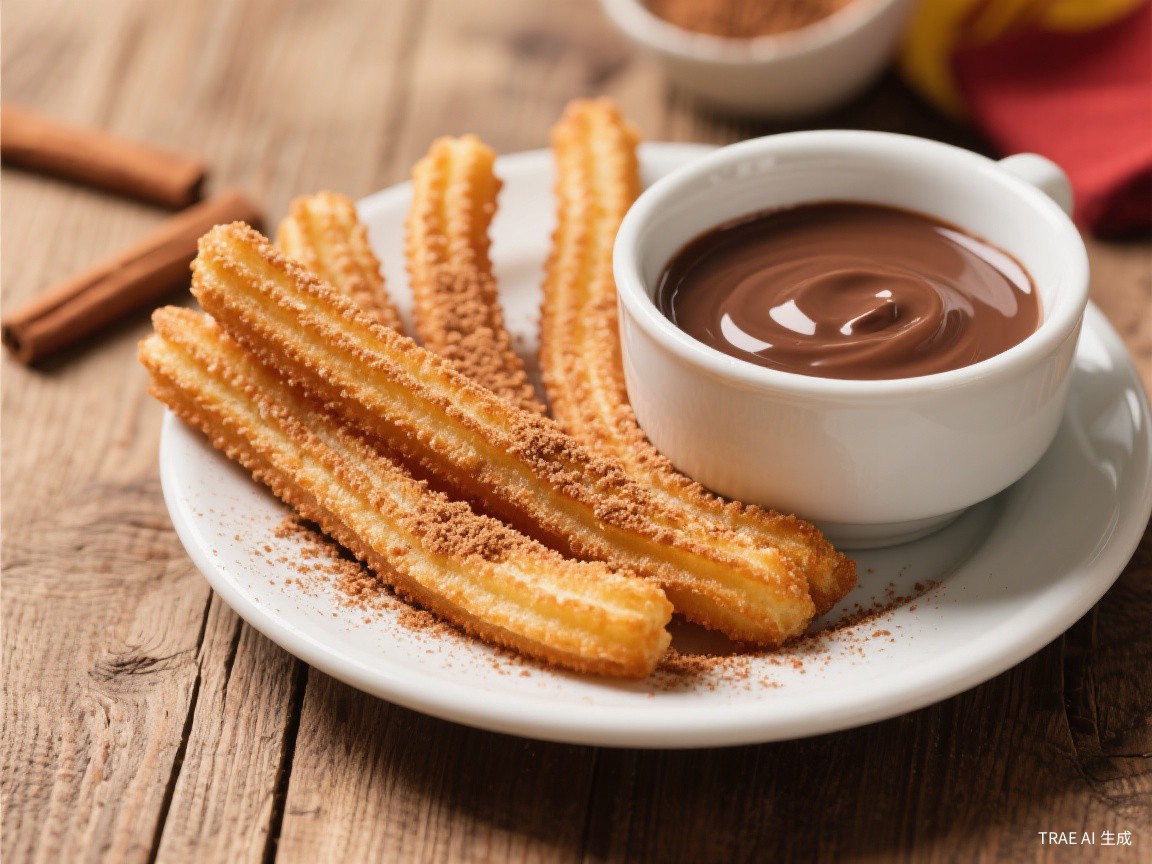
One of the most common mistakes home cooks make with churros is coating them in sugar too early or too late. The window is narrow, and getting it right makes all the difference. Sugar should be applied within thirty seconds to one minute after the churros come out of the oil. At this point, the surface is still slightly tacky with residual oil, which allows the sugar to adhere beautifully. Wait too long, and the churros cool and dry, causing the sugar to slide right off.
Traditional Spanish churros are simply rolled in granulated sugar, but the addition of ground cinnamon—a Latin American influence that has been enthusiastically adopted across Spain—adds warmth and complexity. Mix one tablespoon of ground cinnamon with every half cup of sugar for the perfect coating. Some churrerias in Madrid use a combination of sugar and a pinch of salt, which enhances the sweetness without making the churros cloying.
Spanish Hot Chocolate: Liquid Pudding
No discussion of churros is complete without addressing their inseparable companion: Spanish hot chocolate, or chocolate a la taza. This is not the thin, milky hot chocolate of American childhood. Spanish hot chocolate is thick—so thick that a churro stands upright in it without falling over. It has the consistency of warm pudding or a thin custard, and it is intensely chocolatey, slightly bitter, and utterly luxurious.
The thickness comes from a combination of high-quality dark chocolate and a small amount of cornstarch, which acts as a thickener. The traditional recipe calls for equal parts dark chocolate (minimum 60% cacao) and whole milk, with a tablespoon of cornstarch dissolved in a splash of cold water. The chocolate is melted slowly into the warm milk, the cornstarch slurry is whisked in, and the mixture is stirred constantly over medium-low heat until it coats the back of a spoon like custard.
Chef's Tip
For the most authentic Spanish hot chocolate, use a blend of two chocolates: a bitter 70% dark chocolate for depth and intensity, and a sweeter 50% dark chocolate for roundness and body. A small pinch of sea salt and a strip of orange zest, simmered with the milk and removed before serving, elevate the flavor to something truly extraordinary.
The Churreria: A Spanish Institution
In Spain, churros are not just a dessert—they are a social ritual. The churreria, the shop that specializes in churros and chocolate, is a gathering place that transcends age, class, and occasion. In Madrid, the legendary Chocolateria San Gines has been serving churros and chocolate since 1894, and its narrow, tile-lined dining room is as much a pilgrimage site as a restaurant. People come at all hours: after a night of dancing, before a morning at the office, on a rainy Sunday afternoon with children in tow.
The morning churro ritual is particularly beloved. In Spain, breakfast is a light affair—coffee and toast, perhaps—but on weekends and holidays, families make the pilgrimage to their neighborhood churreria for a plate of churros and thick chocolate. It is a shared experience, a moment of indulgence that marks the transition from the workweek to rest. The churros are always fresh, always hot, always eaten with fingers, and always accompanied by the kind of chocolate that demands to be scooped with a spoon.
Common Mistakes and How to Avoid Them
- Adding eggs to hot dough: The dough must cool slightly before adding eggs, or they will scramble. Beat each egg in completely before adding the next
- Crowding the fryer: Too many churros at once lowers the oil temperature and causes them to stick together. Fry in small batches of four to six
- Using the wrong oil: Neutral oils with high smoke points—sunflower, canola, or grapeseed—are ideal. Olive oil imparts too strong a flavor
- Serving cold churros: Churros are at their absolute best within ten minutes of frying. After that, they begin to soften. Reheating in an oven can help, but it will never match the fresh-fried experience
- Skipping the wire rack: Draining on paper towels creates steam against the bottom surface, leading to sogginess. A wire rack allows air circulation on all sides
A Simple Joy, Perfectly Executed
What I love most about churros is their honesty. There is no pretense, no molecular gastronomy, no foam or smoke or sleight of hand. It is flour, water, butter, eggs, oil, sugar, and chocolate—ingredients found in any kitchen on earth—combined with technique and care to produce something that brings people together and makes them close their eyes with pleasure. My abuela knew this intuitively, standing over that pot of oil in her tiny kitchen in Seville, turning simple dough into moments of pure, uncomplicated joy. That is the power of churros, and it is a power that never fades.
Ready to Make Perfect Churros?
Download our complete guide with piping technique illustrations and oil temperature timing charts.
Get the Free Guide