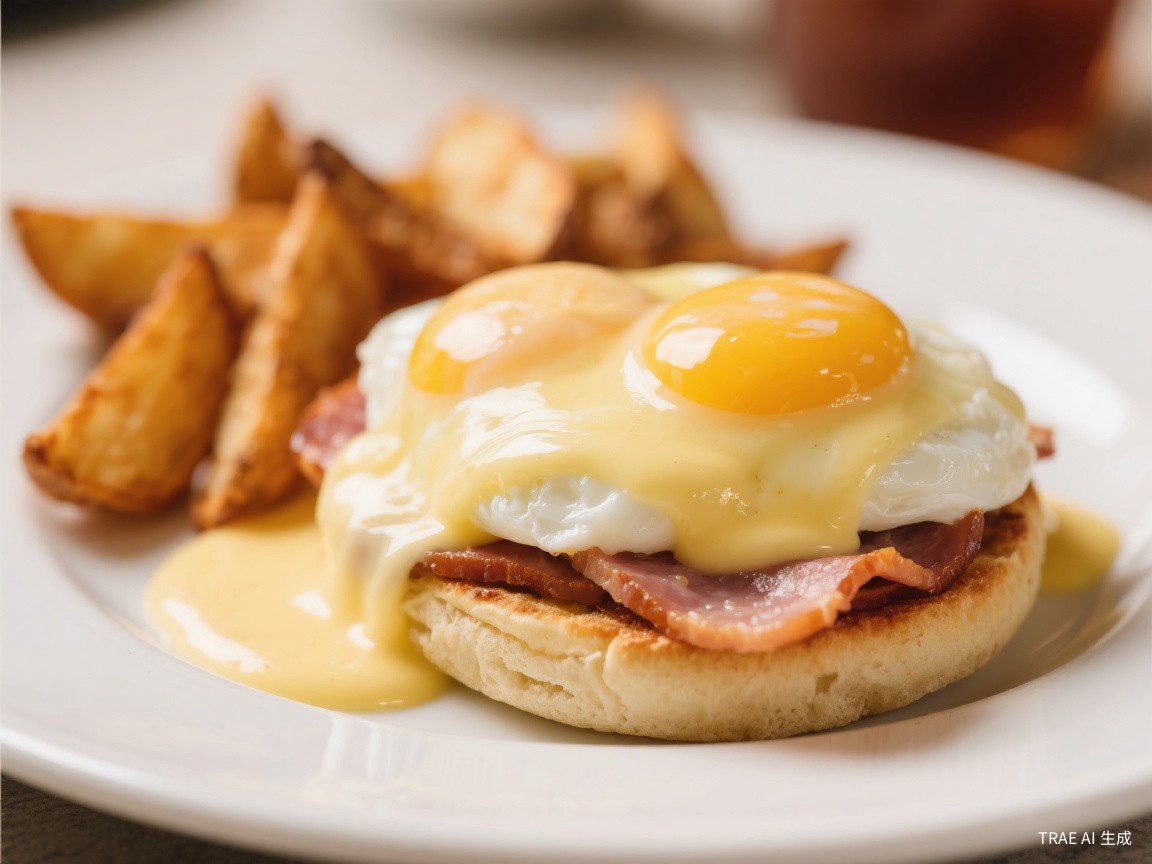
There is a reason eggs Benedict commands the top spot on virtually every brunch menu in the Western world. It is not because the dish is easy—far from it. It is because when executed properly, eggs Benedict achieves something rare in cooking: a perfect balance of textures and temperatures in a single bite. The toasted English muffin provides a warm, craggy foundation. The Canadian bacon adds a savory, meaty whisper. The poached egg, with its trembling, just-set white and liquid golden yolk, is an act of culinary precision. And the hollandaise—rich, buttery, faintly tangy—blankets everything in a warm, golden embrace. One perfect forkful, and you understand why this dish has endured for over a century and a half.
The Delmonico's Legend: Where It All Began
The origin story of eggs Benedict is shrouded in the kind of glamorous ambiguity that suits a dish of its stature. The most widely accepted account traces the dish to Delmonico's, the legendary New York City restaurant that opened in 1827 and became the first fine-dining establishment in the United States. According to the restaurant's own records, a regular patron named Mrs. LeGrand Benedict arrived for lunch one day in the 1860s and found the menu lacking. She requested something new—a dish that would serve as a hangover remedy, as the story goes—and worked with the chef, Charles Ranhofer, to devise what would become eggs Benedict.
Ranhofer, a classically trained French chef who had worked under the legendary Marie-Antoine Careme, codified the recipe in his 1894 cookbook, "The Epicurean." His version included poached eggs on toasted bread with ham and a hollandaise-like sauce, though the English muffin and Canadian bacon as we know them today came later. The dish quickly became a signature at Delmonico's and spread to other high-end restaurants across America, eventually trickling down to become the brunch staple we know today.
"Eggs Benedict is the ultimate test of a brunch cook's skill. The hollandaise must hold. The eggs must be pristine. The timing must be precise. When all three come together, there is nothing on a brunch menu that can touch it."
— Chef Sarah
A Rival Origin Story
A competing claim comes from Wall Street broker Lemuel Benedict, who allegedly wandered into the Waldorf-Astoria Hotel in 1894 with a terrible hangover and ordered "buttered toast, poached eggs, crisp bacon, and a hooker of hollandaise." The Waldorf's Oscar Tschirky—known as the "Oscar of the Waldorf" and one of the most famous maitre d's in American history—was reportedly so impressed that he put his own version on the menu, substituting an English muffin and Canadian bacon for the toast and bacon. Both stories are plausible, both are charming, and neither can be definitively proven. The truth, as with many great dishes, likely belongs to no single person.
Hollandaise Sauce: The Science of Emulsion
Hollandaise is one of the five French mother sauces, and it is the one that strikes fear into the hearts of home cooks everywhere. The reason is simple: hollandaise is a delicate emulsion, and emulsions are inherently unstable. An emulsion is a mixture of two liquids that normally do not combine—in this case, butter (fat) and water (from the egg yolks and lemon juice). Left to their own devices, these liquids will separate into distinct layers. Hollandaise works because the lecithin in egg yolks acts as an emulsifier, creating a bridge between the fat and water molecules that holds them together in a smooth, creamy suspension.
The traditional method involves whisking egg yolks and a splash of water or lemon juice over a double boiler until the yolks thicken, lighten in color, and reach approximately 160 degrees Fahrenheit—the temperature at which they are pasteurized and safe to eat. Then, clarified butter is added in a very thin, slow stream while whisking vigorously. The key word is "slow." If you add the butter too quickly, the emulsion will break, and you will be left with a greasy, curdled mess that no amount of whisking can rescue.
Chef's Tip
If your hollandaise breaks, do not panic. Whisk one tablespoon of warm water into the broken sauce. The water provides a new continuous phase for the emulsion to reform around. If that does not work, start with a fresh egg yolk in a clean bowl and slowly whisk the broken sauce into it—the fresh yolk will re-emulsify the whole batch.
Clarified Butter: Why It Matters
Traditional hollandaise calls for clarified butter (beurre noisette), from which the milk solids and water have been removed. This matters because milk solids contain proteins that can cloud the sauce and affect its stability. Clarified butter is pure butterfat, which emulsifies more cleanly and produces a hollandaise that is smoother, glossier, and more stable. To clarify butter, melt it gently in a saucepan, skim the foam from the surface, let it settle, then carefully pour off the golden fat, leaving the white milk solids behind.
That said, many modern chefs—including myself—regularly make hollandaise with whole melted butter and achieve excellent results. The sauce is slightly less stable and has a shorter shelf life, but for home cooking, where the sauce goes from pan to plate in minutes, this is rarely a problem. The convenience factor is significant: melting butter takes thirty seconds in a microwave, while clarifying it requires ten minutes of careful stovetop work.
The Perfect Poached Egg: The Vortex Method
A properly poached egg is a thing of beauty: an oval sphere of tender, just-set egg white encasing a completely liquid yolk. The white should be smooth and cohesive, without the wispy, ragged tendrils that plague poorly poached eggs. Achieving this requires controlling three variables: egg freshness, water temperature, and technique.
Fresh eggs are essential. As eggs age, the whites thin out and become more alkaline, which causes them to spread in the water rather than holding their shape. A very fresh egg has a thick, viscous white that clings tightly to the yolk and forms a neat, compact shape during poaching. If you are unsure about freshness, crack each egg into a small bowl or ramekin first and inspect it. If the white is thin and watery, save that egg for scrambling and use a fresher one for poaching.
The vortex method is the most reliable technique for producing restaurant-quality poached eggs at home. Bring a pot of water to a gentle simmer—small bubbles rising from the bottom, not a rolling boil. Add a generous splash of white vinegar, which helps the egg whites set quickly by lowering the pH of the water. Create a whirlpool in the pot by stirring vigorously with a spoon or whisk. The swirling current will wrap the egg white around the yolk as it cooks, producing a neat, round shape. Gently slide the egg into the center of the vortex and let it cook for three to four minutes without disturbing the water.
Timing and Temperature
- Three minutes: Very runny yolk, barely set white. Best for diners who want the yolk to flood the plate when cut
- Three and a half minutes: Soft, flowing yolk with a just-set outer layer. The sweet spot for most preferences
- Four minutes: Firm yolk that still flows slightly. A safer option for those who are uneasy about undercooked eggs
- Water temperature: Maintain 180 to 190 degrees Fahrenheit. A thermometer is your best friend here—too hot, and the eggs will be tough and rubbery; too cool, and they will fall apart
Canadian Bacon vs. Ham: A Crucial Distinction
The meat component of eggs Benedict is a subject of more debate than you might expect. Traditional recipes call for Canadian bacon, which is not bacon at all in the American sense. Canadian bacon—also known as back bacon—is a lean, boneless pork loin that has been cured and smoked. It is pre-cooked, so it only needs to be warmed through, and it has a mild, slightly sweet flavor that complements the richness of the hollandaise without competing with it.
Regular American bacon, by contrast, is cured pork belly, which is much fattier, saltier, and more aggressively smoky. While delicious in its own right, American bacon can overwhelm the delicate balance of eggs Benedict, turning the dish into something heavier and more assertive than intended. Some restaurants offer a "florentine" variation that substitutes sauteed spinach for the meat entirely, and others use smoked salmon (eggs royale) or crab meat (eggs sardou). All are valid, but the original Canadian bacon remains the gold standard for a reason: it supports the dish without stealing the spotlight.
The English Muffin: Foundation and Forgiveness
The English muffin is the unsung structural engineer of eggs Benedict. Its job is to absorb the yolk and hollandaise without collapsing into a soggy mess, and not all English muffins are up to the task. You want a muffin with a dense, chewy crumb and plenty of those signature nooks and crannies—those irregular pockets and holes that trap the sauce and yolk and create pockets of flavor in every bite.
Splitting and toasting the muffin properly is essential. Never use a knife to split an English muffin—this cuts through the crumb and creates a smooth surface that cannot absorb liquid. Instead, use a fork to pierce the muffin around its equator and gently pull it apart. This preserves the irregular, craggy interior that makes English muffins so good at soaking up sauces. Toast the halves under a broiler or in a toaster until golden brown and firm, then butter them lightly while still warm. The butter creates a waterproof barrier that slows down the absorption of egg and sauce, buying you precious minutes before the muffin begins to soften.
Chef's Tip
For the most even toasting, place the split muffin halves cut-side up under a broiler set to high. Watch them constantly—they go from golden to burnt in about sixty seconds. A light dusting of Parmesan cheese on the muffin before broiling adds a savory, crispy layer that takes the dish to another level.
Assembly: The Final Act
Eggs Benedict is a dish that demands to be assembled and served immediately. Every component—the toasted muffin, the warm Canadian bacon, the freshly poached egg, the hollandaise—has a narrow window of optimal temperature and texture. Assemble the dish in this order: toasted muffin on the plate, Canadian bacon on the muffin, poached egg on the bacon, hollandaise over everything. A light dusting of cayenne pepper or paprika and a few snipped chives provide color and a final layer of flavor.
The moment of truth comes when the diner cuts into the egg. The yolk should flow freely, pooling on the plate and mingling with the hollandaise to create a sauce that is richer and more complex than either component alone. The English muffin should be firm enough to support a forkful but tender enough that it yields without resistance. The Canadian bacon should be warm and savory, a quiet counterpoint to the richness above and below it. When all four elements harmonize in a single bite, you understand why eggs Benedict has earned its title as the crown jewel of brunch.
Beyond the Classic: Modern Variations
While the classic eggs Benedict remains the benchmark, the dish has proven remarkably adaptable over the decades. Eggs Florentine replaces the Canadian bacon with wilted spinach and sometimes adds a layer of sauteed mushrooms. Eggs Royale substitutes smoked salmon for the meat, a variation that is particularly popular in Britain. Eggs Sardou, a New Orleans creation, replaces the English muffin with artichoke bottoms and adds creamed spinach and anchovies. And in recent years, chefs have pushed the boundaries further: short rib Benedict, lobster Benedict, crab cake Benedict, even Korean BBQ Benedict with kimchi and gochujang hollandaise.
These variations speak to the enduring appeal of the eggs Benedict concept: the combination of a starch base, a savory element, a perfectly poached egg, and a rich sauce is a template that can accommodate virtually any flavor profile. But no matter how creative the interpretation, the fundamentals remain the same. Nail the hollandaise, master the poach, and respect the balance, and you will have a dish worthy of any brunch table, any occasion, and any diner lucky enough to hold a fork.
Ready to Master Eggs Benedict?
Download our hollandaise troubleshooting guide and poached egg timing chart for perfect results every time.
Get the Free Guide