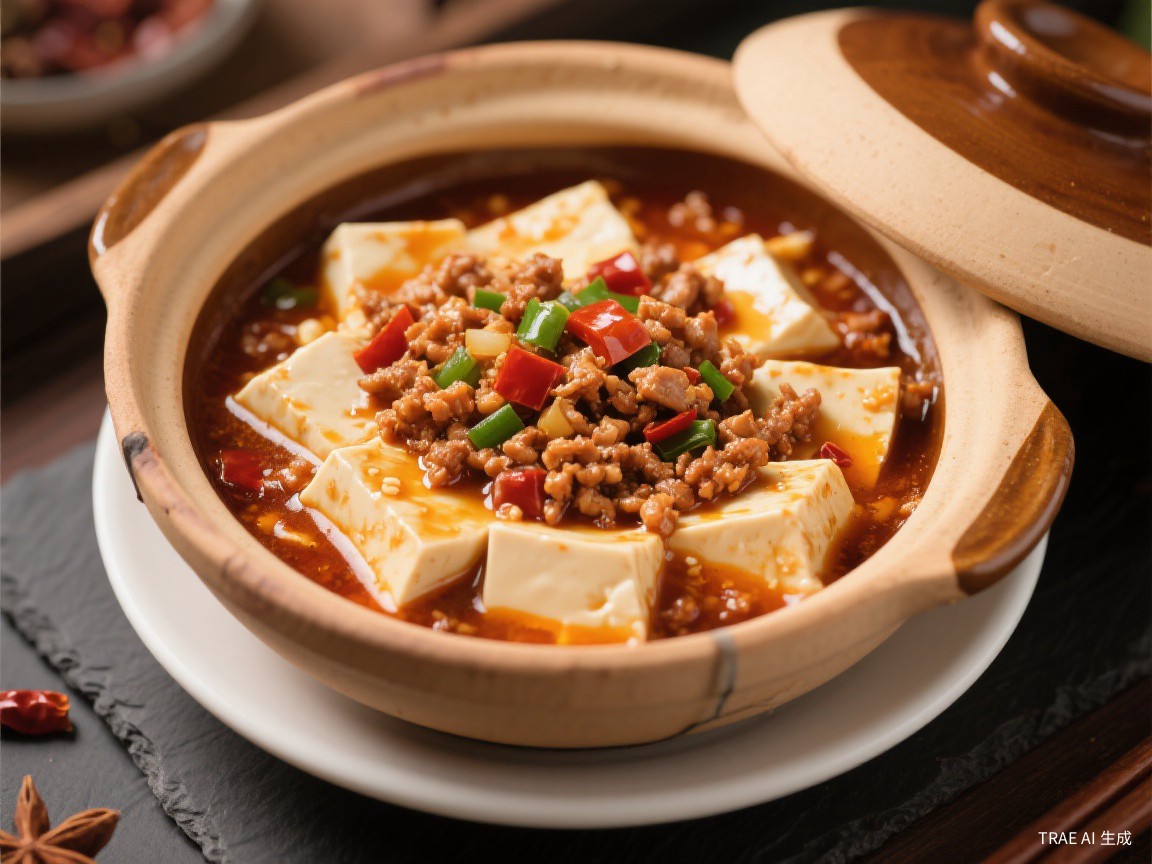
There is a sensation in Sichuan cuisine that has no equivalent in the Western culinary vocabulary. It is called málà—a compound of two Chinese characters, má meaning "numbing" and là meaning "spicy"—and it describes the simultaneous tingling of Sichuan peppercorns and the burning of chili peppers on your tongue. Mapo tofu is the dish that most perfectly embodies this sensation: a bubbling cauldron of silken tofu and minced meat suspended in a fiery, brick-red sauce that makes your lips vibrate and your forehead glisten. It is not merely spicy. It is an experience.
The Legend of Chen Mapo
Like many of China's greatest dishes, mapo tofu has a origin story rooted in a specific person and place. The dish was created in the 1860s by a woman named Chen Qingfu, who ran a small restaurant near the Wanfu Bridge in Chengdu, the capital of Sichuan province. Her face was marked with pockmarks (má in Sichuanese dialect), and she was known as Mapo—"pockmarked old woman." The tofu she served was so extraordinary that her name became inseparable from the dish.
Chen's original recipe was built on ingredients that were, and remain, the backbone of Sichuan cooking: fermented broad bean paste, chili oil, Sichuan peppercorns, garlic, ginger, and scallions. The genius of her creation was the way these bold, aggressive flavors were tamed by the gentle, custard-like texture of the tofu, creating a dish that was simultaneously fierce and comforting. More than 160 years later, her name still appears on restaurant signs across Chengdu, and the dish she invented is recognized as one of the defining achievements of Chinese regional cuisine.
"Mapo tofu is not about heat for the sake of heat. It is about building layers of flavor—fermented, roasted, numbing, aromatic—until the tongue cannot distinguish one sensation from another. That is the art of mala."
— Chef Wei, on the philosophy of Sichuan cooking
Doubanjiang: The Soul of the Sauce
If you remove every other ingredient from mapo tofu and keep only one, it must be doubanjiang—fermented broad bean paste, often called "the soul of Sichuan cooking." This thick, dark reddish-brown paste is made from broad beans (fava beans) that have been salted and fermented with chilies, sometimes for years. It provides the deep, savory umami foundation that defines the dish, along with its characteristic brick-red color and complex, fermented heat.
Not all doubanjiang is created equal. The gold standard is Pixian doubanjiang, named after Pixian County near Chengdu, where the paste has been produced for over three centuries. Authentic Pixian doubanjiang is aged for a minimum of one year, and premium versions are aged for three, five, or even ten years. The aging process deepens the color from bright red to dark mahogany and transforms the flavor from sharp and salty to mellow, sweet, and profoundly complex. If you can find Pixian doubanjiang at an Asian grocery store, buy it. The difference between Pixian and supermarket brands is the difference between a fine wine and boxed wine.
Frying the Doubanjiang
One of the most critical techniques in mapo tofu is the way the doubanjiang is introduced to the wok. It must be fried in oil—slowly, over medium-low heat—until the oil turns a deep red and the paste releases an intoxicating, roasted aroma. This process, which takes about two to three minutes, is called "blooming" the doubanjiang, and it transforms the paste from a raw, salty condiment into a deeply flavored sauce base. Rush this step, and your mapo tofu will taste flat and one-dimensional. Give it the time it deserves, and the entire dish will sing.
Chef's Tip
When frying doubanjiang, keep the heat low enough that the paste sizzles gently rather than splattering aggressively. If the heat is too high, the chilies in the paste will scorch and turn bitter, which will ruin the entire dish. Stir constantly and watch for the moment the oil turns from pale to a deep, glossy red—that is your signal to proceed.
Tofu: Choosing and Preparing the Canvas
The tofu in mapo tofu is not merely an ingredient—it is the canvas upon which all the bold flavors are painted. The traditional choice is soft or silken tofu, which has a delicate, custard-like texture that absorbs the sauce while providing a soothing contrast to the fiery heat. Firm or extra-firm tofu is a common Western substitution, but it produces a fundamentally different dish with a chewier, less luxurious mouthfeel.
Preparing the tofu properly is essential. Fresh soft tofu should be gently cut into one-inch cubes, then blanched in simmering salted water for two to three minutes. This step serves two purposes: it firms the tofu slightly so it does not break apart during cooking, and it removes the raw beany taste that some people find unpleasant. After blanching, drain the tofu carefully and set it aside. Handle it gently—soft tofu is fragile, and rough handling will produce crumbles instead of clean cubes.
The Meat: Ground Pork vs. Beef
Traditional mapo tofu uses ground pork, and in Sichuan province, this is essentially non-negotiable. The pork fat renders during cooking, adding richness and body to the sauce that leaner meats cannot replicate. The meat should be roughly chopped rather than finely ground—a bit of texture is desirable, giving the dish a rustic, handcrafted quality that distinguishes it from the overly smooth, machine-processed versions found in many restaurants.
Beef is a common alternative, particularly in Muslim communities in China where pork is not consumed. Beef mapo tofu has a slightly different character—leaner, with a deeper, more mineral flavor that some people actually prefer. In the West, ground beef is often used simply because it is more widely available, and the results can be excellent if the beef is not too lean. A mixture of ground pork and beef, about seventy-thirty, is a compromise that captures the best qualities of both.
The Vegetarian Question
Vegetarian mapo tofu is a legitimate and increasingly popular variation, particularly among Buddhist practitioners and the growing number of plant-based eaters. The meat is typically replaced with finely chopped shiitake mushrooms, which provide a meaty texture and an umami depth that complements the doubanjiang beautifully. Some versions use a mixture of mushrooms and finely crumbled extra-firm tofu to mimic the texture of ground meat. The key is ensuring that the vegetarian version still delivers the same intensity of flavor—there is no reason it should be milder or less satisfying than the meat version.
- Traditional ground pork: Rich, fatty, and authentic—the gold standard
- Ground beef: Leaner and deeper in flavor, common in Muslim communities
- Pork-beef blend: A balanced compromise with the best of both
- Shiitake mushrooms: The best vegetarian option, with meaty texture and umami
- Finely crumbled firm tofu: Adds protein and texture to vegetarian versions
Achieving the Mala Balance
The defining characteristic of authentic mapo tofu is the málà balance—the interplay between the numbing hydroxy-alpha-sanshool compound in Sichuan peppercorns and the capsaicin heat of the chilies. Getting this balance right is what separates good mapo tofu from great mapo tofu, and it requires careful attention to both the quantity and quality of your pepper and chili components.
Sichuan peppercorns should be freshly ground or lightly toasted before use. Stale peppercorns lose their numbing power and develop a flat, woody flavor. Toast them in a dry skillet for about two minutes until fragrant, then grind them coarsely in a mortar and pestle or spice grinder. The amount varies by personal tolerance, but a typical ratio is one to two teaspoons of ground peppercorns per pound of tofu and meat.
The chili heat comes primarily from the doubanjiang and the chili oil used to finish the dish. Additional dried red chilies can be fried in the oil alongside the doubanjiang for extra heat, and a tablespoon of chili oil (lájiào yóu) drizzled over the finished dish adds both heat and a gorgeous red gloss. The goal is a sauce that is genuinely spicy but not painful—complex and layered rather than one-dimensionally hot.
Authentic vs. Westernized: Knowing the Difference
If you have only eaten mapo tofu in Western Chinese restaurants, you may be surprised by the authentic version. Many Western adaptations sweeten the dish with sugar or hoisin sauce, thicken it excessively with cornstarch, and tone down the heat to a gentle warmth. The result is pleasant enough but bears little resemblance to the real thing. Authentic mapo tofu is not sweet. It is not thick and gloppy. It is a loose, soupy dish with a thin, glossy sauce that coats the tofu and rice without overwhelming them.
- Authentic: Rust-red color, loose sauce, bold mala heat, no sweetness
- Westernized: Dark brown, thickened with cornstarch, mild heat, often sweet
- Restaurant-style: Often a middle ground—thicker than authentic but spicier than Westernized
The cornstarch slurry used in many recipes should be applied sparingly—just enough to give the sauce a slight body, not enough to turn it into gravy. In Chengdu, some restaurants use no thickener at all, relying on the natural starch released by the tofu to give the sauce its characteristic silky texture. This is the purest expression of the dish, and it is worth striving for.
Serving and the Rice Imperative
Mapo tofu must be served over steamed white rice—short-grain or medium-grain, never long-grain or basmati. The rice is not a side dish; it is an integral component, absorbing the fiery sauce and providing a cooling, starchy counterpoint to the heat. A proper serving ratio is about one part tofu to one part rice by volume. The dish should be served immediately, while the sauce is still bubbling and the aroma of toasted Sichuan peppercorns fills the room.
Garnish with a generous sprinkle of ground Sichuan peppercorns and finely chopped scallion greens. Some Sichuan cooks add a handful of toasted peanuts or a drizzle of additional chili oil for visual drama. But the essential elements are simple: tofu, meat, sauce, rice. Everything else is embellishment. When you take that first bite and the mala sensation floods your palate—tingling, burning, savory, deeply satisfying—you will understand why this dish has captivated eaters for over a century and a half.
Ready to Master Authentic Mapo Tofu?
Download our complete guide with Pixian doubanjiang sourcing, wok temperature charts, and the authentic Chengdu recipe passed down through generations.
Get the Free Guide