I grew up in a house where the smell of frying samosas was the official announcement that something worth celebrating was about to happen. My grandmother would begin the dough in the late morning, working it with her hands while narrating stories about her own childhood in Lahore, and by afternoon the entire house would be wrapped in the warm, golden aroma of ghee and cumin. The samosa was never just a snack in our home. It was a ritual, a connection to a place and time that existed only in memory and flour and oil. That is the power of this extraordinary pastry—it carries within its crisp, triangular shell the weight of centuries of history and the warmth of countless family kitchens.
A Pastry Older Than the Mughals
The samosa did not originate in India, though India made it irrevocably its own. The earliest references to a samosa-like pastry appear in Middle Eastern and Central Asian texts dating back to the tenth century, where it was known as sanbusak or sanbusaj. These early versions were smaller, often filled with minced meat, nuts, and dried fruits, and they traveled along the ancient trade routes that connected Central Asia to the Indian subcontinent.
When the Mughal Empire established itself in India during the sixteenth century, the samosa arrived with the court and was quickly adopted and adapted by local cooks. The most significant transformation was the filling: where Central Asian samosas contained meat, Indian cooks developed the aloo samosa—a potato-filled version that was vegetarian, affordable, and deeply satisfying. This adaptation was so successful that today, when most of the world hears the word "samosa," it is the potato-filled Indian version that comes to mind, not the meat-filled Middle Eastern original.
The Ain-i-Akbari, a detailed record of the Mughal emperor Akbar's court written in the late sixteenth century, explicitly mentions samosas being served among the imperial dishes. From the royal kitchens of Agra and Delhi, the samosa filtered down through every layer of Indian society, eventually becoming the most ubiquitous snack in a nation of over a billion people. Today, it is sold on railway platforms, in school canteens, at wedding feasts, and in five-star hotel restaurants. No other Indian food occupies such a universal position across class, region, and religion.
"The samosa is democratic in a way that few foods are. A billionaire and a day laborer eat the same samosa from the same street cart, and both of them are happy. That is a kind of equality you cannot legislate."
— Chef Priya, on the cultural significance of the samosa
The Dough: Where Most People Go Wrong
The difference between a memorable samosa and a mediocre one lies almost entirely in the dough. A proper samosa dough is not a simple flour-and-water mixture. It is a carefully engineered pastry designed to produce a crisp, flaky exterior that shatters at first bite while remaining sturdy enough to hold its filling without leaking. The secret lies in two ingredients that many home cooks overlook: fat and the resting process.
The dough is made from all-purpose flour, a pinch of salt, and a fat—traditionally ghee, though oil works as well. The fat is rubbed into the flour with your fingertips until the mixture resembles coarse breadcrumbs, a technique identical to making pie crust. This coats the flour particles in fat, which inhibits gluten formation and creates the flaky, layered texture that distinguishes a great samosa from a heavy, bready one. The amount of fat is critical: too little, and the dough will be tough. Too much, and it will be greasy and fragile. The ideal ratio is roughly four tablespoons of ghee or oil per two cups of flour.
The Resting Period
After the dough comes together, it must rest for at least thirty to forty minutes, covered with a damp cloth. This is not optional. Resting allows the gluten to relax and the flour to fully hydrate, producing a dough that is easier to roll, more pliable, and less prone to tearing. Dough that has not been rested will shrink back when you try to roll it thin, resulting in thick, heavy samosas with a bread-like texture rather than the desired crisp, flaky shell.
Chef's Tip
For the flakiest possible samosa, add a tablespoon of semolina (sooji) to the dough along with the flour. The semolina creates tiny, crunchy granules in the finished pastry that add an extra dimension of texture. My grandmother swore by this technique, and the results speak for themselves—a samosa with semolina in the dough has a distinctive, almost sandy crunch that is impossible to replicate any other way.
Shaping: The Triangular Art
The classic samosa shape—a plump, triangular pyramid with a pleated seam—is both functional and beautiful. The triangle is not merely aesthetic; it provides structural integrity, distributing the filling evenly and creating a shape that fries uniformly. Shaping samosas is a skill that improves with practice, and the method, while not difficult, requires a bit of patience to master.
The dough is divided into balls about the size of a golf ball, then rolled into oval discs about six inches long and four inches wide. Each disc is cut in half to form two semi-circles. A semi-circle is moistened along the straight edge with water or a flour paste, then folded into a cone, with the moistened edge sealed to form the triangular base. The filling is spooned into the cone—about one and a half tablespoons—and the open top is pinched and pleated shut, creating a decorative sealed edge that also helps the samosa hold its shape during frying.
The Filling: A Continent of Variations
The aloo samosa—the potato-filled version—is the most common type found across India, but it is far from the only one. The filling varies dramatically by region, community, and occasion, reflecting the extraordinary diversity of Indian cuisine. Understanding these variations is key to appreciating the samosa's versatility.
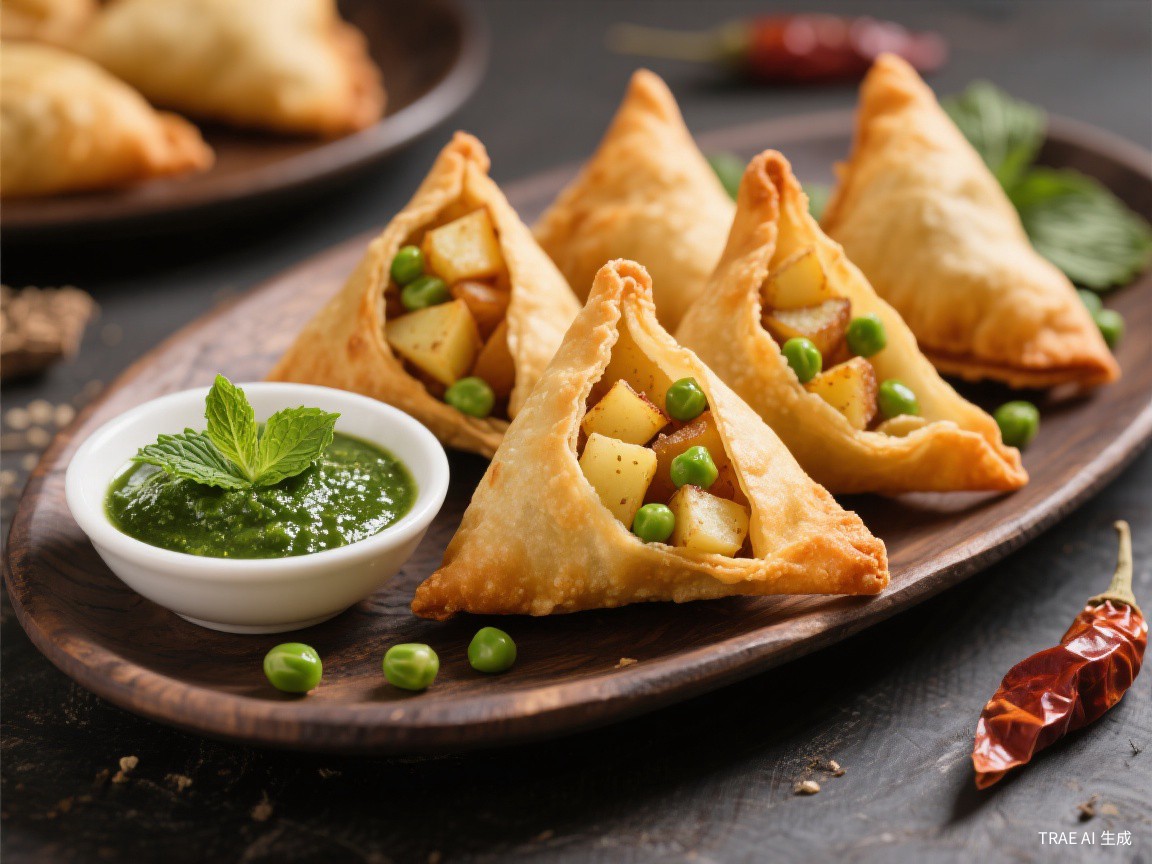
In North India, the classic filling consists of boiled potatoes mashed with green peas, cumin seeds, green chilies, ginger, and a spice blend that typically includes garam masala, amchur (dried mango powder), and coriander powder. The amchur is particularly important—it provides a bright, fruity acidity that cuts through the richness of the fried pastry and elevates the potatoes from starchy to vibrant. Some Punjabi versions add a handful of pomegranate seeds (anardana) for a tangy crunch that is uniquely refreshing.
In South India, particularly in Kerala and Tamil Nadu, samosas often contain a spiced meat filling—lamb or beef minced with onions, curry leaves, and a blend of spices that leans heavily toward black pepper and fennel. These meat samosas are smaller and more delicately shaped than their northern counterparts, and they are often served as part of the elaborate feast known as the Iftar during Ramadan.
- North Indian aloo: Potatoes, peas, cumin, amchur, garam masala—the classic
- Punjabi keema: Spiced minced lamb with onions, ginger, and green chilies
- Keralan beef: Minced beef with curry leaves, fennel, and black pepper
- Bengali aloor chop: Potato filling with mustard seeds and poppy seeds
- Sweet samosa: Filled with khoya, nuts, and sugar, popular during festivals
Frying: Temperature Is Everything
Deep frying is the step that transforms raw dough and filling into the golden, shattering pastry that the world loves, and it is also the step where most home cooks stumble. The oil temperature must be carefully controlled—too hot, and the outside will burn before the interior cooks through. Too cool, and the samosa will absorb excess oil, becoming heavy and greasy instead of light and crisp.
The ideal frying temperature is between 325 and 340 degrees Fahrenheit (160-170 degrees Celsius). At this moderate temperature, the samosa cooks slowly and evenly, allowing the dough to puff and blister into multiple flaky layers while the filling heats through. Fry the samosas in batches of three or four, depending on the size of your pan, and never overcrowd the oil. Overcrowding drops the temperature dramatically and produces soggy, uneven results.
The Low-and-Slow Method
The most reliable technique for perfectly fried samosas is the low-and-slow method. Begin frying at the target temperature for about four minutes, until the samosas are pale golden and the dough has set. Then reduce the heat to low and continue frying for another six to eight minutes, turning occasionally, until the samosas are a deep, even golden brown. This two-stage method ensures that the pastry cooks through completely before the exterior darkens, producing a samosa that is crisp on the outside and fully cooked on the inside, with no raw dough or underdone filling.
- Stage one (325-340°F): Fry for 4 minutes until pale golden—this sets the structure
- Stage two (low heat): Continue for 6-8 minutes until deep golden brown—this develops crispness
- Drain properly: Rest on a wire rack, not paper towels, to prevent sogginess
- Do not rush: Patience during frying is the difference between good and extraordinary
Chutney Pairings: The Essential Accompaniments
A samosa without chutney is like a sentence without a verb—incomplete. Two chutneys are traditionally served alongside samosas, and both are essential. The first is a sweet and tangy tamarind chutney (imli ki chutney), made from tamarind pulp, jaggery or sugar, dates, cumin, and a pinch of salt. Its dark, syrupy sweetness provides a luscious contrast to the savory, spiced filling, and its acidity cuts through the richness of the fried pastry.
The second is a fresh green mint and cilantro chutney (hari chutney), made from fresh mint leaves, cilantro, green chilies, ginger, lemon juice, and a pinch of cumin. This chutney is bright, sharp, and herbaceous, with a raw heat that wakes up the palate between bites. The combination of sweet tamarind and sharp green chutney creates a flavor dynamic that is greater than the sum of its parts—each one makes the other more interesting.
Some regional variations add a third condiment: a thin, spiced yogurt raita or a sprinkling of chaat masala over the samosa before eating. In the chaat shops of Old Delhi, samosas are sometimes smashed open and drenched in chickpea curry, yogurt, tamarind chutney, and green chutney to create a dish called samosa chaat—a glorious, messy, over-the-top preparation that transforms the humble samosa into an entirely new experience.
Ready to Make Perfect Samosas at Home?
Get our complete guide with step-by-step shaping photos, frying temperature charts, and five regional filling recipes from across India.
Get the Free Guide