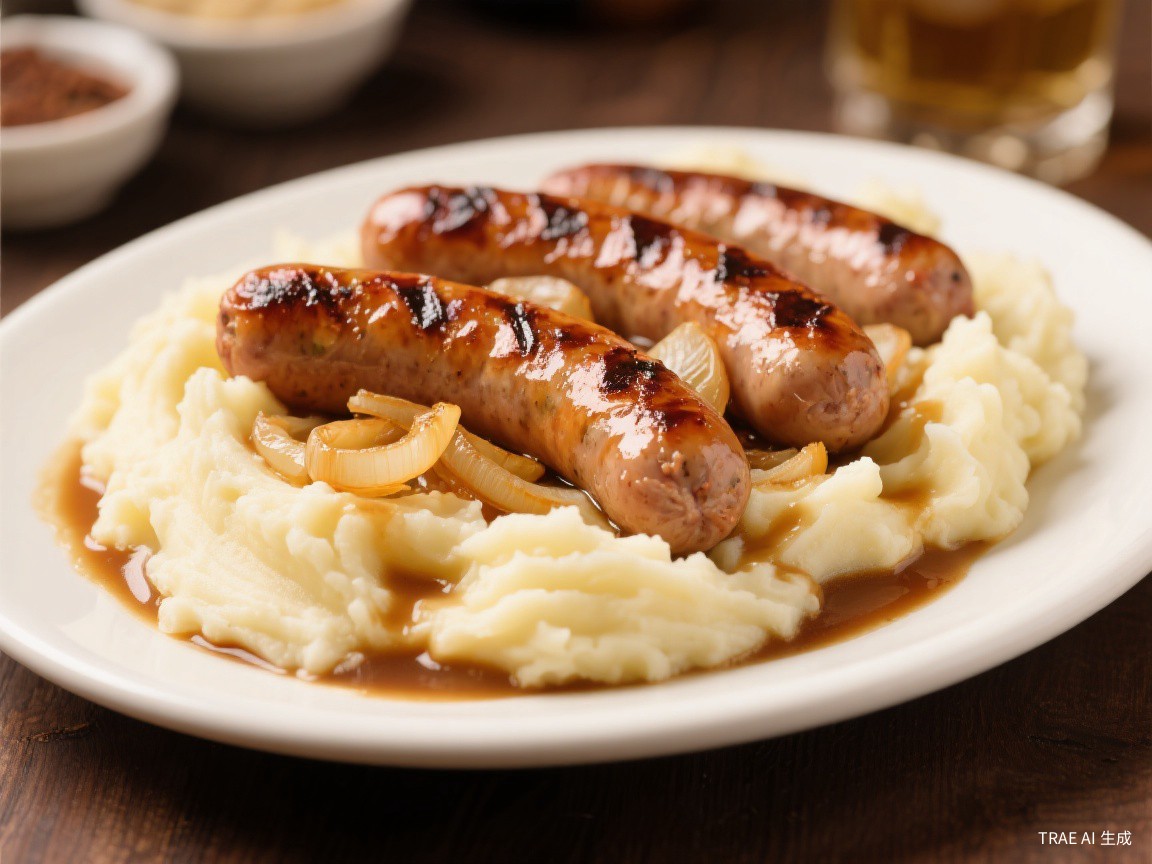
There is a particular quality to British comfort food that resists explanation until you actually sit down to eat it. It is not flashy, not photogenic, not the kind of dish that earns Instagram likes. Bangers and mash—plump sausages nestled in a drift of creamy mashed potatoes and drenched in dark onion gravy—is the antithesis of food trends. It does not need to prove anything. It has been feeding people through winters, wars, and Wednesday evenings for the better part of two centuries, and it does not require your approval. But when it is made well, with proper sausages and real butter and gravy that tastes of something, it achieves a kind of profound satisfaction that no amount of molecular gastronomy can replicate.
The Sausage: Britain's Regional Pride
The "bangers" in bangers and mash are, of course, sausages, and in Britain the sausage is a serious matter with deep regional identities. Unlike the uniform, mass-produced tubes found in most supermarket chains, traditional British sausages vary enormously by county, each with its own blend of meats, seasonings, and casings. Choosing the right sausage is the single most important decision you will make when preparing this dish, because the sausage provides the dominant flavor and texture.
Cumberland sausages, from the county of Cumbria in northwest England, are perhaps the most celebrated variety for this dish. They are distinctive for their long, coiled shape—traditionally sold as a single continuous rope rather than individual links—and their coarse, chunky texture. The meat is pork, seasoned with black pepper, white pepper, nutmeg, and sometimes thyme or sage. The coarseness of the grind is crucial: it gives the sausage a meaty, substantial bite that holds up beautifully against the softness of the mash. A good Cumberland sausage should feel like you are eating seasoned pork, not a processed product.
"The British sausage is one of the great underrated foods of the world. We do not give it the reverence that the Italians give to salami or the French give to charcuterie, but we should. A proper Cumberland sausage, cooked with care, is a thing of genuine beauty."
— Chef Oliver, on the art of the British banger
A Regional Sausage Guide
Lincolnshire sausages, from the east of England, are another outstanding choice. They are flavored primarily with sage, giving them a distinctly herbal, almost autumnal character that pairs wonderfully with onion gravy. The texture is slightly smoother than Cumberland but still coarser than commercial sausages. In the Midlands, the Pork Leicester sausage incorporates a hint of mace and lemon zest for a brighter, more delicate flavor. Gloucester sausages include a small amount of apple, which caramelizes during cooking and adds a subtle sweetness.
- Cumberland: Coarse-cut pork, black pepper, nutmeg—robust and peppery
- Lincolnshire: Sage-forward, slightly smoother—herbal and warming
- Pork Leicester: Mace and lemon zest—bright and delicate
- Gloucester: With apple—subtly sweet, excellent with mustard
- Cumberland-style (modern): Individual links with traditional seasoning—widely available
Chef's Tip
The term "banger" originated during the Second World War, when sausage meat was heavily bulked out with water and rusk due to rationing, causing the sausages to explode with a loud bang in the hot pan. To avoid this with quality sausages, prick them lightly with a fork before cooking and start them in a cold pan, then gradually increase the heat. This gentle approach allows the fat to render slowly and the casing to crisp evenly without bursting.
The Mash: Butter, Cream, and Technique
Mashed potatoes are deceptively simple, and the difference between good mash and great mash comes down to three things: the potato variety, the dairy, and the technique. For bangers and mash, you want a floury potato rather than a waxy one. Maris Piper is the gold standard in Britain—a large, golden-fleshed potato with a high starch content that breaks down beautifully when mashed, producing a fluffy, creamy texture. King Edward is another excellent choice, with a slightly drier, more powdery consistency that some cooks prefer.
The cooking method matters enormously. Potatoes should be peeled, cut into evenly sized chunks—about one and a half inches—and started in cold, generously salted water. Bringing them to a boil from cold ensures even cooking throughout. Boil until a knife slides through with no resistance, about fifteen to twenty minutes. Overcooking makes the potatoes waterlogged and gluey; undercooking leaves hard lumps. Drain thoroughly, then return the potatoes to the hot pan for a minute to evaporate any remaining surface moisture. This step is essential for achieving a fluffy rather than wet mash.
Butter vs. Cream: The Eternal Question
The debate between butter and cream in mashed potatoes is one of the most passionately contested in British cooking. The butter camp argues that nothing but butter produces the richest, most luxurious mash. The cream camp counters that cream adds a silky smoothness that butter alone cannot achieve. The truth, as with most culinary debates, is that both are right—and the best mash uses both.
The technique is this: after draining and drying the potatoes, add a generous knob of salted butter—about three tablespoons per two pounds of potatoes—and mash until the butter is fully incorporated and the potatoes are smooth. Then add warm whole milk or heavy cream, a little at a time, stirring gently until the mash reaches your desired consistency. The milk or cream should be warm, not cold; adding cold liquid to hot potatoes can cause the starches to seize, producing a gluey texture. Season generously with salt and white pepper—white pepper is traditional in British mash because it does not leave visible specks in the creamy white potatoes.
The Onion Gravy: The Unsung Hero
Many people treat the gravy as an afterthought, but in a properly made plate of bangers and mash, the gravy is arguably the most important element. It is the unifying force that brings sausage and potato together, providing moisture, depth, and a savory richness that elevates the entire dish. A thin, watery gravy will ruin even the best sausages and mash, while a thick, glossy, deeply flavored gravy can make even modest ingredients sing.
The foundation of great onion gravy is, unsurprisingly, the onions. Use large yellow onions, sliced thinly—about an eighth of an inch thick—and cooked slowly in butter until they are deeply golden and sweet. This caramelization process takes twenty to thirty minutes over medium-low heat, and it cannot be rushed. The onions should be soft, sweet, and deeply colored before you add any liquid. Some cooks add a pinch of sugar to accelerate caramelization, but patience produces a more complex, less one-dimensional sweetness.
Building the Gravy
Once the onions are caramelized, the gravy is built in layers. First, a tablespoon of plain flour is stirred into the onions and cooked for one to two minutes to remove the raw starch taste. Then, beef stock is added gradually, stirring constantly to prevent lumps. A splash of dark ale or stout adds depth and a subtle bitterness that balances the sweetness of the onions. A teaspoon of English mustard—Coleman's, ideally—adds a sharp, pungent kick. Worcestershire sauce contributes umami and a fermented tang. A small knob of butter stirred in at the end gives the gravy a glossy, velvety finish.
- Caramelize the onions: 20-30 minutes in butter until deep golden
- Add flour: Cook 1-2 minutes to remove raw starch taste
- Deglaze with ale or stout: Scrape up all the caramelized bits from the pan
- Add beef stock gradually: Stir constantly to prevent lumps
- Season and finish: Mustard, Worcestershire sauce, salt, pepper, and a knob of butter
The Pub Tradition
Bangers and mash is inextricably linked to the British pub, and understanding this connection is key to understanding the dish's cultural significance. The pub has been the center of British social life for centuries, and bangers and mash has been on pub menus for nearly as long. It is the dish that a publican serves when they want to reassure their customers that some things in this world remain constant. In a country where culinary trends come and go with bewildering speed, the permanence of bangers and mash on a pub menu is a source of genuine comfort.
The best pub bangers and mash share certain qualities. The sausages are locally sourced, preferably from a butcher within twenty miles. The mash is made fresh to order, not held in a warming tray. The gravy is made from the pan juices of the sausages themselves, enriched with caramelized onions and reduced stock. The plate arrives piping hot, with the gravy pooled around the mash rather than poured over the sausages, preserving their crisp skin. It is served with a pint of ale—bitter, mild, or stout—and perhaps a side of mushy peas if you are in the north of England.
Modern Interpretations
The gastropub revolution of the early 2000s elevated bangers and mash from humble pub grub to something approaching fine dining, and many of these innovations have become standard. Upscale versions might feature wild boar sausages, truffle oil in the mash, or red wine in the gravy. Some chefs add caramelized apple to the onions, or serve the dish with a fried egg on top for extra richness. Vegetarian and vegan versions have become increasingly common, with plant-based sausages and dairy-free mash that can be genuinely excellent when made with care.
These modern touches are welcome, but the core of the dish remains unchanged: good sausages, good mash, good gravy. No amount of truffle oil or molecular technique can improve on a plate where these three elements are executed with skill and sincerity. The beauty of bangers and mash is its honesty. It does not pretend to be anything other than what it is—nourishing, satisfying, and deeply, unapologetically British.
Ready to Make the Ultimate Bangers and Mash?
Download our complete guide with sausage sourcing tips, mash consistency charts, and the pub-style onion gravy recipe that took three generations to perfect.
Get the Free Guide