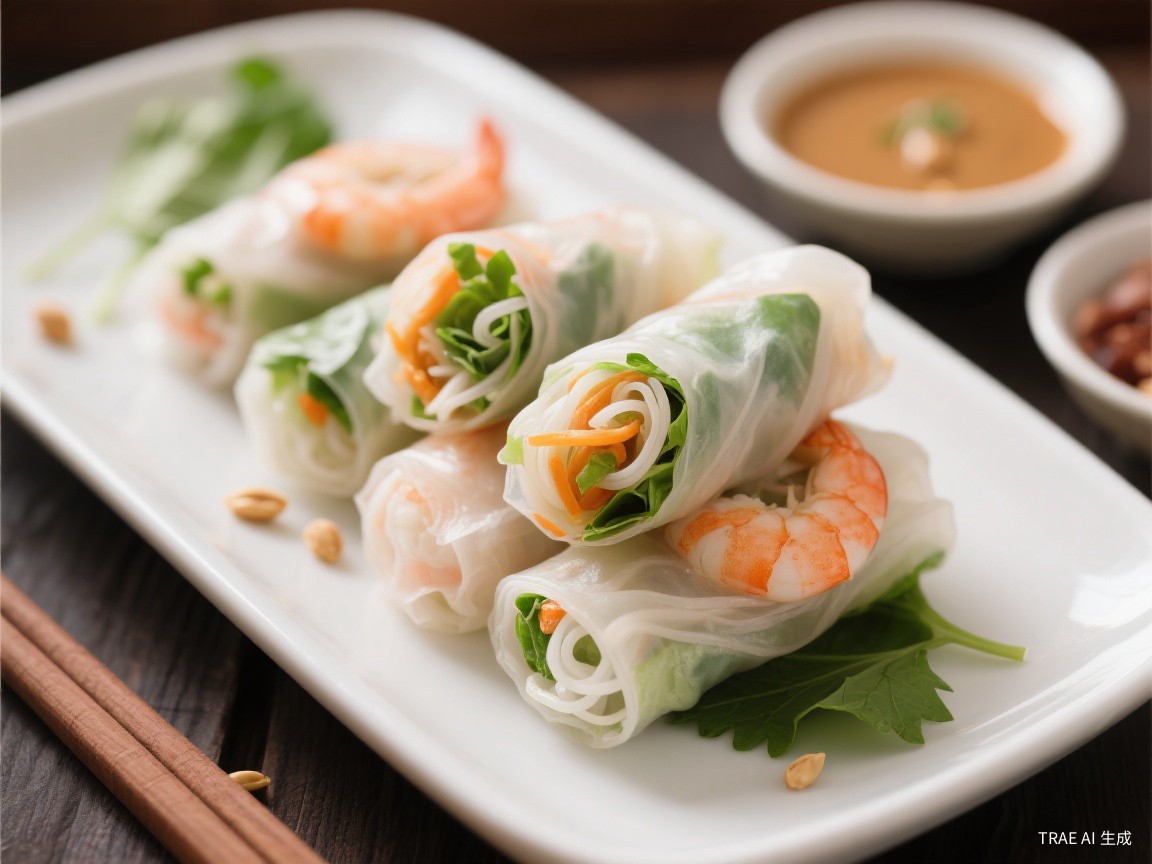
Of all the dishes in the Vietnamese culinary repertoire, few are as visually striking and immediately inviting as goi cuon—the fresh spring roll. Translucent rice paper wrapped around a vibrant mosaic of shrimp, pork, vermicelli, herbs, and vegetables, it is a dish that eats with the eyes before it ever reaches the mouth. Unlike its deep-fried cousin, the imperial roll, goi cuon is served at room temperature, uncooked, relying entirely on the quality and freshness of its ingredients for its appeal. It is, in many ways, the purest expression of Vietnamese cooking philosophy: let the ingredients speak.
Goi Cuon vs. Imperial Rolls: A Critical Distinction
Before diving into technique, it is essential to clarify a confusion that persists in Western contexts. The term "spring roll" is used to describe two entirely different dishes. The deep-fried, crispy rolls filled with minced pork, mushrooms, and glass noodles are called cha gio in southern Vietnam or nem ran in the north—commonly referred to as imperial rolls or egg rolls in English. These are delicious, but they are not what this article is about.
Goi cuon, the subject of this guide, are fresh, uncooked rolls made with hydrated rice paper. They are never fried. They are served at room temperature or slightly chilled, accompanied by a dipping sauce. The contrast between these two preparations illustrates a fundamental duality in Vietnamese cuisine: the same basic ingredients—rice paper, pork, vegetables—can yield two completely different dishes depending on whether heat is applied. One is rich, crispy, and indulgent. The other is light, fresh, and delicate. Both are essential to understanding Vietnamese food.
In Vietnam, goi cuon are eaten throughout the day. They appear at breakfast alongside a bowl of pho, at lunch as a light main course, at dinner as an appetizer or side dish, and at celebrations where they are assembled communally, with each guest rolling their own. This versatility is part of their charm—they are equally at home in a street-side stall and an elegant banquet.
"My mother always said that you can judge a Vietnamese cook by their goi cuon. A beautiful roll is tight, even, and transparent enough to see the colors inside. A sloppy roll is a sign of impatience, and impatience has no place in the kitchen."
— Chef Linh, Vietnamese Cuisine Expert
Rice Paper: The Canvas
Rice paper, called banh trang in Vietnamese, is the single ingredient that makes goi cuon possible, and understanding how to work with it is the most important skill in this entire article. Rice paper rounds are made from a batter of rice flour, water, and salt, spread thin on a cloth stretched over a pot of boiling water, steamed briefly, then dried on bamboo screens. The result is a thin, brittle, translucent disc that becomes pliable when hydrated.
The hydration process is where most beginners stumble, and it is worth discussing in detail. The instinct is to soak the rice paper in water until it is completely soft. This is a mistake. Rice paper continues to soften after it is removed from the water, and if you soak it too long, it becomes fragile, sticky, and prone to tearing. The correct approach is to dip the paper briefly—just two to three seconds—in warm (not hot) water, then immediately transfer it to your work surface. It will feel stiff at first, but within ten to fifteen seconds, it will become perfectly pliable.
Chef's Tip
Use the largest rice paper rounds you can find, typically 22 centimeters or larger. Smaller rounds are difficult to fill and roll neatly, and the resulting rolls will be too thin to hold a satisfying amount of filling. If you can find rice paper made with a blend of rice flour and tapioca starch, choose it—the tapioca adds elasticity and makes the paper more forgiving during rolling.
Choosing the Right Rice Paper
Not all rice paper is created equal. The best rice paper for goi cuon is thin, smooth, and translucent when hydrated. Avoid papers that are excessively thick or that have a pronounced texture, as these will be chewy and opaque, hiding the beautiful filling inside. Papers with sesame seeds or other inclusions are better suited for frying, where the seeds toast and add crunch. For fresh rolls, you want a clean, neutral canvas.
In Vietnamese markets, rice paper is often sold by the region of manufacture. Papers from Ben Tre, in the Mekong Delta, are particularly prized for their thinness and even texture. If you have access to a Vietnamese grocery store, ask for "banh trang deo" (soft rice paper) specifically, as some papers are formulated for frying and will be too stiff for fresh rolls.
The Filling: Balance and Proportion
The filling of a goi cuon is a study in balance. Each component contributes a specific texture and flavor, and the ratio between them is critical. Too much vermicelli and the roll becomes heavy and starchy. Too many herbs and it becomes unwieldy and bitter. Too much protein and it loses its light, refreshing character. The ideal roll contains a little bit of everything, in harmony.
The Protein Layer
Traditional goi cuon feature two proteins: shrimp and pork. The shrimp—medium-sized, peeled, boiled, and halved lengthwise—are placed along the bottom edge of the rice paper with their curved backs facing down, so that their pink color shows through the translucent wrapper. This is not merely aesthetic; the shrimp's position at the bottom of the roll ensures that it is the first thing the diner sees when the roll is presented cut-side up on a plate.
The pork is typically thin slices of boiled pork belly or pork shoulder, seasoned only with salt and a touch of sugar during boiling. The meat should be tender but not falling apart, with enough fat to remain moist. Some modern variations substitute grilled pork, which adds a smoky dimension, but the classic preparation uses plain boiled pork, allowing the herbs and dipping sauce to provide the flavor interest.
The Vermicelli and Vegetables
Bun, or thin rice vermicelli, provides the filling's starchy backbone. Cooked according to package directions, rinsed in cold water to stop the cooking, and drained thoroughly, the vermicelli should be tender but not mushy. A small handful—about two tablespoons per roll—is sufficient.
The vegetable component typically includes julienned cucumber and carrot, and sometimes bean sprouts. These should be cut into thin, uniform matchsticks so that they distribute evenly through the roll. Some cooks blanch the carrot briefly to soften it slightly; others leave it raw for maximum crunch. Both approaches are valid.
The Herb Garden
Herbs are the soul of goi cuon, and the Vietnamese approach to herbs in fresh rolls is far more generous than Western cooks might expect. A single roll may contain four or five different herbs, each contributing a distinct note to the overall flavor. The essential herbs include:
- Thai basil (hung que): Peppery, slightly sweet, with a licorice undertone that complements the pork
- Mint (rau hung lui): Cool and refreshing, providing a bright contrast to the richness of the proteins
- Cilantro (rau mui): Earthy and citrusy, used sparingly as its flavor can dominate
- Perilla (tia to): A large-leafed herb with a complex flavor somewhere between mint and basil, with a slightly metallic finish
- Vietnamese balm (kinh gioi): Lemon-scented and delicate, adding a floral note that elevates the entire roll
The Rolling Technique
Rolling goi cuon is a skill that improves with practice, and the basic technique can be mastered in a single session. The key principle is tightness without tearing—rolling firmly enough that the filling is compact and the roll holds its shape, but not so tightly that the rice paper splits.
Begin by placing the hydrated rice paper on a flat surface. Arrange the shrimp, cut-side down, along the bottom edge, about two inches from the border. Layer the herbs, vermicelli, vegetables, and pork on top of the shrimp. Fold the bottom edge of the rice paper up and over the filling, tucking it snugly underneath. Fold in the left and right sides, then continue rolling forward, applying gentle, even pressure, until the roll is sealed. The moisture in the rice paper will seal the edge naturally.
Place each finished roll on a plate, seam-side down, and cover with a damp towel to prevent drying. If you are not serving immediately, wrap the plate tightly in plastic wrap and refrigerate for up to four hours. Do not stack the rolls without separating them, as they will stick together.
The Peanut Dipping Sauce: Hoisin Nuoc Cham
No discussion of goi cuon is complete without addressing the dipping sauce, and the most popular accompaniment is a thick, sweet-savory peanut sauce based on hoisin. This sauce—made by combining hoisin sauce with peanut butter, warm water, rice vinegar, and crushed roasted peanuts—is rich, slightly sweet, and deeply satisfying, providing a flavor contrast that elevates the light, fresh rolls.
For a more traditional Vietnamese approach, serve the rolls with nuoc cham—a simple dipping sauce of fish sauce, lime juice, sugar, garlic, and chili. This lighter, more acidic sauce lets the flavors of the herbs and vegetables shine through and is the preferred accompaniment in southern Vietnam, where goi cuon originated.
Common Mistakes to Avoid
- Over-soaking the rice paper: A quick dip is all you need. The paper continues to soften off the water.
- Overfilling: Less is more. An overstuffed roll is impossible to roll tightly and will tear.
- Skipping the herbs: Herbs are not optional garnish—they are an essential structural and flavor component.
- Not draining the vermicelli: Wet vermicelli will make the rice paper soggy from the inside.
- Serving dry: Always cover finished rolls with a damp towel until ready to serve.
Ready to Roll Like a Pro?
Download our step-by-step visual guide with photos for every stage of the rolling process.
Get the Free Guide