The first time I watched my grandfather cook tandoori chicken in his backyard in Amritsar, I was five years old and utterly transfixed. He had built a clay tandoor himself—a squat, bell-shaped vessel sunk into the ground, fired with charcoal until the interior walls glowed a fierce, impossible red. He would reach into that inferno with his bare hands, skewers of marinated chicken balanced on his forearms, and slap them against the searing clay walls. The sizzle was immediate and dramatic, a sound like rain hitting a hot tin roof, and within minutes the yard was filled with a smoky, spiced aroma that made the entire neighborhood stop and breathe deeply.
The Tandoor: An Ancient Oven with Modern Magic
The tandoor is not merely an oven. It is a cooking technology that predates recorded history in the Indian subcontinent, with archaeological evidence of similar clay ovens dating back to the Indus Valley Civilization around 3000 BCE. The design is deceptively simple—a cylindrical or bell-shaped clay vessel, open at the top, heated from within by charcoal or wood embers—but the cooking environment it creates is extraordinarily complex and difficult to replicate with modern equipment.
The interior of a properly heated tandoor reaches temperatures of 480 to 500 degrees Celsius (900 to 930 degrees Fahrenheit), far hotter than most home ovens can achieve. But the critical difference is not just temperature—it is the combination of intense radiant heat from the glowing clay walls, convective heat from the rising hot air, and conductive heat where the food makes direct contact with the clay surface. This three-dimensional heat transfer is what gives tandoori food its unique character: a charred, smoky exterior with a moist, tender interior that no conventional oven can fully reproduce.
The charcoal itself plays an essential role. The smoke from burning charcoal—particularly hardwood charcoal made from mango wood, which is traditional in Punjab—imparts a distinctive flavor that permeates the meat during cooking. This smokiness is not an afterthought or a garnish; it is woven into the fabric of the dish, as integral to tandoori chicken as the spices in its marinade.
"A tandoor does not just cook food. It transforms it. The clay, the charcoal, the heat—they create something that no modern appliance can replicate. It is the taste of fire and earth, and it has been feeding people for five thousand years."
— Chef Priya
The Yogurt Marinade: Chemistry on Your Countertop
The brilliant red color of tandoori chicken comes not from the cooking method but from the marinade, and understanding the science behind this marinade is the key to making great tandoori chicken at home. The base is full-fat plain yogurt—never Greek yogurt, never low-fat, never flavored. Whole milk yogurt provides the ideal balance of acidity, fat, and moisture that the marinade requires to function properly.
The acidity in yogurt comes primarily from lactic acid, a byproduct of bacterial fermentation. When lactic acid comes into contact with meat proteins, it begins to denature them—unraveling their tightly coiled structures in much the same way that heat does, but more gently and over a longer period. This denaturation is what makes marinated meat tender. The acid literally begins to "cook" the surface of the meat, breaking down tough muscle fibers and connective tissue without raising the temperature.
But acid alone is not enough. If you were to marinate chicken in straight lemon juice or vinegar for twelve hours, the result would be tough, chalky, and unpleasant—the surface proteins would be completely broken down, squeezing out moisture and creating a dry, stringy texture. Yogurt's genius lies in its buffering capacity. The proteins and fats in yogurt moderate the acid's effect, allowing tenderization to occur gradually over many hours without crossing the line into mushiness. This is why a yogurt marinade can—and should—marinate for twelve to twenty-four hours, while a straight acid marinade should never exceed two hours.
Chef's Tip
Always make shallow, deep cuts in the chicken before marinating. These cuts—two or three per piece, slashed down to the bone—dramatically increase the surface area exposed to the marinade, allowing the yogurt and spices to penetrate deep into the meat rather than just coating the surface. This is the technique that separates restaurant-quality tandoori from home versions that taste seasoned only on the outside.
The Spice Blend: More Than Just Color
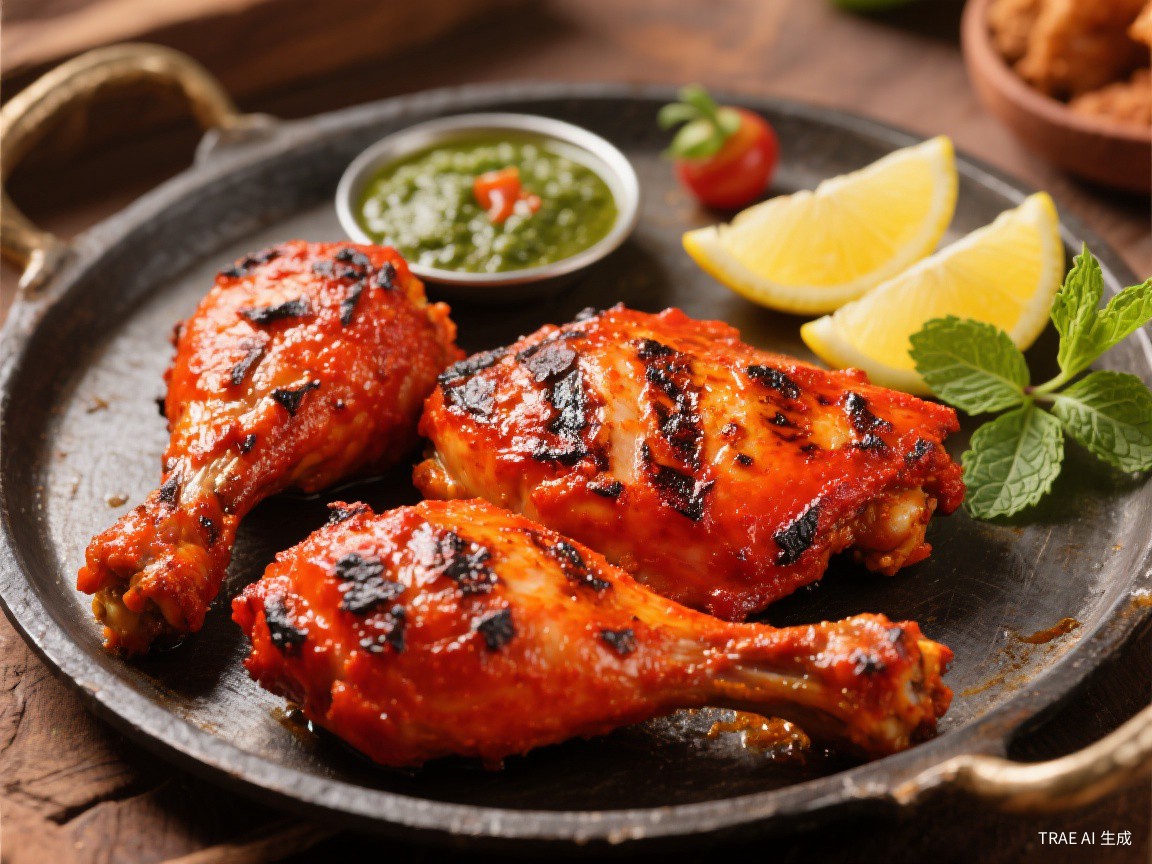
The marinade's spice blend is where tandoori chicken gets its signature character. Kashmiri red chili powder is the star, and it is worth seeking out the authentic variety rather than substituting standard Indian red chili powder. Kashmiri chilies are prized not for their heat—which is surprisingly mild, roughly comparable to a jalapeno—but for their extraordinary deep red color. They dye the yogurt marinade a vivid, almost artificial-looking crimson that intensifies during cooking and gives tandoori chicken its famous appearance.
Beyond Kashmiri chili, the marinade typically includes ground cumin, ground coriander, turmeric, garam masala, dried ginger, and garlic paste or freshly minced garlic. Some regional variations add a pinch of nutmeg or mace, and Punjabi versions often include a small amount of mustard oil for additional pungency. The proportions vary from cook to cook, but the general principle is balance: no single spice should dominate. The marinade should taste complex and harmonious, with warmth from the ginger, earthiness from the cumin, floral sweetness from the coriander, and a gentle hum of heat from the chili.
The Punjabi Connection: From Village to World Stage
Tandoori chicken as we know it today is inextricably linked to the Punjab region of northern India and Pakistan. The dish was popularized in its modern form by Kundan Lal Gujral, a Hindu refugee who fled Pakistan during the Partition of 1947 and settled in Delhi. Gujral had operated a restaurant in Peshawar (now in Pakistan) before Partition, and after arriving in Delhi, he opened the Moti Mahal restaurant, where he served tandoori chicken to an audience that had never encountered it outside of Punjab's villages and roadside dhabas.
The dish was an immediate sensation. Delhi's elite, accustomed to the refined Mughlai cuisine of the old courts, were captivated by the primal simplicity and extraordinary flavor of chicken cooked in a clay oven over charcoal. Moti Mahal became one of Delhi's most famous restaurants, and tandoori chicken became synonymous with Indian cuisine worldwide. When Indian diplomats and dignitaries traveled abroad in the decades following independence, tandoori chicken was often the dish they chose to represent their country's culinary heritage.
What made Gujral's version distinctive was his addition of butter and cream to the sauce—a modification that eventually gave birth to butter chicken (murgh makhani), one of the most widely consumed Indian dishes on the planet. But the original tandoori chicken, served simply with fresh naan, raw onion rings, and a sharp green mint chutney, remains the purer expression of the tandoor's power.
Adapting for the Home Kitchen
Most home cooks do not have access to a traditional tandoor, and building one in your backyard is not exactly a weekend project. Fortunately, there are several effective alternatives that can produce excellent results, even if they cannot fully replicate the tandoor's unique combination of radiant, convective, and conductive heat.
The best home method is a combination of a very hot grill and a finishing stint under the broiler. Marinate the chicken as directed, then grill it over high, direct heat—charcoal if possible, gas if necessary—turning frequently to achieve even charring. The grill provides the smoky flavor and the high-heat sear that approximates the tandoor's effect. Once the chicken is charred on the outside but not yet cooked through, transfer it to a sheet pan and finish under a hot broiler until cooked to temperature.
- Grill + broiler method: Best overall approximation. Grill for char, broiler for finish.
- Oven-only method: Set oven to its maximum temperature (500 degrees Fahrenheit or higher). Use a cast-iron skillet or pizza stone preheated for thirty minutes to simulate the tandoor's hot surface.
- Smoker method: Excellent for flavor but requires longer cooking times at lower temperatures.
- Stovetop method: Use a cast-iron grill pan over the highest heat, then finish in the oven. Least authentic but still produces tasty results.
The Liquid Smoke Question
If you are cooking indoors and cannot use charcoal, a small amount of liquid smoke added to the marinade can help approximate the tandoor's smoky character. Use it sparingly—no more than a quarter teaspoon for a full batch of marinade. Too much liquid smoke tastes chemical and artificial, overwhelming the delicate spice balance. A better alternative is to place a small piece of natural hardwood charcoal directly on your stove burner until it glows, then transfer it to a small bowl inside your oven with the chicken. The smoke will circulate and impart a more authentic flavor.
Serving the Complete Experience
Tandoori chicken is almost never eaten alone. It is part of a larger ensemble that includes fresh, pillowy naan bread baked in the same tandoor (or a hot cast-iron skillet at home), a sharp and refreshing mint-cilantro chutney, thin rings of raw red onion with a squeeze of lemon, and often a simple kachumber salad of diced cucumber, tomato, and onion dressed with lemon juice and chaat masala.
The mint chutney deserves special attention because it performs a crucial function. The rich, smoky, deeply spiced chicken needs a bright, acidic, herbaceous counterpoint to prevent palate fatigue, and the chutney provides exactly that. A good mint chutney is made from fresh mint leaves, fresh cilantro, green chilies, lemon juice, and a pinch of salt—blended to a rough paste, not a smooth puree. Some versions add a small amount of yogurt for creaminess, but I prefer the sharp, clean version that cuts through the richness of the chicken like a knife.
- Rest the chicken: Let it rest for five minutes after cooking to allow juices to redistribute
- Serve with fresh naan: Tear pieces of warm bread to wrap around each bite
- Offer mint chutney: A generous dollop alongside each plate
- Include raw onions: Thin rings of red onion with lemon juice and chaat masala
- Garnish with cilantro: Fresh cilantro leaves and a squeeze of lemon just before serving
A Dish That Bridges Centuries
Tandoori chicken occupies a unique place in the global culinary landscape. It is ancient in its technique—clay oven cooking has been practiced for millennia—yet modern in its worldwide recognition. It is simple in its ingredients—chicken, yogurt, spices, fire—yet complex in its execution and flavor. It is a village dish that became a national symbol, a refugee's recipe that conquered the world. Every time you bite into a piece of properly made tandoori chicken, with its smoky char and tender, spiced interior, you are tasting five thousand years of culinary history distilled into a single, extraordinary bite.
Ready to Make Tandoori Chicken at Home?
Download our complete guide with marinade ratios, grilling techniques, and chutney recipes.
Get the Free Guide